Quick answer
Valencia needs two to three days: the old town and its markets, the City of Arts and Sciences with the Turia Gardens, and the beach or the Albufera lagoon, home of paella.
Key facts
- Mid-March brings the Fallas festival; book months ahead or avoid those days if you want a quiet stay.
Valencia needs 2 to 3 days: 1 for the old town and its markets, 1 for the City of Arts and Sciences and the Turia Gardens, and 1 for the beach or the Albufera lagoon, where paella was born. The city is flat, compact and easy by bike, with a mild winter and long summer. Avoid mid-March unless you are coming for the Fallas, when the streets fill day and night.
This guide covers the best things to do in Valencia and how to fit them into one trip.
The City of Arts and Sciences
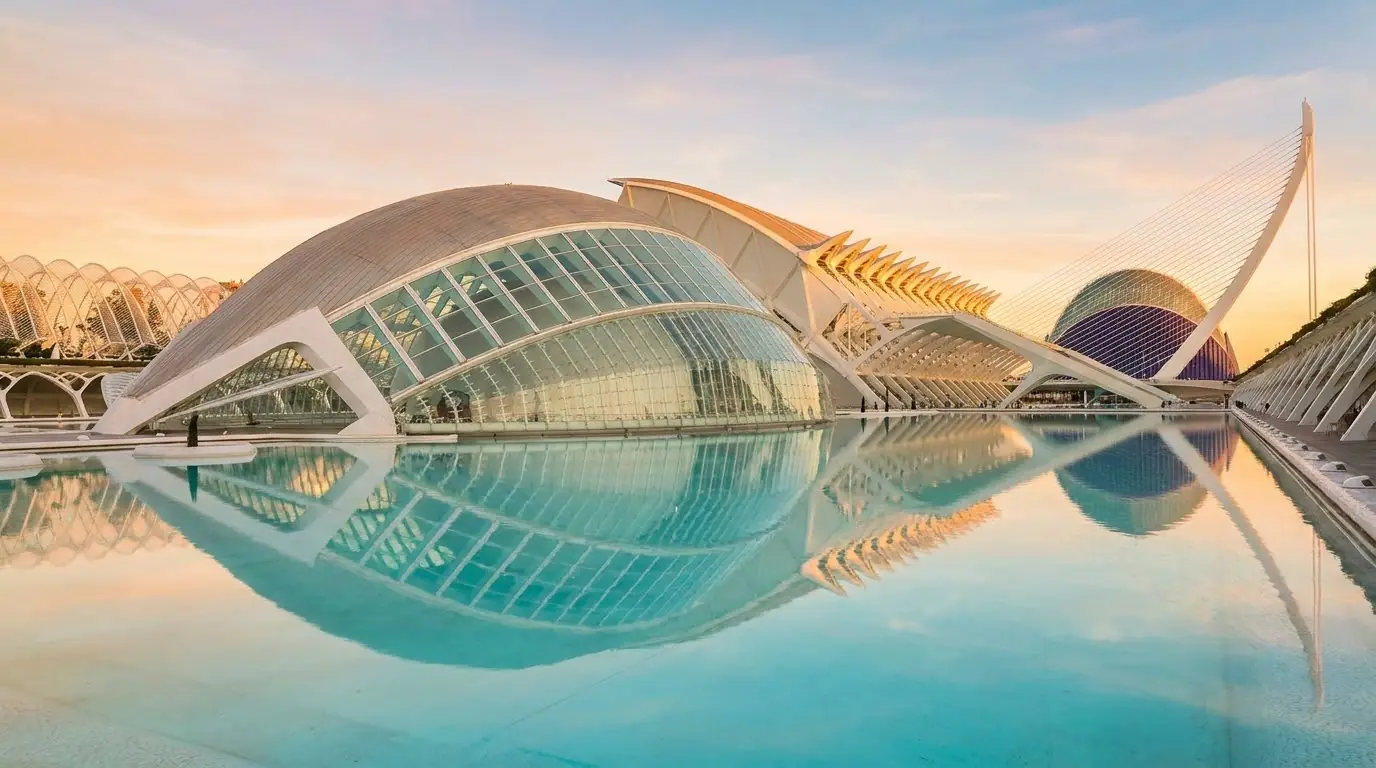
A complex of white futuristic buildings set in shallow turquoise pools at the eastern end of the Turia Gardens, it is Valencia’s landmark.
- The Oceanogràfic is one of the largest aquariums in Europe, with marine habitats from the Mediterranean to the polar seas.
- The Science Museum is a hands-on museum in a building like the skeleton of a whale.
- The Hemisfèric, shaped like an eye, holds a cinema and planetarium.
- The Palau de les Arts is the city’s opera house.
The buildings are free to walk around and best photographed at sunset, when the light reflects in the pools. Inside, each venue has its own ticket; the Oceanogràfic is the best known.
The old town: the cathedral, the Silk Exchange and the towers
The cathedral, the Silk Exchange and the medieval city gates sit within a few minutes of each other in a compact, walkable centre.
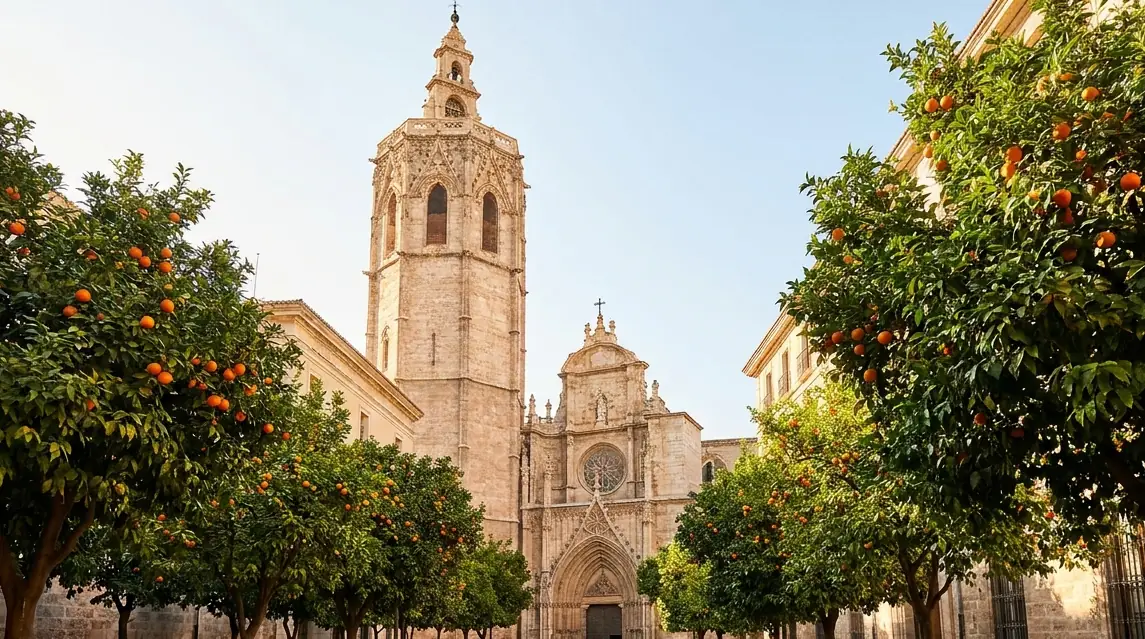
- The cathedral houses a chalice venerated as the Holy Grail; its bell tower, the Micalet, gives a view over the roofs.
- The Silk Exchange, La Lonja de la Seda, is a Gothic trading hall with twisted columns, a UNESCO World Heritage site since 1996.
- The Serranos and Quart towers are the surviving medieval gates, both climbable.
- The Plaza de la Virgen and the lanes of El Carmen are the liveliest part of the old town at night.
Markets, paella and horchata
Valencia takes its food seriously, and its markets, paella and horchata are a large part of the appeal.
- The Central Market, a Modernista hall of iron, glass and tiles, is one of the largest food markets in Europe.
- The Mercado de Colón, in the Eixample, is a decorated market hall now full of cafés and restaurants.
- Paella valenciana is made with chicken, rabbit and green beans; seafood versions are also common. It is a lunch dish.
- Horchata, a cold drink made from tiger nuts, is a Valencian speciality, served with fartons, long sweet buns.
The best paella is usually found in restaurants by the beach or in El Palmar, a village in the Albufera rice fields, rather than near the cathedral.
The Turia Gardens and Ruzafa
A long park in a former riverbed, and a lively neighbourhood of cafés and bars south of the centre, show how Valencians live.
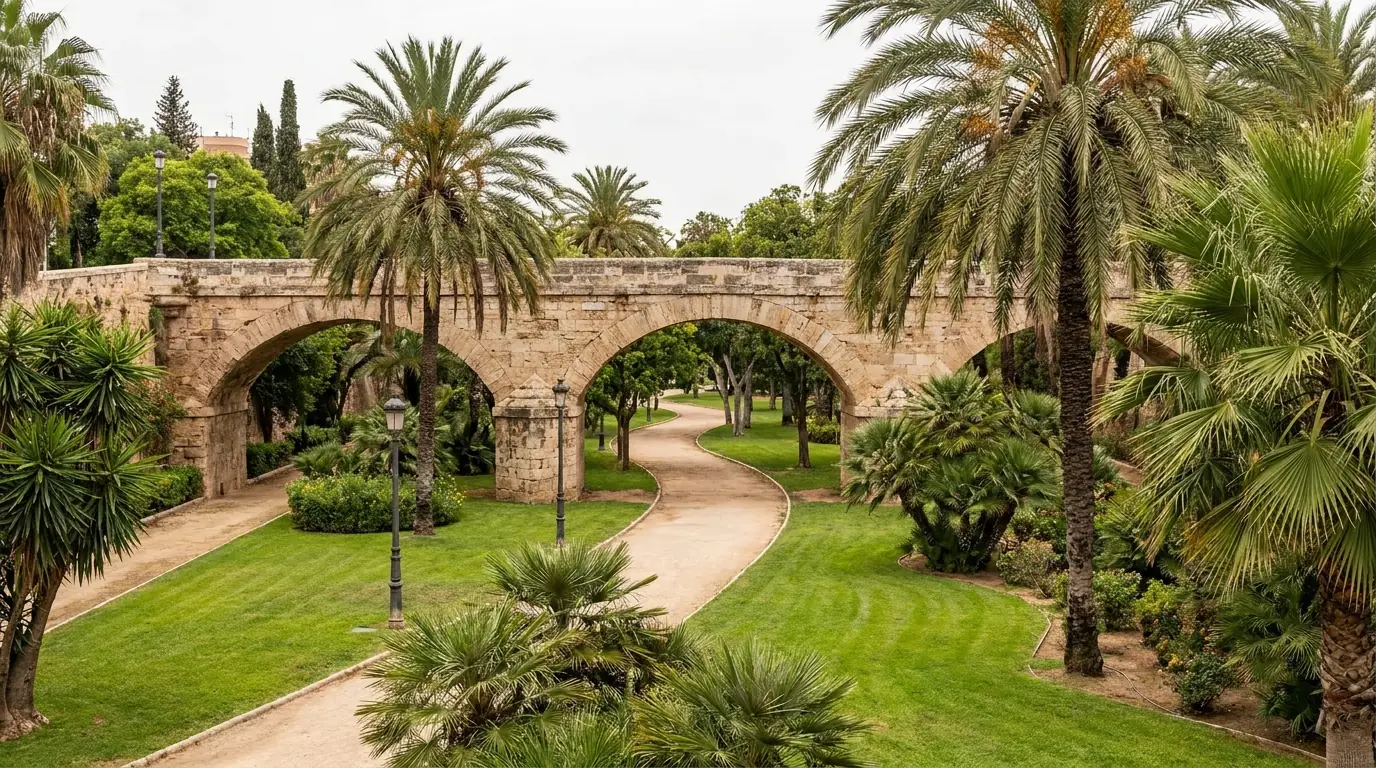
- The Turia Gardens run for about 9 km through the city in the bed of the river, diverted after a great flood in 1957.
- Walk or cycle the length of the park from the Bioparc to the City of Arts and Sciences.
- Ruzafa has the best concentration of cafés, brunch spots and independent restaurants in the city.
- The Gulliver park, a giant figure children can climb, is a favourite with families.
The beach and El Cabanyal
A short tram or metro ride from the centre, a wide sandy shore has the old fishermen’s quarter behind it.
- Malvarrosa and Las Arenas are long urban beaches with a promenade and restaurants.
- El Cabanyal is a grid of low houses with tiled facades, once a fishing village, now a neighbourhood of bars.
- The port area has a marina and was the base for sailing races.
- Further south, the beaches of the Albufera natural park are wilder, backed by dunes and pine woods.
The Albufera and day trips
Rice fields, a lagoon and old towns add a second side to the city.
- The Albufera, a freshwater lagoon south of the city, is surrounded by rice fields; boat trips leave from El Palmar at sunset.
- Xàtiva, inland, has a castle along a ridge above the town.
- Sagunto has a Roman theatre and a castle on the hill above it.
- Peñíscola, further north, is a walled town on a rocky peninsula.
When to go, and the Fallas
The Fallas, the beach and a quiet city break each point to different months. The figures are the 1981-2010 normals for València from AEMET.
- January averages a 16.4°C high, mild enough for a winter city break.
- August averages 30.2°C, with humid nights; the beach is the place to be.
- September and October are the wettest months, at 70 mm and 77 mm, often in short heavy storms.
- The Fallas, from 15 to 19 March, fill the streets with giant satirical figures that are burned on the last night; the festival is on UNESCO’s list of intangible heritage.
For events and opening times, check the city’s official tourism site, Visit València.
What to skip, or do differently
Timing and paella cause most of the mistakes:
- Paella for dinner: Valencians eat it at lunch, and the evening versions are often aimed at visitors.
- The Fallas week if you want sleep: fireworks and crowds run day and night.
- Only the City of Arts and Sciences: the old town and the markets are the heart of the city.
- Driving in the centre: the old town is best on foot, and the city is flat and easy by bike.
For the wider route, see the Spain itinerary, which links Valencia with Madrid and Barcelona by fast train.
Where to stay in Valencia
In Valencia, Ciutat Vella is the base for a first visit, and Ruzafa for food and nightlife. The map shows the same property across Booking.com and Agoda, with prices live from them.
Common questions
What is Valencia best known for?
Valencia is best known for paella, the City of Arts and Sciences, the Fallas festival in March and its long sandy beaches. Its old town has the cathedral with a chalice venerated as the Holy Grail and the Gothic Silk Exchange, a UNESCO World Heritage site.
How many days do you need in Valencia?
You need two to three days in Valencia: one for the old town and the markets, one for the City of Arts and Sciences and the Turia Gardens, and one for the beach or the Albufera lagoon. Add a fourth day for a trip to Xàtiva, Sagunto or Peñíscola.
Is Valencia worth visiting?
Valencia is worth visiting for a city break that mixes history, modern architecture, food and the beach. It is flat, easy by bike and less crowded than Barcelona, with a mild winter. It suits least those who dislike heat in August or crowds during the Fallas.
Where should you eat paella in Valencia?
Eat paella in Valencia at lunchtime, in a restaurant by the beach at Las Arenas or in El Palmar, a village in the Albufera rice fields where the dish was born. Traditional paella valenciana uses chicken, rabbit and green beans; seafood versions are common too.
Keep planning Valencia
Written and checked by
Travel Guide Kit Editorial
An editorial desk, not an invented persona. Every opening time, ticket price and transport connection here is checked against the operator’s own website and carries the date it was read. Where a page cannot draw on direct experience, it says so.