Quick answer
Three days covers Madrid; a fourth is for Toledo, which is the better of the two classic day trips.
In short
- Madrid eats late — lunch from about 2pm, dinner from about 9pm. Turning up at 7pm means the tourist tables.
- The three great museums sit within a fifteen-minute walk of each other, and the Prado and the Reina Sofía open free for the last two hours of most days; the Thyssen’s free slots are Monday midday and Saturday night.
- September and the first half of June are the months to aim for; July and August average highs of 31–32°C, and October is the wettest month of the year.
Madrid needs 3 days, and a 4th belongs to Toledo, the better of the two classic day trips. The most useful thing to know before you arrive is the clock: lunch runs from about 2pm and dinner does not really start until 9pm, so a 7pm table puts you in the emptiest, most touristed rooms. Come in September or early June, since July and August average highs above 31°C.
The clock is the thing to plan around
The clock is the thing to plan around in Madrid, which runs later than almost anywhere else in Europe; visitors who keep northern hours spend the trip eating alone. This is not a quirk to observe — it is a planning constraint that decides how each day is shaped.
- Lunch runs roughly 2pm to 4pm, and it is the big meal of the day. The menú del día — a fixed lunch menu on weekdays — is the best value food in the city.
- Dinner does not fill up until about 9.30pm. A restaurant with tables free at 8pm on a Friday is telling you something.
- Bars serve tapas through the afternoon gap, which is how you bridge from lunch to a late dinner.
- Museums close earlier than you expect, most by 8pm — so sightseeing goes before dinner, not after.
The practical version: do the museums and the old centre in daylight, take the afternoon gap slowly, and treat 9pm as the start of the evening rather than the end.
Three museums in fifteen minutes of walking
Three museums sit within fifteen minutes of walking along the same boulevard: the Prado, the Reina Sofía and the Thyssen-Bornemisza. Together they hold the collection most people come to Madrid for, and the Prado and the Reina Sofía open free for the last two hours of most days; the Thyssen’s free slots are Monday midday and Saturday night.
- Prado — Spanish court painting: Velázquez, Goya, El Greco, Bosch. The largest of the three and the one to give a full morning.
- Reina Sofía — twentieth-century Spain, built around Picasso’s Guernica. Free entry Monday and Wednesday to Saturday 7pm–9pm, and Sunday 12.30pm–2.30pm (checked with the museum, August 2026).
- Thyssen-Bornemisza — a private collection filling the gaps the other two leave, from early Italian painting to Pop art. The smallest, and the easiest to do in ninety minutes.
- Each also opens free in its final hours, but the windows differ between the three and change — check the museum’s own page on the day rather than trusting a blog.
The free hours are genuinely busy, and the queue forms before the window opens. If you only have one free evening, spend it at the Reina Sofía: Guernica is in a room of its own and the crowd moves through faster than at the Prado.
Old Madrid is small, and one market in it is a trap
Old Madrid is small: the historic centre is compact enough to cross on foot in twenty minutes, which is why most itineraries do it in a single morning.
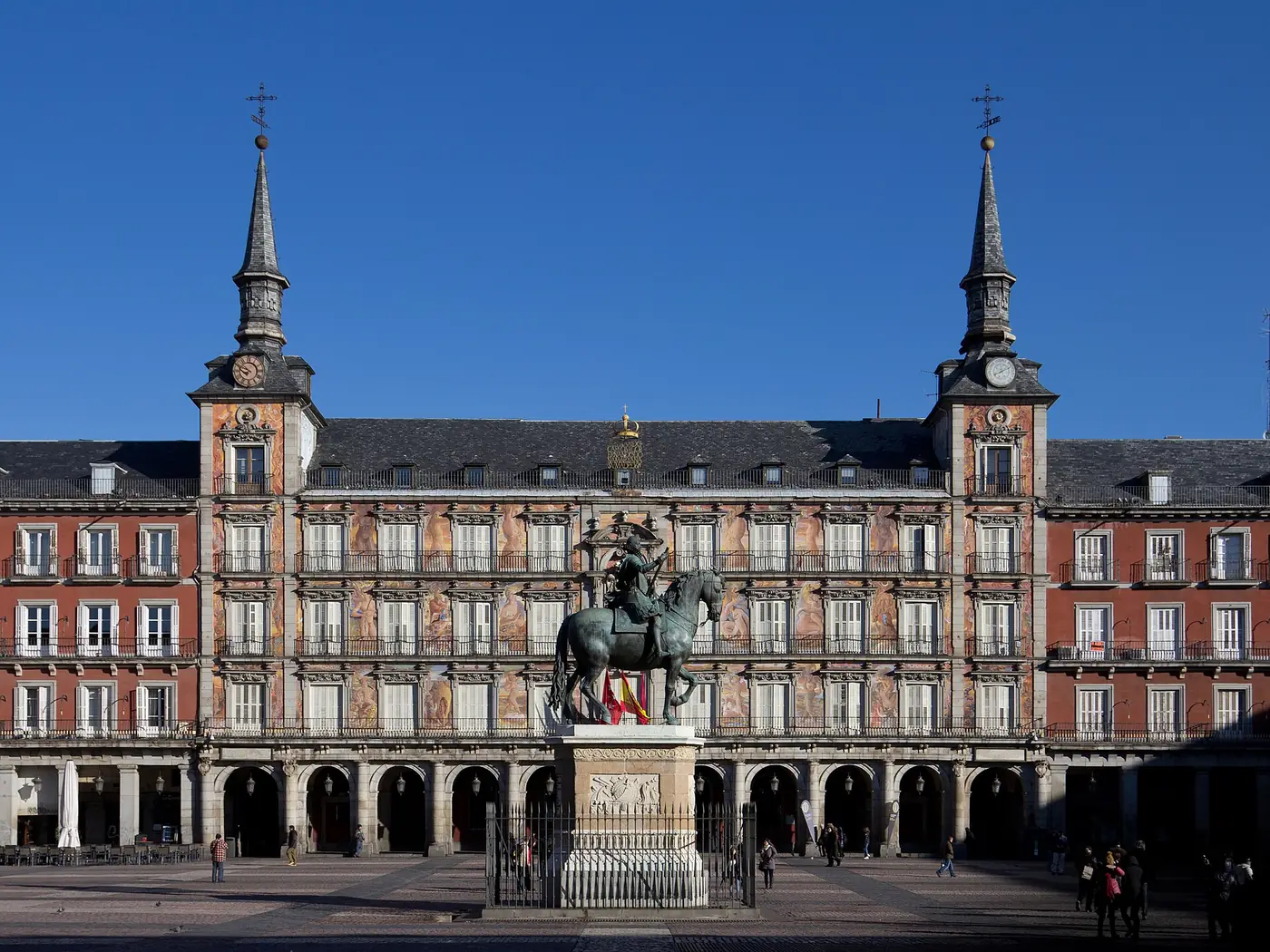
- Plaza Mayor — the arcaded square at the centre of it. Walk through; the restaurants under the arches are priced for people who will not come back.
- Palacio Real — the largest royal palace in western Europe by floor area, and still used for state occasions. The changing of the guard happens on set days.
- Almudena Cathedral — next door to the palace, and unusually modern inside for a cathedral of its scale.
- La Latina — the tapas neighbourhood south of the palace. Calle Cava Baja is the street, and Sunday afternoon after the Rastro market is when it is at its best.
Mercado de San Miguel appears on every list of things to do in Madrid. It is a beautiful iron-and-glass hall.
It is also the most expensive and most crowded place to eat in the centre. Go in, look at the building, then eat in La Latina or at Mercado de San Fernando in Lavapiés for a third of the price.
The best two hours in Madrid are free
The best two hours in Madrid are free: a late afternoon in Retiro Park and sunset at the Templo de Debod.
- Retiro Park — the old royal gardens, now the city’s back garden. The Crystal Palace at its centre is glass and iron and costs nothing to enter.
- Templo de Debod — an Egyptian temple given to Spain in the 1960s, rebuilt on a rise west of the centre. It faces west, which is why it is the sunset spot.
- Parque del Oeste — the park the temple sits in, and the walk down through it towards Príncipe Pío.
Debod at sunset is the most photographed spot in Madrid and it does get crowded, but the rise is wide enough that arriving twenty minutes early gets you space.
Toledo or Segovia — pick one
Toledo or Segovia: both appear on every Madrid list and both are worth the journey, but doing them in the same trip means two days of trains for two half-seen cities.
| Where | One way | What it needs |
|---|---|---|
| Toledo | 33 min by AVE from Atocha | A full day. Walled hill city; the cathedral alone takes two hours |
| Segovia | 30 min by AVE from Chamartín | A full day. Roman aqueduct and a fairy-tale alcázar |
| El Escorial | 1 hour by cercanías | A half day. One enormous monastery-palace, and little else |
| Aranjuez | 45 min by cercanías | A half day. Royal gardens, best in spring |
If you are choosing: Toledo is the denser, older, more overwhelming of the two, and it is the one that repays a full day. Segovia is easier and more immediately photogenic. Neither works as a half day — the AVE is quick, but the walking is not.
What to skip, or do differently
What to skip in Madrid is mostly about timing and the tourist circuit. These are the common mistakes:
- Dinner at 7pm: the restaurants fill from about 9.30pm, and an early table means an empty room.
- Three great museums in one day: pick one and do it fully, then rest in Retiro.
- Lunch at the Mercado de San Miguel or on the Plaza Mayor: eat in La Latina or Lavapiés instead.
- Toledo and Segovia on a three-day trip: each needs a full day, and doing both leaves one day for Madrid.
- Sightseeing outdoors in the July and August afternoons: keep the museums for the heat of the day.
For the days around this list, use Madrid in 3 days or the Madrid itinerary, and check where to stay in Madrid.
Where to stay in Madrid
Which part of town you sleep in decides more of the trip than the day count does. The map shows the same property across Booking.com and Agoda, with prices live from them.
Common questions
Is 3 days enough to visit Madrid?
Yes for the city itself — one day for the museums, one for the old centre and La Latina, one loose. A fourth day is what you need if you also want Toledo, which does not work as a half day.
What should you not miss in Madrid?
Do not miss the Prado, the Reina Sofía for Guernica, Retiro Park with the Crystal Palace, sunset at the Templo de Debod and one long lunch in La Latina. If you do those properly you will have seen what Madrid is; add a day trip to Toledo if you have a fourth day.
Are the Madrid museums free?
All three of the big ones open free for their final hours. The Reina Sofía is free Monday and Wednesday to Saturday from 7pm to 9pm and Sunday 12.30pm to 2.30pm (checked August 2026). The Prado and the Thyssen have their own windows, which change — check their pages on the day.
What time do people eat dinner in Madrid?
People in Madrid eat dinner from about 9pm, and restaurants do not fill until 9.30pm or later. Lunch is the big meal and runs from about 2pm to 4pm, with tapas bridging the gap. Eating at 7pm is possible, but it puts you in the rooms aimed at visitors.
Toledo or Segovia — which day trip is better?
Toledo is the better day trip if you have one day: denser, older, and the walled hill city is the more memorable of the two, 33 minutes by high-speed train from Atocha. Segovia is easier to see quickly and more immediately striking, with the Roman aqueduct in the middle of town.
Opens a price map of Madrid. We may earn a commission if you book, at no extra cost to you.
Also on Madrid
- Is Madrid Worth Visiting?
- Madrid Itinerary
- Madrid in 3 Days
- How Many Days in Madrid?
- Best Time to Visit Madrid
- Where to Stay in Madrid
Where to next
Where to Stay in Madrid
Which area suits you, and which streets to refuse.
The rest of Spain
More places, sorted by region.
Keep planning Madrid
Written and checked by
Travel Guide Kit Editorial
An editorial desk, not an invented persona. Every opening time, ticket price and transport connection here is checked against the operator’s own website and carries the date it was read. Where a page cannot draw on direct experience, it says so.