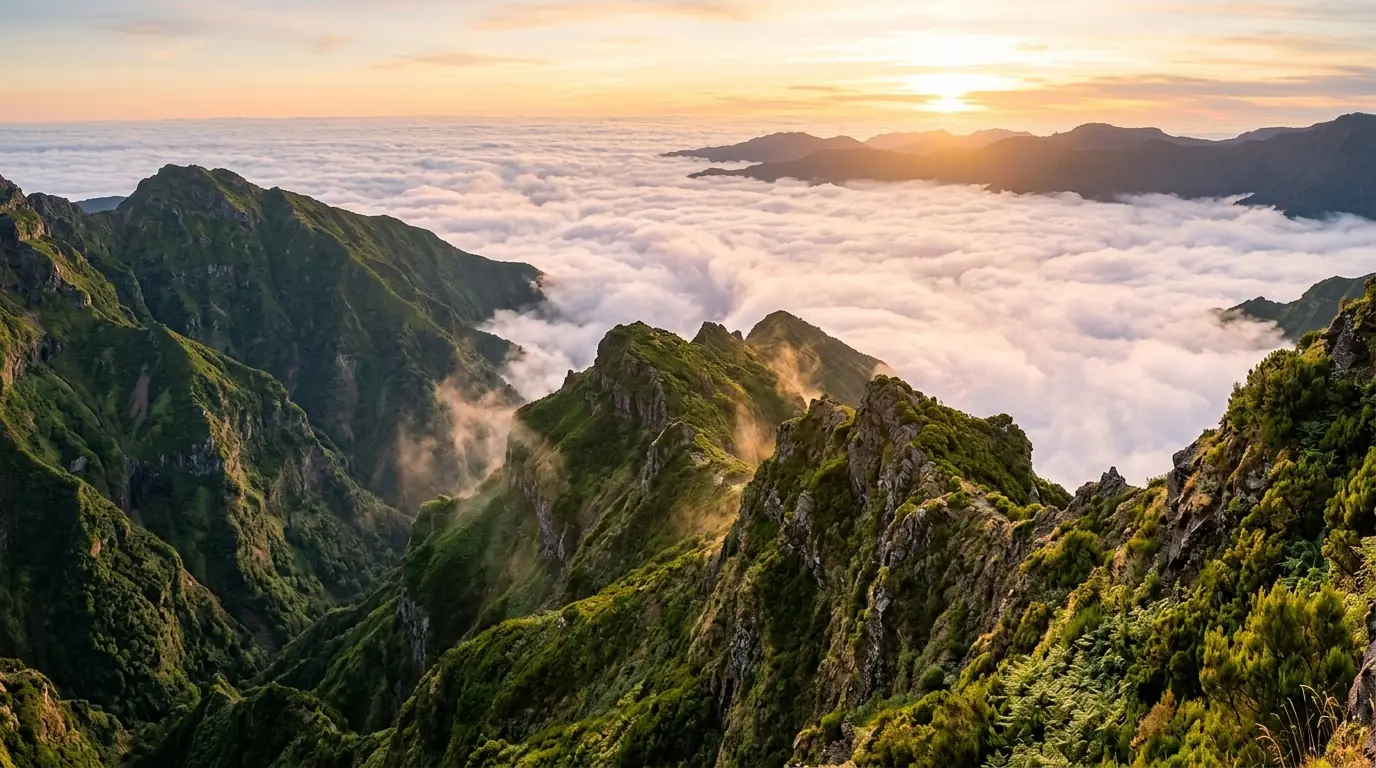
Quick answer
The best things to do in Madeira are the sunrise ridge walk from Pico do Arieiro to Pico Ruivo, a levada walk in the laurel forest, the Porto Moniz rock pools and Funchal's market and Monte cable car; give them five days, or a week for the hikes.
In short
- Madeira needs a hire car — the island is steep, the roads run through tunnels, and the buses do not reach most trailheads at useful times.
- Funchal on the south coast is mild all year, with a 20.0°C January high, but the mountains and the north coast are cooler, wetter and often in cloud.
- Mountain trails and levada paths on Madeira sometimes close after landslides or fires, so check their status before setting out.
The best things to do in Madeira are mostly outdoors: the ridge walk between Pico do Arieiro and Pico Ruivo, a levada walk through the laurel forest, the natural pools at Porto Moniz, and Funchal’s market, old town and cable car to Monte. Outside Funchal nearly all of them need a hire car, and the mountains have a different climate from the coast.
The 17 below run from Funchal outwards. For how long to give them, see how many days to spend in Madeira; for the order to do them in, the Madeira itinerary.
The best things to do in Madeira
1. Walk the ridge from Pico do Arieiro to Pico Ruivo
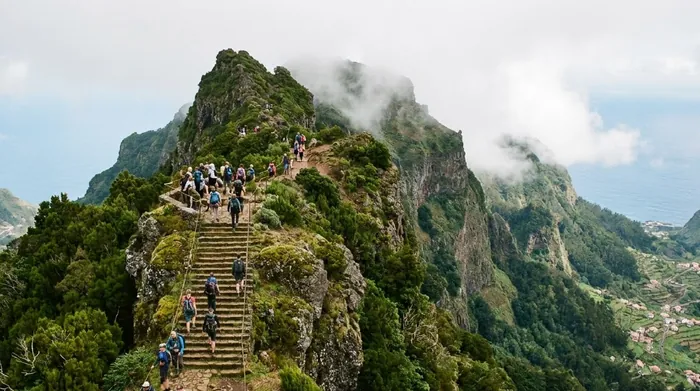
The walk between Pico do Arieiro, at 1,818 m, and Pico Ruivo, the island’s highest peak at 1,862 m, is the best-known hike on Madeira: a ridge of stairs and tunnels above the cloud. It is demanding, with steep steps and drops, and as the PR1 it needs a timed booking (see below).
Start at sunrise or early morning, when the peaks are most often above the cloud, and carry a warm layer even in August, a rain jacket, water and shoes with grip. Sections close after rockfalls or fires; if the trail is shut or the peaks are in cloud, the viewpoint at Pico do Arieiro is reachable by road.
2. Walk a levada through the laurel forest
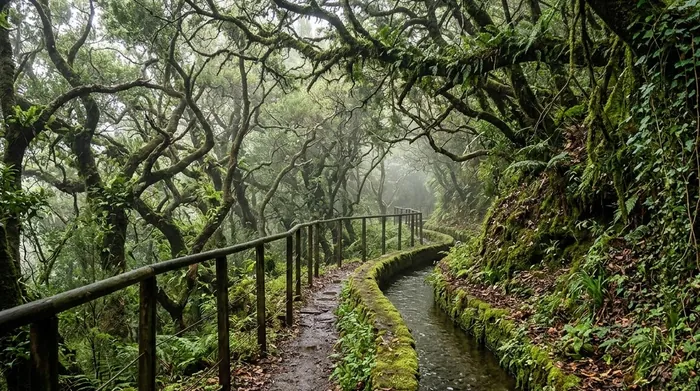
A levada walk follows one of the irrigation channels cut along the mountainsides, with a narrow path beside the water, and many are nearly level. The 25 Fontes and Risco waterfalls walks start from Rabaçal in the west, in the laurel forest, the Laurisilva, a UNESCO World Heritage site. The Caldeirão Verde walk, from Queimadas near Santana, runs through tunnels to a waterfall, so bring a torch.
The easier levadas suit families and older walkers; the long tunnel levadas suit older children and confident walkers, and several paths run beside steep drops, so read the route before you book. Guided walks with a licensed operator include the trail booking and transport from Funchal, which solves the trailhead problem without a car.
3. Mercado dos Lavradores and Funchal’s old town
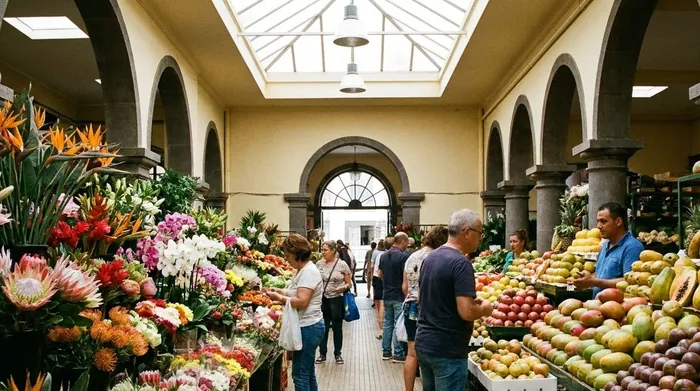
Mercado dos Lavradores is Funchal’s covered market for fruit, flowers and fish. Beside it, the old town, the Zona Velha, has doors along Rua de Santa Maria painted by artists, and the seafront promenade runs west from there to the marina and the hotel zone.
4. Taste Madeira wine in a Funchal lodge
The Madeira wine lodges in the centre of Funchal age the island’s fortified wine in old warehouses and pour it to taste at the counter. A lodge fits easily into the same afternoon as the market or the cable car.
5. The cable car to Monte and the toboggan ride down
The cable car climbs from Funchal’s seafront to Monte, the old hill village with its church and tropical garden. The Monte toboggans are wicker sledges steered by two men in straw hats down the steep road back towards Funchal, for part of the way. Neither needs a car.
6. The Botanical Garden above Funchal
The Botanical Garden sits on the hill above the city, and a second cable car links it with Monte. With both cable cars, Monte and the garden make a half-day from Funchal without a car.
7. Look down from the cliff at Cabo Girão
Cabo Girão, on the south coast west of Funchal, is a sheer sea cliff with a glass-floored viewing platform. Pair it with one other big stop rather than two: Cabo Girão, Porto Moniz and a levada in one day is too much driving.
8. Câmara de Lobos, the fishing village
Câmara de Lobos, just west of Funchal, is a fishing village with bars along its waterfront by the harbour. It is quieter and often cheaper than the capital, with buses into Funchal.
9. Swim in the natural pools at Porto Moniz
Porto Moniz, on the north-west tip, has natural swimming pools in the volcanic rock. It is far from everything else and often windy, so treat it as a day out rather than a base; Calheta and Ponta do Sol, on the south-west coast, are the closer bases.
10. Seixal’s black-sand beach
Seixal, on the north coast, has a black-sand beach below green cliffs. The north coast faces the prevailing weather and is greener, wetter and cloudier than the south, so choose a clear day for it.
11. The thatched houses of Santana
Santana, on the north coast, keeps Madeira’s traditional triangular thatched houses. The Caldeirão Verde levada starts from Queimadas near Santana, so the houses and the walk share a day on the north side.
12. Walk the São Lourenço peninsula
Ponta de São Lourenço, the bare eastern tip of the island, is a dry, rocky peninsula and the setting for one of Madeira’s best-known coastal walks. The east is windier and drier than the rest of the south coast, so take a hat and a windproof layer.
13. Garajau’s marine reserve and Machico’s bay
Garajau and Caniço, east of Funchal, sit on cliffs above a protected marine reserve popular with divers. Machico, beyond the airport, is a historic town around a sheltered bay with a golden-sand beach, one of the few on the island.
14. Calheta’s sheltered beach
Calheta, on the sunny south-west coast, has a marina and one of Madeira’s few sandy beaches, made with imported sand and sheltered by breakwaters, so the water is calmer than in the rock pools. Above the marina, the MUDAS museum shows contemporary art.
15. A sand day on Porto Santo
The neighbouring island of Porto Santo has the long sandy beach Madeira lacks, reached by ferry from Funchal or a short flight. Give it a full day at least, and on a ten-day trip two or three nights.
16. Funchal’s Flower Festival and New Year’s Eve
The Flower Festival brings parades and flower carpets to Funchal in spring, and the New Year’s Eve fireworks over the bay make the busiest week of the year, with cruise ships anchored offshore. Both need rooms booked months ahead.
17. Eat espetada and drink poncha
Island food means grilled meat, fish from deep water and bread baked on a stone. Funchal has the widest choice, and the north-coast villages have simple restaurants for lunch after a walk.
- Espetada: beef on a bay-wood skewer, grilled over embers and hung at the table.
- Espada: the black scabbard fish, often served with banana and passion fruit sauce.
- Bolo do caco: flat bread cooked on a basalt stone, served warm with garlic butter.
- Lapas: grilled limpets with garlic and lemon, in the coastal villages.
- Poncha: the island’s drink of sugar-cane rum, honey and lemon, stirred with a wooden stick.
The south-west around Calheta has far fewer restaurants, and evenings there are about sunsets over the Atlantic rather than nightlife.
Madeira’s coast and where to swim
Madeira is cliffs, rock pools and black stone rather than sand, and the best of the coast is on the north and north-west shores. The swimming is in rock pools, the sea and a few small beaches; for a long sandy beach, take the ferry to Porto Santo.
| Place | What it is | Where |
|---|---|---|
| Porto Moniz | Natural swimming pools in the volcanic rock | North-west |
| Seixal | A black-sand beach below green cliffs | North coast |
| Santana | Traditional triangular thatched houses | North coast |
| Cabo Girão | A sheer sea cliff with a glass-floored viewing platform | South, west of Funchal |
| Ponta de São Lourenço | A dry, rocky peninsula walk | Eastern tip |
Book the trails before you go
The classified walking routes on Madeira, the PR trails, now need a paid, timed reservation through SIMplifica, the regional government’s online portal. In 2026 the fee is €4.50 per person per trail, and €10.50 for PR1 between Pico do Arieiro and Pico Ruivo.
- Each booking is for one trail and a time slot; two trails in one day need two bookings.
- Residents of Madeira and children aged 12 and under do not pay, but residents still book a slot.
- Guided walks with a licensed operator include the booking, usually at a lower trail fee.
- Pay before you drive up: mobile coverage at many trailheads is weak or absent.
Check the trail status on the same day as well: a booked slot does not reopen a path closed by a landslide.
The island has two climates
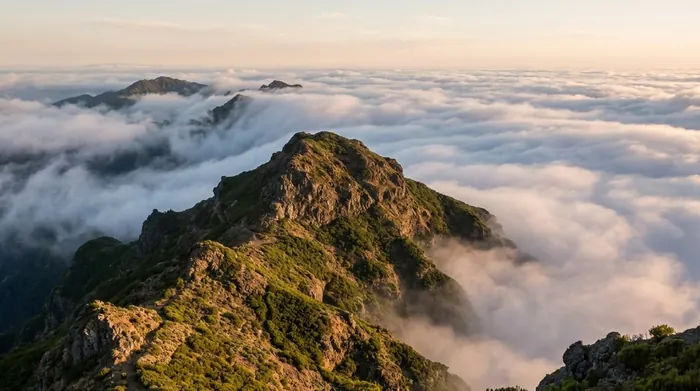
Funchal’s weather tells you very little about the weather in the mountains or on the north coast.
- Funchal, on the sunny south coast, averages a 20.0°C high in January and 26.8°C in August (IPMA, Funchal Observatório, 1991-2020 normals).
- Funchal is almost dry in summer — 1.7 mm in July and 1.3 mm in August — and wettest from October to January.
- The north coast faces the prevailing weather and is greener, wetter and cloudier.
- The central peaks are often above the cloud in the early morning and inside it by midday.
- Pack a warm layer and a rain jacket for any day in the mountains, whatever Funchal looks like.
Plan the peaks for the morning, keep a flexible day in the schedule, and check the mountain forecast rather than the Funchal one.
Funchal month by month, in short
Funchal’s temperature changes less through the year than its rain. The range between the coldest and warmest months is under seven degrees, and very hot days are rare: Funchal averages only 2.5 days a year above 30°C. Rain is the variable, with October at 91.2 mm and December at 94.8 mm.
June, at 7.8 mm, and September, at 23.1 mm, are the dry, warm months that suit both hiking and swimming, and September has the warmest sea.
Summer fires and winter storms
Winter storms bring the most trail closures, from rockfalls and landslides, while summer brings a risk of wildfires. Whatever the month, check the trail status and the mountain forecast the evening before, not on the morning of the walk.
Getting around: a hire car, or tours from Funchal
The trailheads, the peaks and the north coast are all a drive away from Funchal, so the car matters more than the length of the trip.
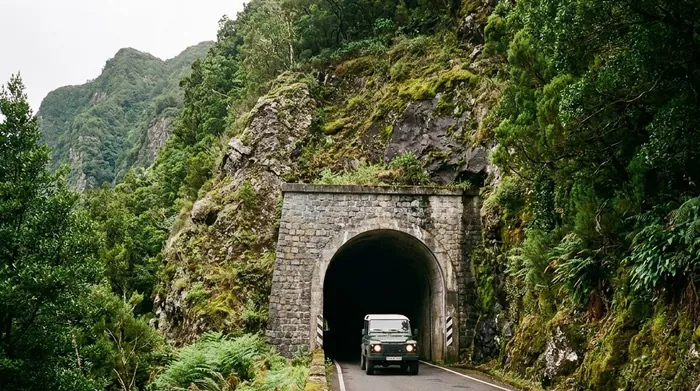
- Madeira is steep, and its roads run through a long sequence of tunnels between the valleys.
- With a car, the peaks, the north coast and the trailheads are all day trips from one base.
- Without one, you get Funchal, the cable car to Monte, and organised tours.
- Mountain roads are narrow and steep in places; the expressway along the south coast is fast.
Base yourself in Funchal for the whole stay if you have a car: the expressway brings most of the island within an hour, and you avoid packing up between nights. Without a car, pick a hotel near the seafront and use tours for the mountains.
Getting in from the airport
The airport sits on the east coast near Santa Cruz, a short drive from Funchal along the expressway, with an airport bus or taxi for those without a car. On blustery days flights are sometimes delayed or diverted, so avoid a tight connection on the way home.
Where to base yourself
Funchal is built on a steep amphitheatre, and a hotel high up the slope means a climb or a taxi every evening, so check the altitude on the map. The resort hotels and sea pools are in the hotel zone west of the centre, along the Estrada Monumental.
Calheta and Ponta do Sol, on the south-west coast, are often the sunniest and sit closer to the Rabaçal levadas and Porto Moniz; Câmara de Lobos is the quieter, often cheaper option next to Funchal. The guide to where to stay in Madeira compares every area, and the guide to villas in Madeira covers renting a house on the south-west terraces.
Fitting the list into one trip
Five days covers the main sights above with a hire car, and a week suits hikers who want several trails and a spare day for the mountain weather. The page on how many days to spend in Madeira sets out what each extra day adds, the Madeira itinerary puts the list in order for three, five or seven days, and the best time to visit Madeira covers the weather month by month.
What to skip, or do differently
The usual mistakes on Madeira are about weather and time on the road:
- Driving to Pico do Arieiro in the afternoon: the peaks are usually inside the cloud by then.
- Planning the whole trip around beaches: Madeira has rock pools, and the sand is on Porto Santo.
- Fixing every hike to a set day: keep one spare day for the mountain weather.
- Doing Cabo Girão, Porto Moniz and a levada in one day: two of the three is the realistic limit.
- A hotel high on Funchal’s hillside if you plan to walk to dinner: every evening ends with a climb or a taxi.
- Porto Moniz as a first-visit base: the pools are spectacular, but it is far from everything else and often windy.
Where to stay in Madeira
In Madeira, Funchal is the base for a first visit, and Câmara de Lobos for a fishing-village base near Funchal. The map shows the same property across Booking.com and Agoda, with prices live from them.
Common questions
What is a must do in Madeira?
A must do in Madeira is a levada walk, such as 25 Fontes from Rabaçal, together with the ridge hike between Pico do Arieiro and Pico Ruivo in the early morning, the natural pools at Porto Moniz, and the cable car and wicker toboggans at Monte above Funchal. Book the trails ahead through SIMplifica.
How many days is enough in Madeira, Portugal?
Five days is enough for Madeira: Funchal, the central peaks, the north-west coast and one levada walk. A week suits hikers and leaves room for the weather in the mountains, which can close a trail or hide the peaks in cloud for a day. Keep one day of the plan flexible either way.
Do you need a car in Madeira?
You need a car in Madeira for anything beyond Funchal. The island is steep and the roads run through tunnels; the trailheads and the north coast are hard to reach at useful times by bus. Without a car, stay in Funchal and use organised tours for the peaks and the levadas.
Is Madeira warm all year?
Funchal is warm all year: its January high averages 20.0°C and its August high 26.8°C, according to IPMA’s 1991-2020 normals. The mountains and the north coast are cooler, wetter and often in cloud, so pack a warm layer and a rain jacket for any day in the hills.
Opens a price map of Madeira. We may earn a commission if you book, at no extra cost to you.
Also on Madeira
Where to next
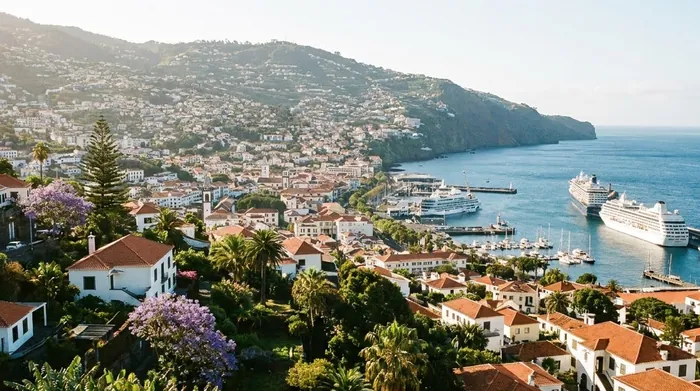
Where to Stay in Madeira
Which area suits you, and which streets to refuse.
The rest of Portugal
More places, sorted by region.
Keep planning Madeira
Written and checked by
Travel Guide Kit Editorial
An editorial desk, not an invented persona. Every opening time, ticket price and transport connection here is checked against the operator’s own website and carries the date it was read. Where a page cannot draw on direct experience, it says so.