Quick answer
June to September is the best time to visit the Azores, with highs of 22 to 26°C and the least rain; spring is best for migrating whales, and winter is mild but wet.
The best time to visit the Azores is June to September, when Ponta Delgada averages highs of 22.4°C to 26.0°C and the least rain of the year, with July at just 26.0 mm. Spring is best for migrating whales, and winter is mild at 17.5°C but grey and wet. Whatever the month, the weather changes fast, so keep plans flexible and pack a rain jacket. Below, the month-by-month figures show the best time to visit the Azores for each kind of trip.
June to September
June to September is warm, mostly dry and the best time for walking, swimming and clear views of the crater lakes.
| When | Mean high | Rain | Verdict |
|---|---|---|---|
| June | 22.4°C | 44.4 mm | Very good: hydrangeas in bloom, fewer visitors |
| July / August | 24.7°C / 26.0°C | 26.0 / 45.8 mm | Best weather; busiest and most expensive |
| September | 25.0°C | 78.2 mm | Warm sea, quieter, but rain returns |
| April / May | 18.8°C / 20.2°C | 79.6 / 61.0 mm | Spring whales; changeable |
| October to March | 17.4°C to 22.6°C | 87.2 to 152.8 mm | Mild but wet and windy |
Temperatures barely change through the year, from a 17.4°C February high to 26.0°C in August. What changes is the rain, the wind and the number of clear days, and that is what decides how much of the islands you see.
The Azores month by month, with the numbers
These are the 1991-2020 climate normals for Ponta Delgada, on São Miguel, published by IPMA, the Portuguese meteorological institute. Rainy days count days with at least 1 mm.
Twelve months at a glance — bars are rain, numbers are mean highs
| Month | Mean high | Mean low | Rain | Rainy days |
|---|---|---|---|---|
| January | 17.5°C | 12.7°C | 102.1 mm | 13.0 |
| February | 17.4°C | 12.1°C | 87.2 mm | 10.8 |
| March | 17.9°C | 12.6°C | 97.1 mm | 11.7 |
| April | 18.8°C | 13.3°C | 79.6 mm | 10.2 |
| May | 20.2°C | 14.6°C | 61.0 mm | 8.7 |
| June | 22.4°C | 16.8°C | 44.4 mm | 6.6 |
| July | 24.7°C | 18.9°C | 26.0 mm | 4.8 |
| August | 26.0°C | 19.9°C | 45.8 mm | 6.5 |
| September | 25.0°C | 19.1°C | 78.2 mm | 9.4 |
| October | 22.6°C | 17.1°C | 118.0 mm | 13.7 |
| November | 19.9°C | 14.9°C | 95.3 mm | 11.8 |
| December | 18.3°C | 13.4°C | 152.8 mm | 15.0 |
Ponta Delgada receives 987.5 mm of rain a year, falling on about 122 days. Horta, on Faial in the central group, is wetter, with 1,087.2 mm, according to the IPMA normals for Horta.
Summer in the Azores: the best weather
The best weather of the year comes in summer, when the islands are at their greenest and busiest.
- July and August average highs of 24.7°C and 26.0°C, warm but rarely hot.
- July has only about 5 rainy days; it is the best month for clear views of Sete Cidades and Lagoa do Fogo.
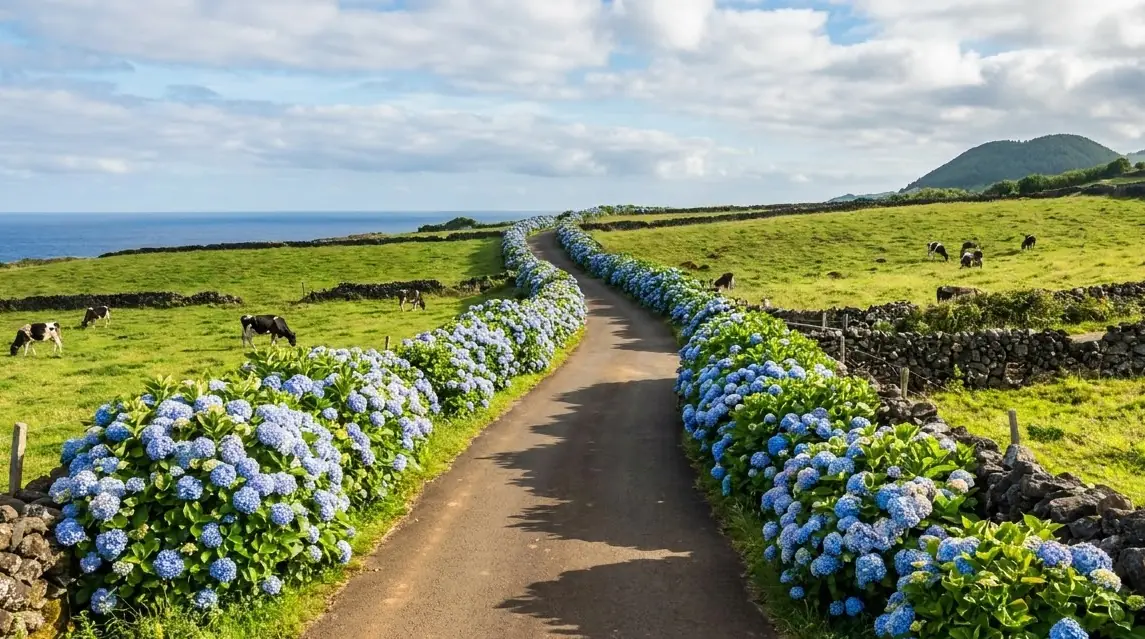
- The hydrangeas that line the roads bloom from June into summer.
- Hire cars, flights and rooms sell out in July and August; book months ahead.
Even in summer, the high ground is often in cloud by midday. Go to the crater viewpoints early, and keep a flexible day for the walk to Lagoa do Fogo.
Hydrangea season
The blue and pink hydrangeas that hedge the fields and roads of the islands bloom from about June into August, turning whole landscapes into postcards. Early summer is the time to see them at their fullest, before the late summer heat fades the flowers.
Festivals in summer
Summer is festival season. The Holy Spirit festivals, with processions and shared meals, run in villages across the islands from spring into summer; the Sanjoaninas fill Angra do Heroísmo on Terceira in June; and Ponta Delgada’s great religious festival of Santo Cristo dos Milagres falls in spring, drawing pilgrims from across the Azores and beyond.
Whale season: spring and summer
Some species can be seen all year, but the season proper runs through spring and summer.
- Sperm whales live around the islands all year.
- In spring, from about April to June, migrating baleen whales pass the islands.
- Dolphins are often seen from spring to autumn.
- Trips are cancelled in rough seas, which are more frequent from October to March.
Spring: April and May
April and May are the shoulder months: highs of 18.8°C and 20.2°C, rain falling on about 9 or 10 days a month, and green islands before the summer crowds. They suit whale watchers and walkers who do not mind a shower, and prices are lower than in summer.
Autumn and winter: mild, wet and quiet
The colder half of the year is a good time for hot springs and empty trails.
- October averages 118.0 mm of rain and December 152.8 mm, the wettest month of the year.
- January and February average highs around 17.5°C, warm by European winter standards.
- Wind and Atlantic storms can delay inter-island flights and cancel ferries and boat trips.
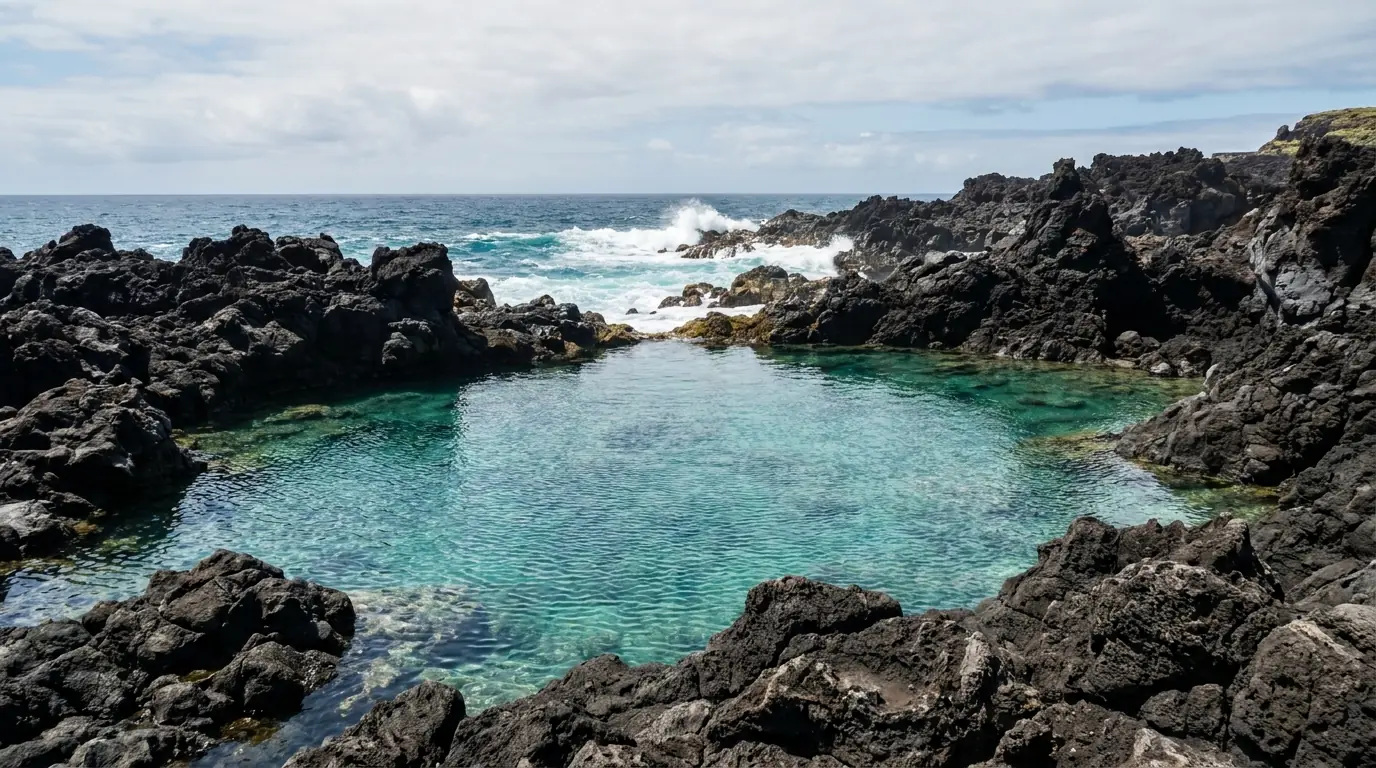
- The hot springs of Furnas and the thermal pools are at their most pleasant on cool days.
Island by island
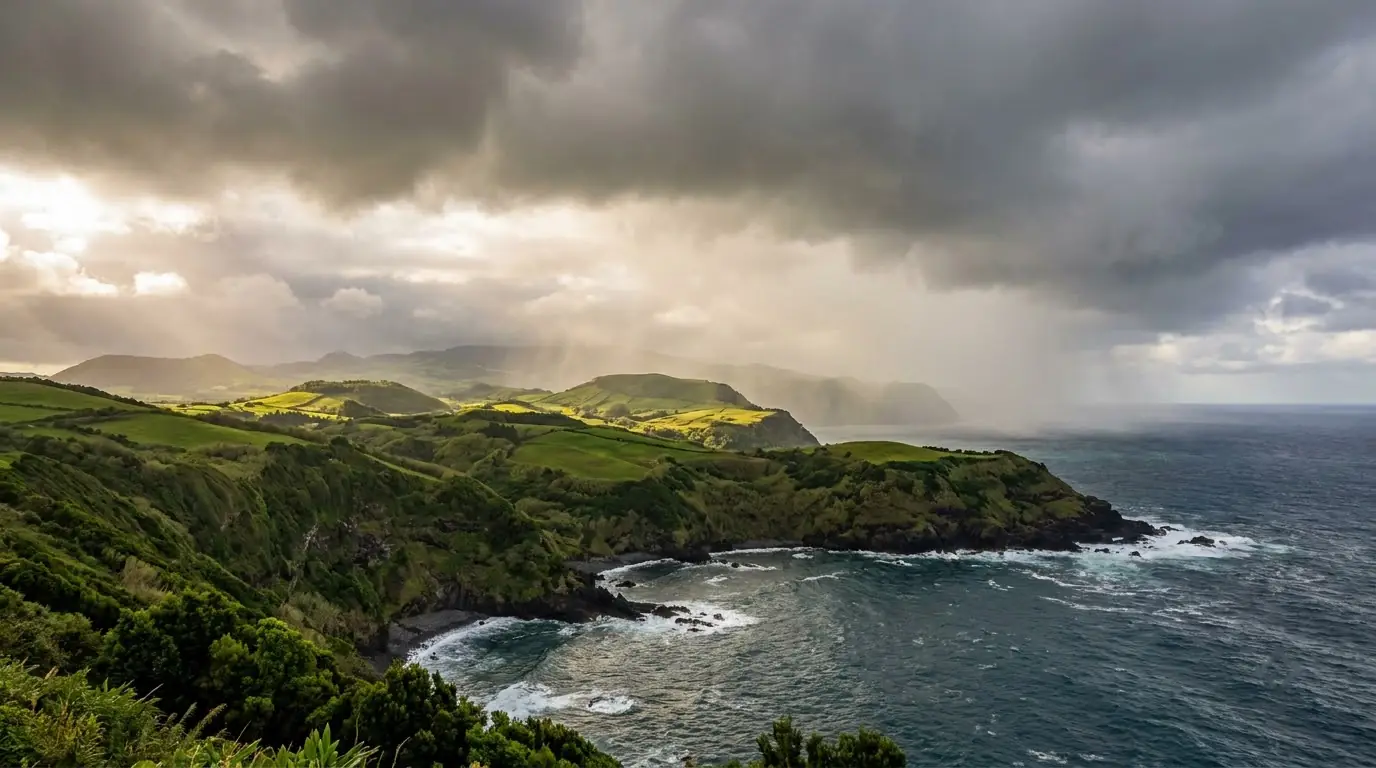
The islands share one climate but not one weather. The central islands around Faial and Pico are wetter than Ponta Delgada, and the high ground everywhere is cooler and cloudier than the coast. Pico’s summit, at 2,351 m, has its own conditions, with cold and strong wind even in summer, and climbs need a permit and a good forecast.
Getting between islands by season
Inter-island flights run all year, while some ferry routes operate mainly in summer. From October to March, storms can delay or cancel both, so a multi-island trip in winter needs buffer days, and the last island should not be the one you fly home from on a tight connection.
A winter trip works best on São Miguel alone, with more flights and more to do indoors, and a few spare days for the weather.
Prices and crowds
Prices and crowds follow the European summer holidays: July and August are the most expensive months for flights, rooms and hire cars, and the most popular viewpoints and hot springs are busiest then. June and September give almost the same weather for less, and from November to March the islands are at their quietest and cheapest.
Packing for island weather
Pack for four seasons in a day: a waterproof jacket, a warm layer for the crater rims, shoes with grip for wet trails, and a swimsuit for the hot springs and rock pools. A dark swimsuit is best for Furnas and Caldeira Velha, whose iron-rich water stains light fabric.
Best time for each kind of Azores trip
Each kind of trip has its own months.
Hiking season
The hiking season runs from late spring to early autumn, when the trails are driest and the crater rims clearest. Winter walks are possible on São Miguel, but paths are muddy and some close after heavy rain; check the official trail network before setting out.
For what to do once you are there, see things to do in the Azores, and compare with the best time to visit Madeira.
When not to book
These choices are the ones to avoid:
- A multi-island trip in winter: storms can ground flights and cancel ferries.
- July and August without bookings: hire cars and rooms run out.
- A tight schedule in any season: one cloudy day can hide the crater lakes.
- A beach-led trip: the islands are for walking and the sea, not long sandy beaches.
Where to stay in Azores
In the busy months the best-placed rooms go first, so choose the area as soon as the dates are set. The map shows the same property across Booking.com and Agoda, with prices live from them.
Common questions
What is the best month to visit the Azores?
July is the best month to visit the Azores for weather: the driest month, at 26.0 mm of rain in Ponta Delgada, with a 24.7°C average high, according to IPMA’s 1991-2020 normals. June and September are close behind, quieter and cheaper, and June has the hydrangeas in bloom.
When is the rainy season in the Azores?
The rainy season in the Azores runs from October to March, peaking in December at 152.8 mm in Ponta Delgada. Even then, rain often comes in showers between sunny spells. The islands receive about 987.5 mm a year over roughly 122 rainy days, so rain is possible in any month.
Is the Azores warm in winter?
The Azores are mild in winter rather than warm: Ponta Delgada averages a 17.5°C high in January, according to IPMA. Winter is wet, windy and grey, with the wettest month in December, but frost is rare and the hot springs are at their most enjoyable.
When is whale season in the Azores?
Whale season in the Azores runs through spring and summer. Sperm whales live around the islands all year, while migrating baleen whales pass from about April to June. Seas are calmer in summer, and trips are often cancelled in winter storms.
Is September a good time to visit the Azores?
September is a good time to visit the Azores: a 25.0°C average high, the sea at its warmest and fewer visitors than in August. Rain returns, at 78.2 mm in Ponta Delgada, so keep spare days for the crater viewpoints and boat trips.
Is June a good time to visit the Azores?
June is a very good time to visit the Azores: a 22.4°C average high in Ponta Delgada, rain on only about 7 days, hydrangeas in bloom and fewer visitors than in July and August. It is also within the season for migrating whales, and prices are lower than in high summer.
Keep planning Azores
Written and checked by
Travel Guide Kit Editorial
An editorial desk, not an invented persona. Every opening time, ticket price and transport connection here is checked against the operator’s own website and carries the date it was read. Where a page cannot draw on direct experience, it says so.