Quick answer
San Sebastián needs two to three days: La Concha beach, a pintxos crawl in the old town, and the views from Monte Igueldo and Monte Urgull, with the Basque coast nearby.
San Sebastián needs 2 to 3 days, about 20 km from the French border: La Concha’s curved beach, an evening of pintxos in the Parte Vieja, and the views from Monte Igueldo and Monte Urgull at either end of the bay. It is a compact, elegant seaside city on the Basque coast, famous above all for its food, and a good base for the fishing towns and cliffs nearby.
This guide covers the best things to do in San Sebastián and how to fit them into one trip.
La Concha and the beaches
Three beaches around a bay and a river mouth, between green hills, give San Sebastián its shape.
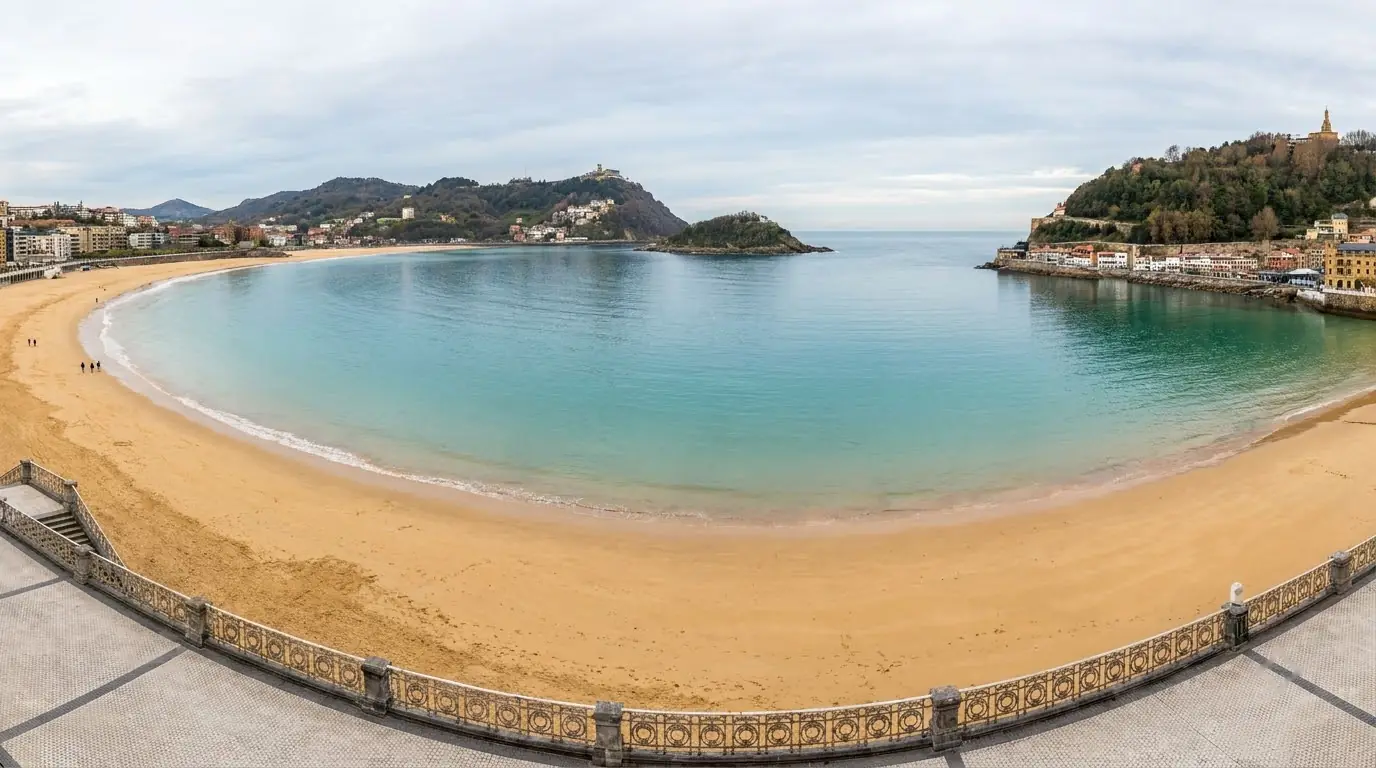
- La Concha, a shell-shaped bay with calm water and a white railing along its promenade, is the city’s emblem.
- Ondarreta, at the western end, is a quieter family beach below Monte Igueldo.
- Zurriola, across the river in the Gros district, faces the open sea and is the surf beach.
- Santa Clara island, in the middle of the bay, can be reached by boat in summer.
Walk the full length of the promenade from the old town to Ondarreta, about 2 km, ending at the Peine del Viento, the Comb of the Wind: iron sculptures by Eduardo Chillida set into the rocks, where waves blow up through holes in the ground on rough days.
Swimming and the tides
Swimming in La Concha is easy in summer: the bay is sheltered, with floating platforms offshore that strong swimmers use as a target. The tide changes the beaches a lot, so at high tide the sand narrows sharply. Check tide times before planning a long beach afternoon.
Surfing at Zurriola
Surfing at Zurriola is a city-centre activity: surf schools line the promenade in Gros and rent boards all year. The waves are usually best from autumn to spring, and the beach suits beginners on calm summer days.
The Parte Vieja and pintxos
Between the harbour and the river, the old town is the heart of San Sebastián’s food scene and the place for pintxos, the Basque version of tapas.
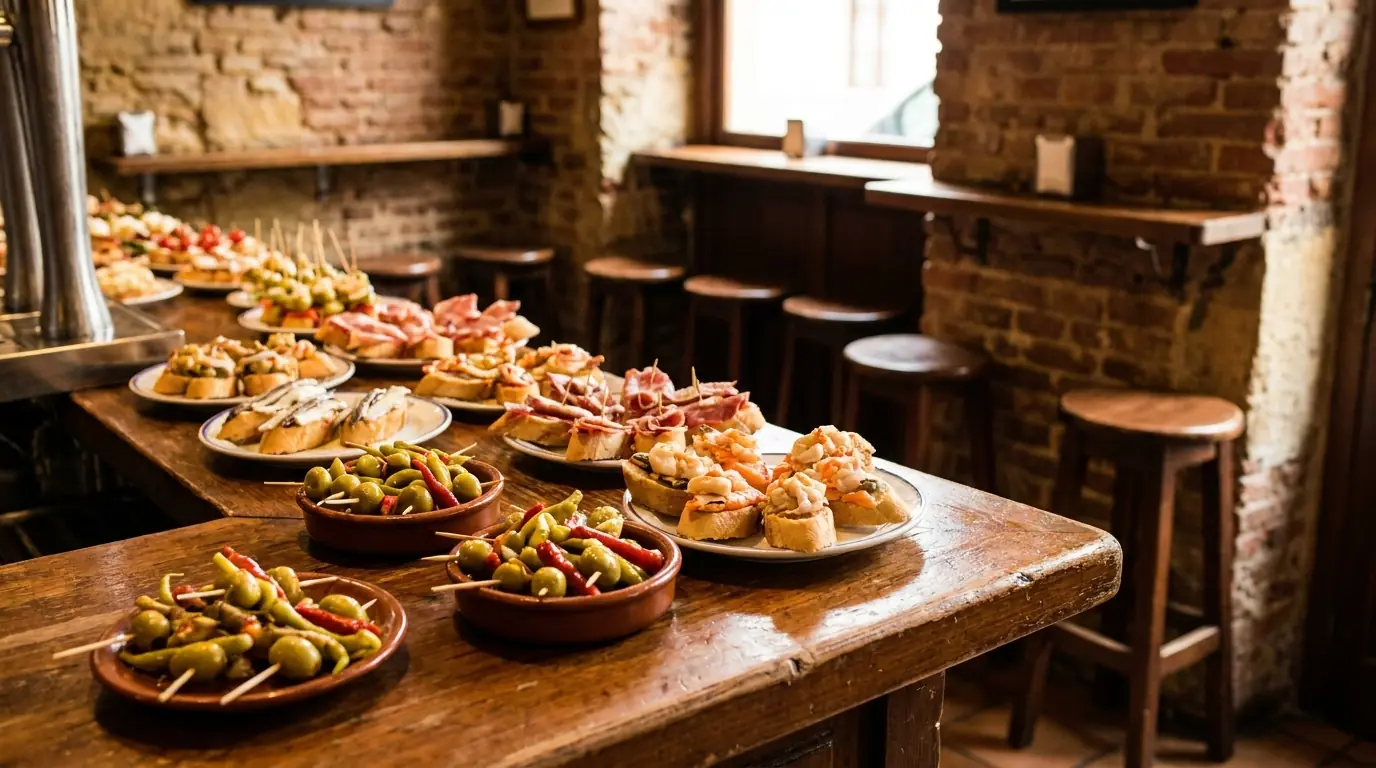
- Bars line their counters with pintxos on bread; point, take a plate, or order hot dishes from the board.
- Go from bar to bar, eating one or two pintxos in each with a small glass of wine or cider.
- Txakoli, a light, slightly sparkling Basque white wine, is poured from a height.
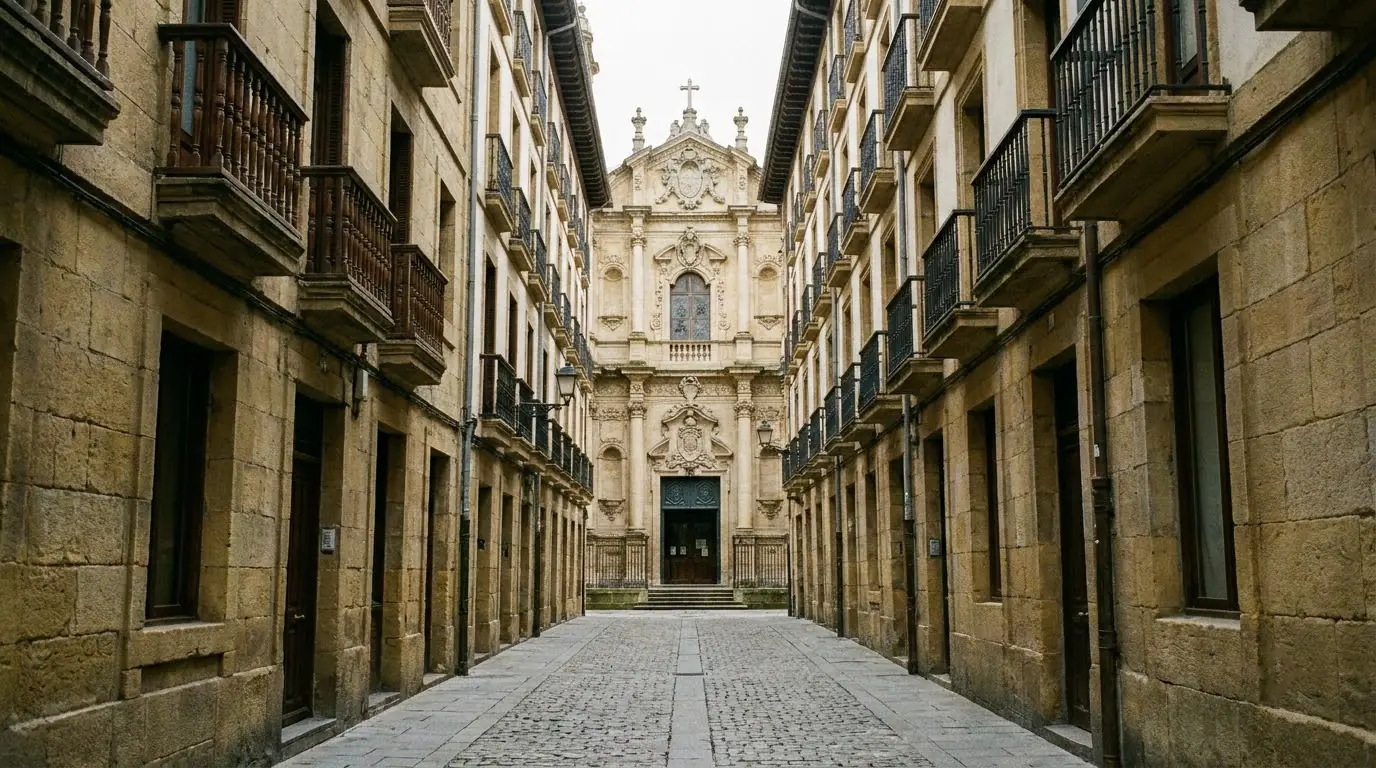
- The Basilica of Santa María, with its baroque façade, closes the end of one of the main streets.
The old town is busiest at lunchtime and from about 8pm. Many bars specialise in one or two hot pintxos, so ask what the house dish is, and pay at the end. Gros, across the river, has its own pintxos bars, with more locals and fewer tour groups.
How to do a pintxos crawl
- Start early by local standards, around 8pm, before the bars fill.
- Have one or two pintxos and a small drink, then move on.
- Mix cold pintxos from the counter with hot ones cooked to order.
- Keep the cheesecake, a local favourite, for the last stop.
Gros
Gros, across the river from the old town, is a lively neighbourhood with its own pintxos bars, the Zurriola surf beach and the cube-shaped Kursaal concert hall. It feels more local than the Parte Vieja and is a good place to eat on busy summer evenings.
Fine dining
Fine dining is the other side of the city’s reputation: San Sebastián and the hills around it are home to several of Spain’s most celebrated restaurants, and the Basque Culinary Center trains chefs here. Tables at the famous names are booked months ahead; the gastronomic societies, private cooking clubs, are a local tradition.
Booking the celebrated restaurants
Booking the celebrated restaurants needs planning weeks or months ahead. Lunch is often easier to get than dinner, which leaves the evenings free for pintxos. A food-focused trip needs at least three nights, with time for the La Bretxa market and, in season, a cider house in the hills.
Monte Igueldo, Monte Urgull and the views
The hills at each end of the bay give the views that make San Sebastián one of the most beautiful cities in Spain.
- Monte Igueldo, at the western end, is reached by an old funicular railway, with an old-fashioned amusement park at the top and the classic view over the whole bay.
- Monte Urgull, above the old town, is a wooded hill with paths, old fortifications, the Mota castle and a large statue of Christ at the top.
- Monte Ulía, east of Gros, has quieter walking paths along the cliffs.
Go up Igueldo for sunset over La Concha, and walk up Urgull in the morning from the harbour. The paths around Urgull also circle the hill above the sea, with views to the open ocean.
Walking to Pasaia
Walking to Pasaia from Gros over Monte Ulía is one of the best walks near the city, a coastal path of a few hours along green cliffs above the sea. It ends at Pasai San Pedro, where a small boat crosses the inlet to the old village of Pasai Donibane. Return by bus.
A one-day walk around the bay
A one-day walk around the bay links both hills and the old town in order:
- Morning: the old harbour and the climb up Monte Urgull.
- Late morning: the Basilica of Santa María and the La Bretxa market.
- Lunch: a first round of pintxos in the Parte Vieja.
- Afternoon: La Concha to Ondarreta and the Peine del Viento.
- Sunset: the funicular up Monte Igueldo, then pintxos again.
Museums, the old harbour and the city
The rest of San Sebastián is best seen on a rainy day or between meals.
- The San Telmo Museum, in a former convent, tells the story of Basque society, with a striking modern extension.
- The old fishing harbour, below Urgull, has colourful boats, fish restaurants and the aquarium.
- The Centro district has grand nineteenth-century streets, the Buen Pastor Cathedral and smart shops.
- Miramar Palace, between La Concha and Ondarreta, has gardens open to the public above the bay.
- Tabakalera, a former tobacco factory, is now a contemporary culture centre with a rooftop view.
Cider houses
Cider houses, sagardotegiak, in the hills around the city, are a Basque tradition. In the cider season, from about January to April, diners eat a set menu of cod omelette, grilled steak and cheese, and catch cider straight from the barrel when the call of txotx goes up. Many open all year now.
Festivals
San Sebastián has a busy calendar of festivals. The Tamborrada on 20 January fills the city with drummers for 24 hours, the Jazzaldia jazz festival takes place in July, the Semana Grande in August brings fireworks over the bay, and the international film festival takes over the city in September.
A rainy day in San Sebastián
Rain is likely on any trip, and the city handles it well, with plenty to do indoors.
- The San Telmo Museum for Basque history and art.
- The aquarium by the old harbour, with a walk-through tunnel.
- A long pintxos lunch in the old town, moving from bar to bar.
- The covered La Bretxa market, and the shops of the Centro district.
- A cookery class on Basque food or pintxos.
- Tabakalera’s exhibitions and its rooftop when the rain stops.
Rain often comes in bursts, and the light after a storm on the bay is one of the city’s best sights, so keep an eye on the sky and be ready to head out again.
San Sebastián with children
San Sebastián with children is easy: the beaches of La Concha and Ondarreta are calm, the funicular and the old amusement park on Monte Igueldo are a treat, and the aquarium suits a rainy morning. Pintxos bars are busy and standing-only, so families often eat earlier or sit down at a restaurant.
Day trips along the Basque coast
Fishing towns, cliffs and France are all within an hour.
- Hondarribia, on the French border, has a walled old town and a colourful fishermen’s quarter.
- Pasai Donibane, a village of old houses on a narrow harbour, is reached by a small ferry across the inlet.
- Getaria, a fishing town known for grilled fish and txakoli vineyards, is linked to Zarautz by a coastal path.
- Zumaia and the flysch cliffs, layered rock strata, are part of the Basque Coast Geopark.
- Bilbao and the Guggenheim Museum are about an hour and a quarter away by bus.
- Biarritz and Saint-Jean-de-Luz, in France, are a short drive across the border.
Most of these work by bus or local train; a car is easiest for Zumaia and the coastal roads.
Hondarribia is the easiest and most rewarding half day: its walled upper town has stone mansions and a castle now used as a hotel, while the old fishermen’s quarter below has houses with brightly painted balconies and some of the best pintxos bars on the coast.
Day trips without a car
Day trips without a car are easy from San Sebastián. Euskotren local trains run to Hendaye on the French border, where French trains continue to Saint-Jean-de-Luz and Biarritz. Buses reach Bilbao in about an hour and a quarter, and Getaria and Zumaia combine in a full day, with lunch on the grill in Getaria.
Bilbao also works as a base of its own for a night or two, and a Basque trip can be split between the two cities. A car gives more freedom for the inland hills, the cider houses and the coastal roads to Zumaia.
How many days, and getting there
The count depends on how much of the coast you add:
- 1 day: La Concha, the old town, Monte Igueldo and an evening of pintxos.
- 2 days: add Monte Urgull, the San Telmo Museum, Gros and Zurriola.
- 3 days: add a day trip to Hondarribia or Getaria and Zumaia.
- 4 to 5 days: add Bilbao and the French Basque coast.
Getting there: the small San Sebastián airport is in Hondarribia, Bilbao airport has more flights and a direct bus, and Biarritz airport is across the border. Trains run from Madrid and from Barcelona; for the Catalan capital, see things to do in Barcelona. In the city, walk: the centre is flat and compact, and local buses cover the rest.
Stay in the old town or Centro for the pintxos bars and the beach on foot, in Gros for a more local feel and the surf, or near Ondarreta and Antiguo for quiet and families. Prices are high by Spanish standards, so book early for summer.
Choosing a base for the nights
The whole centre is walkable, so the choice is about noise and distance.
- Parte Vieja: the bars on the doorstep, but noisy until late; many rooms are in old buildings without lifts.
- Centro: calmer, with many classic hotels and the bus and train stations nearby.
- Gros: slightly cheaper, with the main train station on that side of the river.
- Antiguo and Ondarreta: quiet, 20 to 30 minutes on foot from the old town.
City buses, run by Dbus, cover the bay, the hills and the outer neighbourhoods.
Weather, when to go, and what to skip
The climate is mild and green, which means rain: these are the 1981-2010 normals for Igeldo from AEMET.
- August averages a 22.5°C high and January 11.0°C, so summers are mild rather than hot.
- The city receives about 1,507 mm of rain a year, falling on about 141 days.
- June to September is the best time for the beaches; October and November are the wettest.
Pack a light rain jacket and a warm layer in any season, and shoes that cope with wet streets. Even in summer, a grey morning often turns into a fine afternoon on the beach.
What to skip: planning only beach days, since rain is common in any month; arriving in August or for the film festival without a booking; and filling up at the first pintxos bar instead of moving on. For official event listings, see the city’s tourism office. For more of the country, see our Spain travel guide.
The months in brief
The months in brief follow the same Igeldo normals. July is the driest and sunniest month, at 86 mm and 196 hours of sunshine, though it still rains on about 10 days. November is the wettest, at 169 mm, and December the dullest, with 93 hours of sun.
Surfing is best from autumn to spring, when the swell is biggest, and winter storms send big waves over the promenade. For food without crowds, May, June, October and November are the quieter months. In winter the beaches empty, but the pintxos bars stay open and the cider season starts in January.
Where to stay in San Sebastián
In San Sebastián, Parte Vieja is the base for pintxos and a first trip, and Centro for elegance, shops, all-rounders. The map shows the same property across Booking.com and Agoda, with prices live from them.
Common questions
What is San Sebastián best known for?
San Sebastián is best known for its food, from pintxos in the old town bars to some of Spain’s most celebrated restaurants, and for La Concha, a shell-shaped bay with one of Europe’s most beautiful city beaches. It is also known for its film festival and its Belle Époque architecture.
How many days do you need in San Sebastián?
You need 2 to 3 days in San Sebastián: one for La Concha, the old town and Monte Igueldo, one for Monte Urgull, the museums and Gros, and a third for a day trip to Hondarribia or Getaria. Add days for Bilbao and the French Basque coast.
How do pintxos bars work in San Sebastián?
In San Sebastián’s pintxos bars, you take or point to pintxos on the counter, or order hot ones from the board, with a small drink, and pay at the end. Locals move from bar to bar, eating one or two in each. Ask each bar for its house speciality.
Is San Sebastián worth visiting?
San Sebastián is worth visiting for its food, its beaches and its setting: a compact, elegant city around La Concha bay, with green hills and fishing towns nearby. It suits food lovers and walkers best; those wanting guaranteed sunshine may find the rain frustrating.
Can you swim in San Sebastián?
Yes, you can swim in San Sebastián: La Concha and Ondarreta have calm, sheltered water in the bay, while Zurriola faces the open sea and suits surfers. Summer is the best time, with an August high of 22.5°C, and the beaches have lifeguards in season.
Keep planning San Sebastián
Written and checked by
Travel Guide Kit Editorial
An editorial desk, not an invented persona. Every opening time, ticket price and transport connection here is checked against the operator’s own website and carries the date it was read. Where a page cannot draw on direct experience, it says so.