
Quick answer
Yes, Sintra is worth a full day from Lisbon, about 40 minutes by train, for palaces and gardens unlike anywhere else in Portugal; start early and book Pena ahead.
Yes, Sintra is worth a full day, about 40 minutes by train from Lisbon, and 2 days if you add Monserrate and the coast. Its palaces and gardens on a wooded hill are unlike anything else in Portugal. It disappoints those who arrive late on a summer weekend without a Pena ticket, and it suits least those who cannot manage steep paths or crowds. So, is Sintra worth visiting? The sections below weigh the highlights against the downsides.
Who Sintra suits, and who it frustrates
Sintra is magical for some trips and frustrating for others, usually depending on timing.
Three of the four warnings on the right are about timing or tickets, not about Sintra itself. Most of the disappointment with Sintra comes from the right column, and most of it disappears with an early train, a booked slot and a realistic plan of two sites.
What Sintra does better than anywhere in Portugal
Its speciality is fantasy: palaces and gardens built by nineteenth-century Romantics on a misty hill, now a UNESCO cultural landscape.
- Pena Palace: red and yellow towers on the highest crag, with terraces over the hills and the Atlantic.
- Quinta da Regaleira: gardens, grottoes and a spiral Initiation Well descending into the ground.
- The Moorish Castle: walls along a ridge with the widest view in Sintra.
- Monserrate: a palace with a Moorish-style dome in a garden of plants from around the world.
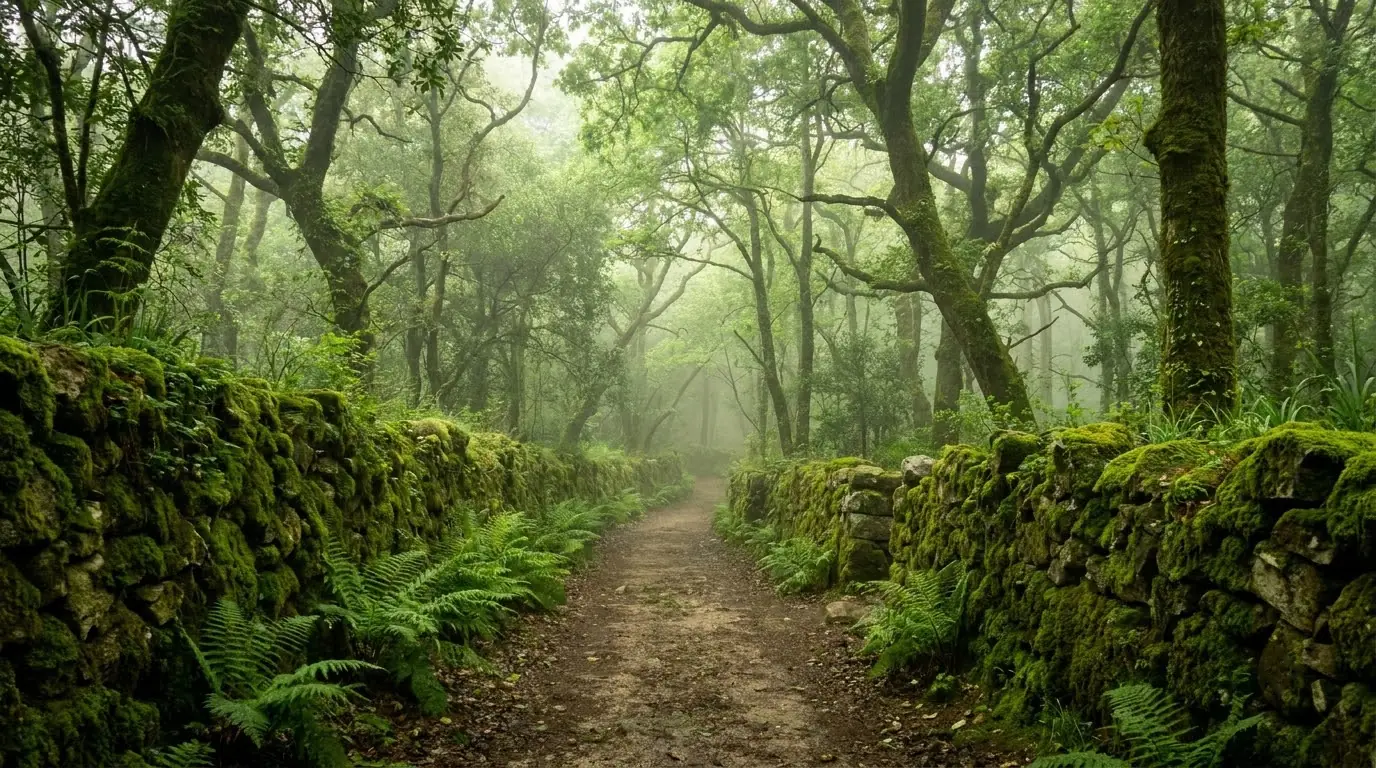
- The forest itself: mossy paths, ferns and old trees between the sights.
The town itself
The town itself is part of the appeal: pastel houses stacked on the slope, the National Palace with its two conical chimneys on the main square, old bakeries selling travesseiros and queijadas, and lanes that climb into the forest. In the evening, after the last trains, it is one of the most peaceful small towns near Lisbon.
No other day trip from Lisbon offers this mix of architecture and landscape, and none is as easy to reach: the suburban train from Rossio takes about 40 minutes and runs through the day.
The downsides of Sintra
Crowds, timing and slopes account for nearly all of them.
- Crowds: from late morning in summer, the terraces at Pena and the well at Regaleira are packed.
- Queues: for the loop bus up the hill, for the Pena palace rooms and for the narrow well at Regaleira.
- Tickets: Pena’s palace is sold for a set date and time on the Parques de Sintra site, and weekend slots sell out.
- Slopes: the paths between the sights are steep, often damp, and hard on the knees.
- Weather: the hill makes its own mist, and Pena can be in cloud while Lisbon is in sun.
Tuk-tuks and traffic
The narrow roads up the hill carry the loop bus, taxis, tuk-tuks and tour vans, and at peak times they move slowly. Walking up from the town to the Moorish Castle takes longer but avoids the queue; walking down from Pena through the forest is one of the best parts of the day.
None of these is a reason to skip Sintra, but together they explain why some visitors leave unimpressed: they came at noon, queued for the bus, missed their Pena slot and saw the palace through fog.
Sintra or another day trip from Lisbon?
With one free day in Lisbon, the right trip depends on what you want from it.
- Sintra: palaces and gardens, about 40 minutes by train; the default first choice.
- Cascais and Cabo da Roca: the coast and the cliffs, about 40 minutes by train to Cascais; easier and calmer.
- Évora: Roman ruins and the Alentejo, about 1 hour 30 minutes by train; quieter and flatter.
- Óbidos: a walled medieval town, about an hour by bus; small and pretty, with fewer crowds.
On a first trip, choose Sintra. On a second, or if the crowds are the worry, Évora or Óbidos give a calmer day. See day trips from Lisbon for the full comparison.
Sintra and Cascais in one day?
Sintra and Cascais in one day is possible by bus over Cabo da Roca, but it leaves Sintra rushed: two palaces, a long bus ride and a short evening by the sea. It works better as two days, or with Cascais as the afternoon of a second Sintra day.
When Sintra is most worth it, and when it is not
The day of the week and the hour matter more than the month.
- Weekdays outside school holidays: the most worth it, with shorter queues for the bus and the palaces.
- Spring and autumn: the gardens at their best and the paths cooler.
- Summer weekends: the least worth it, unless you are on the first train with a booked slot.
- Winter: quiet and atmospheric, but often wet and misty; keep a flexible day if you can.
- Late afternoon: Regaleira and the town are calmer once the tour groups leave.
Whatever the season, the first hour after opening is the best hour in Sintra. The park around Pena opens at 9:00, and the earliest palace slot is the one to book.
Sintra on a rainy day
On a rainy day, Sintra still works if the plan moves indoors: the rooms of Pena Palace and the National Palace in the town, a long lunch, and Regaleira’s grottoes if the rain eases. The Moorish Castle and the open terraces are the parts to skip, since the paths are slippery and the views disappear.
How to make Sintra worth it
A few decisions made the day before set up the visit.
- Book the first Pena palace slot online, the day before at the latest.
- Take an early train from Rossio and go straight up the hill to Pena.
- Plan two sites and the walk between them; add a third only if the morning goes well.
- Visit Regaleira in the afternoon, a short walk from the town centre, when the well queue shortens.
- Wear shoes with grip and carry a layer for the cooler, damper hill.
- Stay a night if you can, and give the second morning to Monserrate.
A sample day
- 8.30am: train from Rossio; at Sintra, the loop bus straight up the hill.
- 9.30am: Pena Palace at the first slot, then the park and the High Cross viewpoint.
- 11.30am: the Moorish Castle walls next door, if the sky is clear.
- 1.30pm: walk down through the forest to the town for lunch.
- 3.30pm: Quinta da Regaleira and the Initiation Well.
- 6pm: a travesseiro and coffee, then the train back to Lisbon.

A second day: Monserrate and the coast
A second day turns Sintra from a sprint into a pleasure: Monserrate’s gardens in the morning, the Convent of the Capuchos if you have a car, and the coast at Cabo da Roca and Azenhas do Mar in the afternoon, ending in Cascais for the train back to Lisbon.
For where to sleep, see where to stay in Sintra, and for the sights in detail, things to do in Sintra.
Is Sintra worth it for families, couples and older travellers?
Each kind of trip needs a few adjustments.
- Couples: Pena at opening time, Regaleira’s gardens and a night in the old town make Sintra one of the most romantic places in Portugal.
- Families: Regaleira’s tunnels and well are the highlight for children; keep the day to two sites and use the loop bus.
- Older travellers: worth it with taxis or tuk-tuks for the climbs, Pena’s terraces and the National Palace in town.
- Visitors with limited mobility: the National Palace and parts of Pena are the most accessible; the castle and Regaleira’s well are not.
With a pushchair
With a pushchair, Sintra is hard work: cobbles, steps and steep forest paths. A baby carrier is far easier, and the town, the National Palace and Pena’s terraces are the most manageable parts of the hill.
Who should skip Sintra
The list is short, but read it before booking the train.
- Visitors with only half a day: the trip and the queues leave too little time for the palaces.
- Anyone who cannot manage steep paths and does not want to use taxis.
- Travellers who dislike crowds and can only come on a summer weekend.
- A three-day Lisbon trip that would lose a city day: Lisbon needs its days first.
- Visitors hoping for a quiet, undiscovered town: Sintra is one of the busiest sights in Portugal.
For everyone else, the answer is yes: no other day trip from Lisbon offers the same mix of palaces, gardens and forest. The difference between a great day and a frustrating one is almost always the hour you arrive and whether Pena is booked.
Where to stay in Sintra
If you go, which part of town you sleep in decides how much you see on foot. The map shows the same property across Booking.com and Agoda, with prices live from them.
Common questions
Is Sintra worth visiting?
Yes, Sintra is worth visiting for a full day from Lisbon, about 40 minutes by train: Pena Palace, Quinta da Regaleira and the Moorish Castle are unlike anything else in Portugal. It disappoints visitors who arrive late on a summer weekend without a Pena ticket, so start early and book ahead.
Is half a day enough for Sintra?
Half a day is not enough for Sintra: the train, the bus up the hill and the queues take a large part of it, leaving time for one palace at most. Give Sintra a full day for Pena and Regaleira, and two days to add Monserrate and the coast.
Is Sintra overrated?
Sintra is not overrated, but it is often visited badly: at noon on a summer weekend, without a booked Pena slot, trying to see three palaces. On a weekday with an early train and two sites, it lives up to its reputation as the best day trip from Lisbon.
Is Sintra or Cascais better?
Sintra is better for palaces, gardens and forest walks; Cascais is better for beaches, the seafront and a relaxed afternoon. Both are about 40 minutes from Lisbon by train. With one day, choose Sintra; with two, do both, linked by the coast road over Cabo da Roca.
Is Sintra worth it in winter?
Sintra is worth it in winter for quieter palaces and an atmospheric, misty hill, but it is often wet and cool. Bring a waterproof layer, keep the day flexible, and swap to the indoor rooms of Pena and the National Palace if the mist hides the views.
How long do you need in Sintra?
You need a full day in Sintra for Pena Palace and Quinta da Regaleira, with the Moorish Castle if you start early. Two days lets you add Monserrate, the National Palace and the coast at Cabo da Roca. Arrive on an early train and plan two sites per day.
Keep planning Sintra
Written and checked by
Travel Guide Kit Editorial
An editorial desk, not an invented persona. Every opening time, ticket price and transport connection here is checked against the operator’s own website and carries the date it was read. Where a page cannot draw on direct experience, it says so.