Quick answer
Sintra needs a full day from Lisbon, about 40 minutes by train: Pena Palace and Quinta da Regaleira are the essentials, and a second day adds Monserrate and the coast.
Sintra needs 1 full day, about 40 minutes by train from Lisbon, and 2 if you want Monserrate and the coast. Pena Palace and Quinta da Regaleira are the essentials; book Pena for a set time, arrive early and plan two palaces rather than three. The whole hill is a UNESCO cultural landscape, and the walks between the sights are part of the visit, so plan the day around them.
This guide covers the best things to do in Sintra and how to fit them into one trip.
Pena Palace: the palace on the highest crag
A Romantic palace in red and yellow, built in the nineteenth century for King Ferdinand II, Pena is the sight to plan the day around.
- Tickets for the palace are sold for a set date and time on the Parques de Sintra site; the surrounding park opens from 9:00 to 19:00.
- The palace interior is entered by slot; the terraces and the park around it are free to wander for the day.
- The park, with lakes, exotic trees and viewpoints such as the High Cross, is worth an hour of its own.
- The walk or shuttle up from the town is steep; take the loop bus or a taxi up and walk down.
Inside the palace
Inside, the palace rooms are kept much as the royal family left them when the monarchy ended in 1910: furniture, stucco, tiles and a mix of Gothic, Manueline and Moorish styles chosen by Ferdinand II. The terraces outside, with views over the hills to the Atlantic and the Tagus, are as much the attraction as the rooms.
Arrive for the first slot of the day: by late morning the terraces are crowded and the queue for the palace rooms grows. On a cloudy day, the palace can be inside the mist while the town below is in sun.
Quinta da Regaleira: the initiation well
The other essential is a mysterious estate of gardens, grottoes and towers close to the historic centre, so it needs no bus.
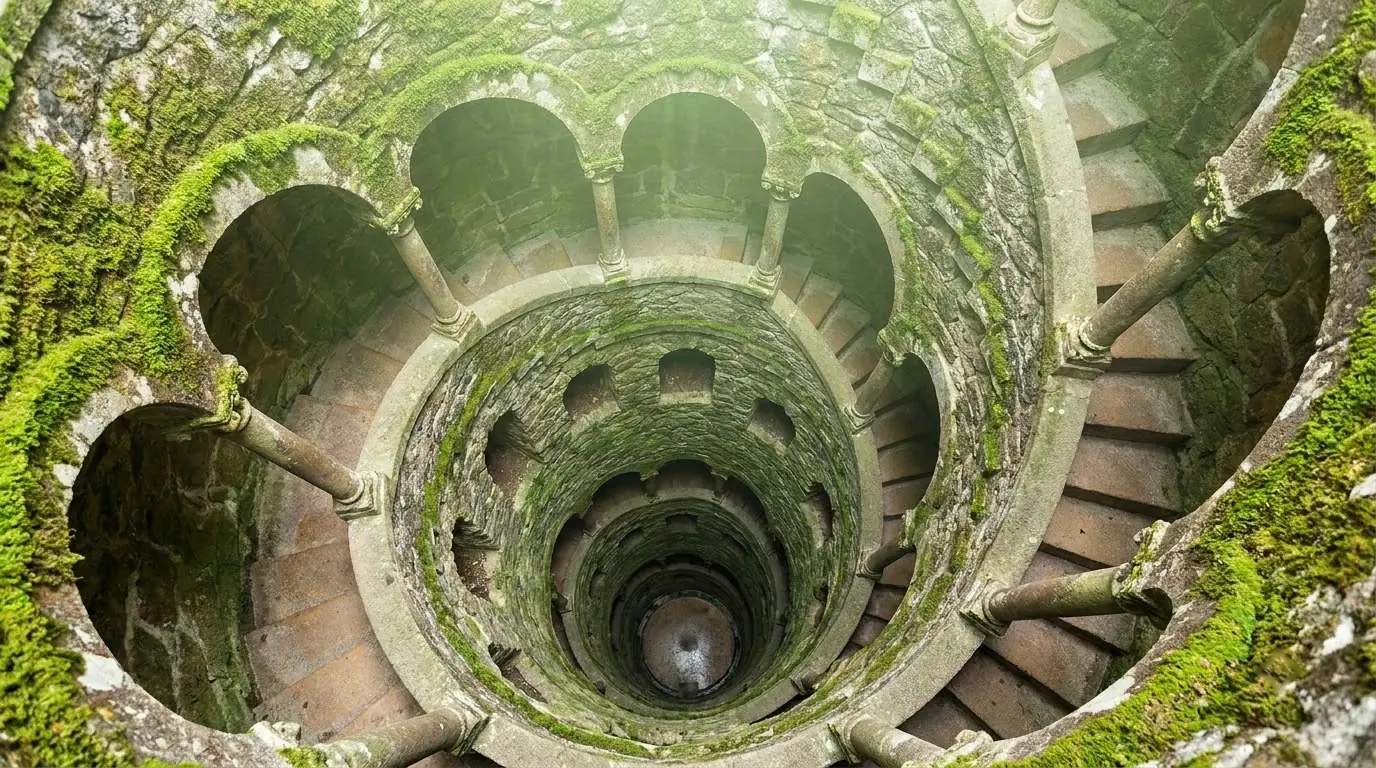
- The Initiation Well is a spiral stairway descending nine levels into the ground, linked by tunnels to grottoes and a lake.
- The gardens are full of symbols, towers and hidden paths; allow two hours.
- Regaleira is run by its own foundation, not by Parques de Sintra, so it has separate tickets.
- It is a ten-minute walk from the town centre, which makes it an easy first or last stop.
Who built it
Regaleira was built in the early twentieth century for António Augusto Carvalho Monteiro, a wealthy collector, by the Italian architect Luigi Manini, who filled the grounds with references to alchemy, the Templars and Dante. Its eccentric mix of styles is part of what makes Sintra feel like nowhere else in Portugal.
Go early or late in the day: the well is narrow, and at midday the queue to descend can be long.
The Moorish Castle and the walls on the ridge
Snaking along the ridge next to Pena, the walls give the widest view in Sintra, over the palaces, the plain and the Atlantic.
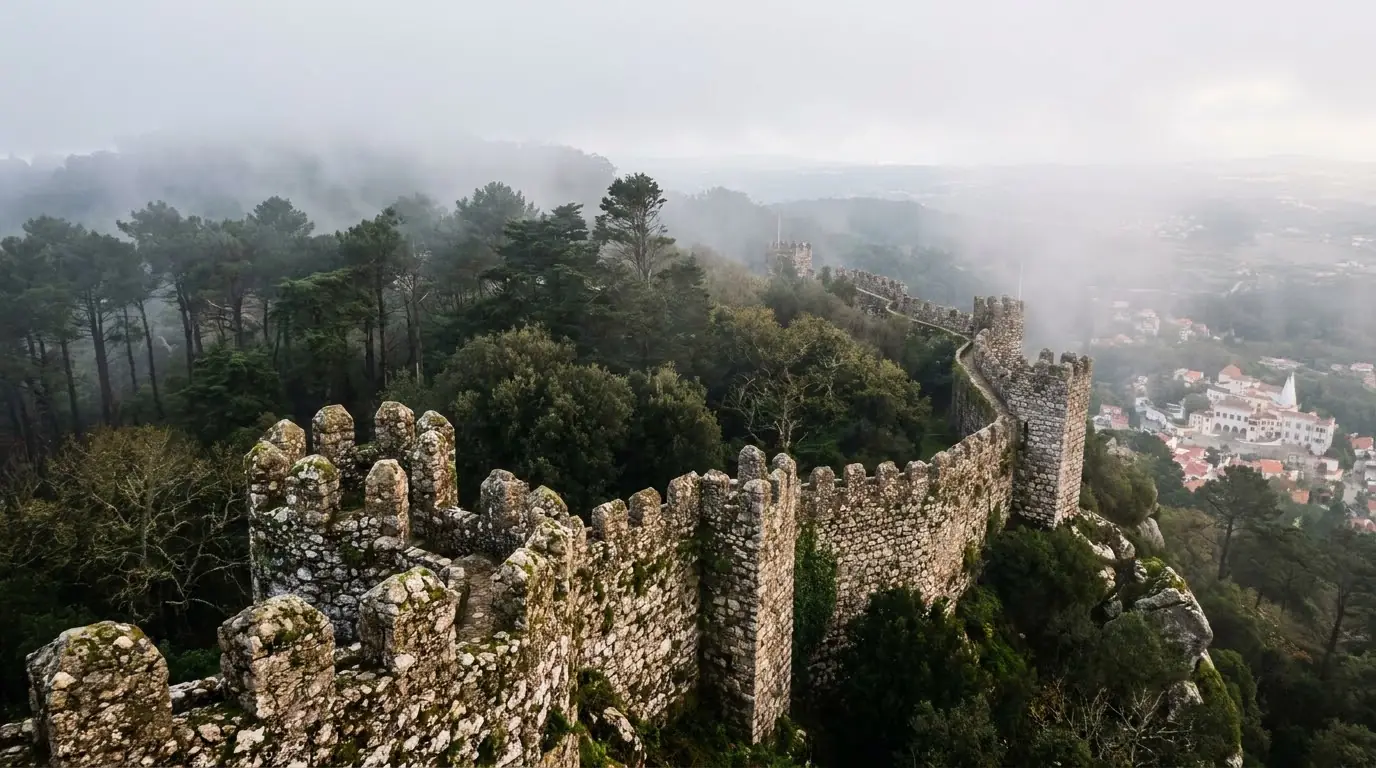
- The walls date from the time of the Moors, restored in the nineteenth century, and can be walked along their battlements.
- It sits a short walk from Pena’s entrance, so the two pair well on the same morning.
- It is exposed and windy; skip it on a day of low cloud, when the view disappears.
The town, the National Palace and Monserrate
These three fill the second day, or a slower first one if you skip the castle.
Sintra National Palace
The Sintra National Palace sits in the middle of the town, recognisable by its two tall conical kitchen chimneys. It was a royal residence for centuries, and its rooms are lined with some of the oldest tiles in Portugal.
Monserrate
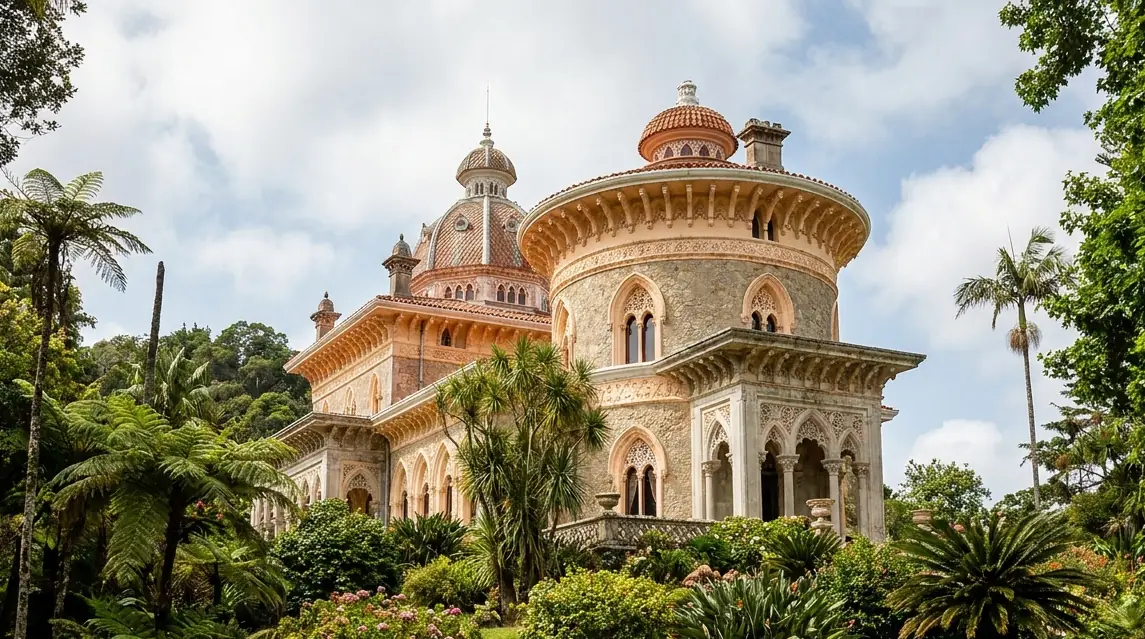
Monserrate, a few kilometres west of the town, is a palace with a Moorish-style dome set in a vast garden of plants from around the world. It is quieter than Pena and Regaleira, and its gardens are worth a morning of their own.
The Convent of the Capuchos
The Convent of the Capuchos is a tiny friary of cork-lined cells hidden in the forest, a short drive from the centre; it suits visitors who want the quiet side of the hill.
Most of these sites are managed by Parques de Sintra, which sells combined tickets; check what each includes before buying.
Travesseiros and queijadas
Sintra has two pastries of its own: travesseiros, pillows of puff pastry filled with almond cream, and queijadas, small tarts of fresh cheese and cinnamon. Old bakeries in the town centre have made them for generations, and a coffee with one is the traditional end to a day on the hill.
Older travellers and limited mobility
Older travellers and visitors with limited mobility can still enjoy Sintra with a few adjustments. The National Palace and parts of Pena are the most accessible; the Moorish Castle and Regaleira’s well are not. Use taxis or tuk-tuks for the climbs, and spend the time on Pena’s terraces and in the town.
Cabo da Roca and the coast
A half day on the coast turns a palace trip into a palace and sea trip.
- Cabo da Roca is the westernmost point of mainland Europe: cliffs, a lighthouse and a strong wind.
- Azenhas do Mar is a white village stacked on a cliff above a natural sea pool.
- Praia da Adraga and Praia Grande are beaches below the cliffs, cold-water and wild.
- A bus links Sintra with Cascais via Cabo da Roca, so the coast can end the day before the train back to Lisbon.
Ending in Cascais
Cascais, the seaside town at the end of the coast road, makes a natural end to a Sintra and coast day: a marina, small beaches and a seafront walk to the Boca do Inferno cliffs, with the train back along the river to Lisbon’s Cais do Sodré in about 40 minutes.
This works best on a second day, or with a car. Squeezing Cabo da Roca onto the end of a palace day leaves the palaces rushed.
Getting to and around Sintra
The train is easy; the hill is not.
- Train: from Lisbon’s Rossio station, about 40 minutes, on the suburban line; check times on CP.
- Loop bus: a tourist bus circles from the station through the town to the Moorish Castle and Pena.
- On foot: the town, the National Palace and Regaleira are walkable; Pena is a steep climb.
- Tuk-tuks and taxis wait in the town for the climb to Pena.
- Car: not recommended; the roads are narrow and parking near the palaces is limited.
Sintra with children
With children, Regaleira’s tunnels and the well are the highlight, and Pena’s park has space to run. Keep the day to two sites, use the loop bus for the climbs, and skip the Moorish Castle’s exposed walls with small children on a windy day. A pushchair is hard work on the hill; a carrier is easier.
The weather on the hill
The hill makes its own weather: it is often cooler, damper and mistier than Lisbon, even when the city is in sun. Bring a layer in every season, and do not cancel the trip because of morning cloud; it often lifts by midday, or the reverse.
The palaces sit on a cultural landscape listed by UNESCO in 1995, where the walks between sights are part of the experience. Wear shoes with grip: the paths are steep and often damp.
Tuk-tuks and traffic on the hill
Tuk-tuks and traffic share the narrow roads up the hill with the loop bus, taxis and tour vans, and at peak times they all move slowly.
Walking up from the town to the Moorish Castle takes longer but avoids the queue, and walking down from Pena through the forest is one of the best parts of the day.
Where to stay for a night
Where to stay for a night depends on how you arrive and what the second day holds.
- Sintra Vila, the historic centre: the first-visit base, quiet after dinner.
- Estefânia, beside the station: easiest with luggage, about 15 minutes’ walk from the National Palace.
- São Pedro de Sintra: very quiet and on the road towards Pena, with an uphill walk back.
- Colares and the coast: the sea, for travellers with a car.
- Cascais: beaches and restaurants, with Sintra about 30 minutes away by bus or car.
One day or two in Sintra
The hill holds more than a single day can, so this is the real planning choice.
One day in Sintra
- 8.30am: an early train from Rossio, arriving before the first tour groups.
- 9.30am: Pena Palace at the first slot, then its park.
- Midday: the Moorish Castle walls, a short walk away, if the sky is clear.
- 2pm: lunch in the town, and a travesseiro with coffee.
- 3.30pm: Quinta da Regaleira and the Initiation Well, ten minutes’ walk from the centre.
- Evening: the train back to Lisbon for dinner.
Two days in Sintra
Two days lets the hill breathe: Pena and the castle on the first morning, Regaleira in the afternoon, and the National Palace, Monserrate and the coast at Cabo da Roca on the second, finishing in Cascais for the train back to Lisbon.
Staying a night
Staying a night in Sintra means seeing Pena or Regaleira before the day visitors arrive and the town quiet in the evening, when its lanes and cafés belong to the people who live there. It also suits travellers with a car who want to continue along the coast the next day.
Sintra or another day trip from Lisbon?
Sintra or another day trip from Lisbon is the choice for visitors with one free day. On a first trip, choose Sintra. On a second, or if the crowds are the worry, a calmer day suits better.
- Cascais and Cabo da Roca: the coast, about 40 minutes by train to Cascais.
- Évora: Roman ruins and the Alentejo, about 1 hour 30 minutes by train.
- Óbidos: a walled medieval town, about an hour by bus.
What to skip, or do differently
Time and crowds cause the common mistakes:
- Sintra as an afternoon: the queues and the climb eat half a day before you reach a palace.
- Three or four palaces in one day: two, and the walk between them, is the realistic limit.
- Pena without a timed ticket at weekends and in summer.
- Driving up to the palaces: the roads are one-way loops with little parking.
- The coast and the palaces on the same day without a car.
For the trip from Lisbon, see day trips from Lisbon and how many days to spend in Lisbon.
When Sintra is at its best
Sintra is at its best on weekdays outside school holidays, with shorter queues for the bus and the palaces. Spring and autumn bring the gardens at their best and cooler paths; summer weekends are the hardest, unless you are on the first train with a booked slot.
The time of day matters as much as the month. The first hour after the park opens at 9:00 is the best hour in Sintra, and in the late afternoon Regaleira and the town calm down once the tour groups leave.
Sintra on a rainy day
On a rainy day, Sintra still works if the plan moves indoors: the rooms of Pena Palace and the National Palace in the town, a long lunch, and Regaleira’s grottoes if the rain eases. Skip the Moorish Castle and the open terraces, where the paths are slippery and the views disappear.
Where to stay in Sintra
In Sintra, Sintra Vila is the base for a first visit, and Estefânia for the train and lower prices. The map shows the same property across Booking.com and Agoda, with prices live from them.
Common questions
What should you not miss in Sintra?
Do not miss Pena Palace, the red and yellow Romantic palace on the highest crag, and Quinta da Regaleira, with its spiral Initiation Well. Add the Moorish Castle walls for the view if you have time, and Monserrate’s gardens on a second day.
Is one day enough for Sintra?
One day is enough for Sintra’s two essentials, Pena Palace and Quinta da Regaleira, with the Moorish Castle if you start early. Two days lets you add Monserrate, the National Palace and Cabo da Roca without rushing. Half a day is not enough.
How do you get from Lisbon to Sintra?
You get from Lisbon to Sintra by suburban train from Rossio station, about 40 minutes. From Sintra station, a loop bus runs through the town to the Moorish Castle and Pena Palace, or you can walk to the town and Regaleira and take a taxi or tuk-tuk up the hill.
Do you need to book Pena Palace in advance?
Yes, book Pena Palace in advance: palace tickets are sold for a set date and time on the Parques de Sintra site, and weekend and summer slots sell out. The park around the palace is open from 9:00 to 19:00, and booking the first slot avoids the worst of the crowds.
Which is better, Pena Palace or Quinta da Regaleira?
Pena Palace is better for the views and the palace interiors; Quinta da Regaleira is better for gardens, grottoes and the Initiation Well. They are very different, so do both in one day, with Regaleira first, near the town, and Pena later by bus.
Can you visit Sintra without a tour?
You can visit Sintra without a tour easily: the train from Lisbon’s Rossio station takes about 40 minutes, the loop bus climbs from the station to the Moorish Castle and Pena, and Regaleira and the town are walkable. Book the Pena slot online first and the day runs on its own.
Keep planning Sintra
Written and checked by
Travel Guide Kit Editorial
An editorial desk, not an invented persona. Every opening time, ticket price and transport connection here is checked against the operator’s own website and carries the date it was read. Where a page cannot draw on direct experience, it says so.