Quick answer
Córdoba needs one full day for the Mezquita, the Judería and the Roman bridge, and two to add Medina Azahara and the patios; it is under an hour from Seville by train.
Córdoba needs 1 full day for the Mezquita, the Judería and the Roman bridge, and 2 days to add Medina Azahara and the flower-filled patios. It is under 1 hour from Seville by high-speed train. Go in spring, ideally in May for the Patios festival, and avoid July and August afternoons, which average highs near 37°C, among the hottest in Spain, when the streets empty after lunch.
This guide covers the best things to do in Córdoba and how to fit them into one trip.
The Mezquita: the reason to come
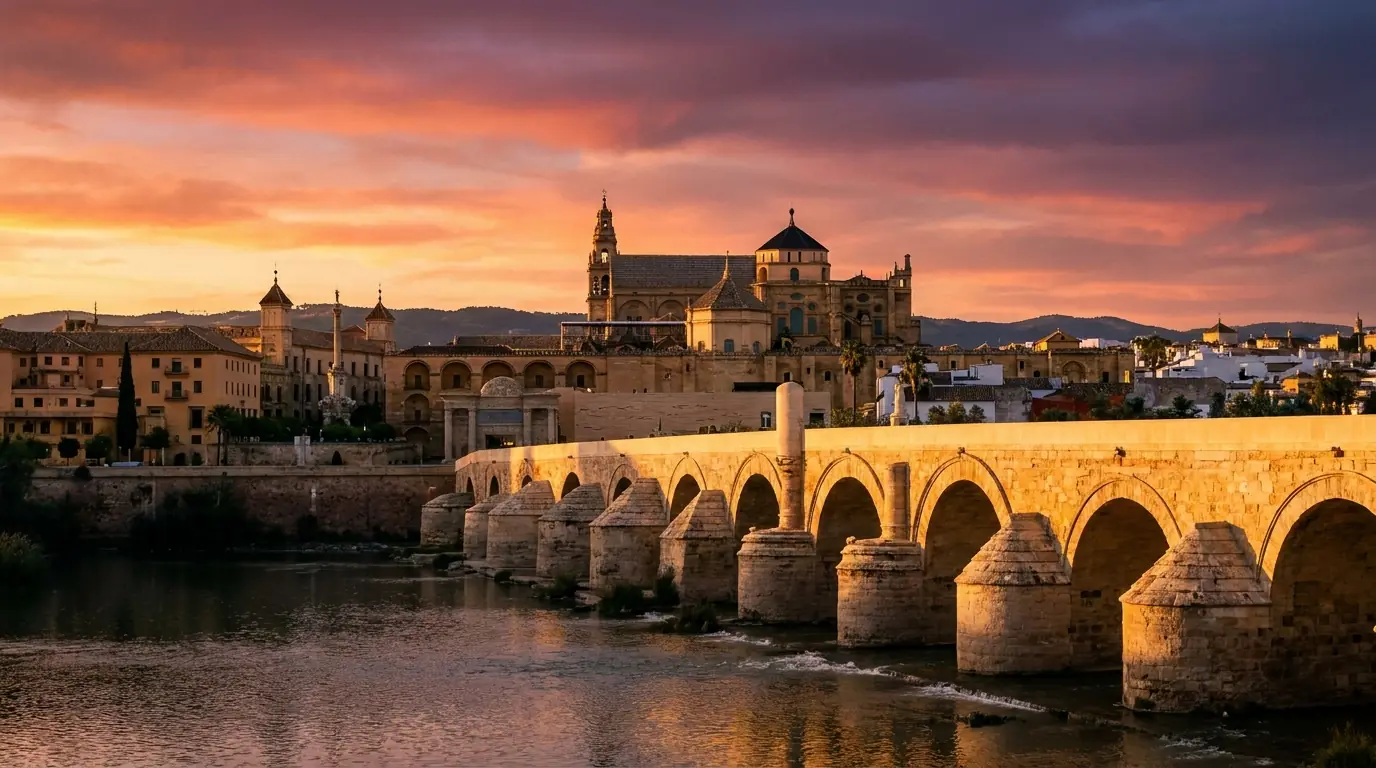
A great mosque begun in the eighth century, with a Renaissance cathedral built into its centre after the Christian conquest, the Mezquita sits at the heart of a UNESCO World Heritage site.
- The prayer hall is a forest of red-and-white striped double arches on hundreds of marble and granite columns.
- The mihrab, the prayer niche, is decorated with gold mosaics, one of the finest works of Islamic art in Europe.
- The cathedral nave rises in the middle, a striking contrast with the arches around it.
- The Patio de los Naranjos, the courtyard of orange trees, and the bell tower, which you can climb for the view.
Go at opening time, before the tour groups arrive from Seville and the coast. Allow at least an hour and a half inside, and dress respectfully: it is a working cathedral.
Tickets and timing
Buy Mezquita tickets online or at the gate; the queue is shortest at opening time and in the last hour before closing. Mass is held in the cathedral on some mornings, when visits may be limited, so check the official hours before planning the day. Audio guides help make sense of the building’s many phases.
The bell tower
The bell tower, built around the old minaret, is climbed by timed groups and gives the best view of the Mezquita’s roofs, the Judería and the river. Tickets are separate and limited, so book them with the main entry.
The Judería: the old Jewish quarter
Wrapped around the Mezquita, the old Jewish quarter is a maze of whitewashed lanes, small squares and patios.
- The Synagogue, from the fourteenth century, is one of only three medieval synagogues surviving in Spain.
- The Calleja de las Flores is a tiny lane hung with flower pots, framing the Mezquita’s bell tower.
- The statue of Maimonides, the Jewish philosopher born in Córdoba, stands in a small square.
- Craft shops sell the city’s traditional embossed leather and silverwork.
A walk through the Judería
- Start at the Puerta de Almodóvar, one of the old city gates.
- Follow Calle Judíos to the Synagogue and the statue of Maimonides.
- Cut through to the Calleja de las Flores for the view of the bell tower.
- Finish at the Mezquita’s northern walls and the Patio de los Naranjos.
The Judería is also where most of Córdoba’s small hotels and guesthouses sit, many in old houses built around their own patios. Staying inside the quarter puts the Mezquita a few minutes away and the lanes to yourself after dinner.
The lanes are prettiest early in the morning and in the evening, when the day visitors have left and the whitewash glows in the low sun.
The Alcázar and the Roman bridge
Both stand by the river, a few minutes’ walk from the Mezquita.
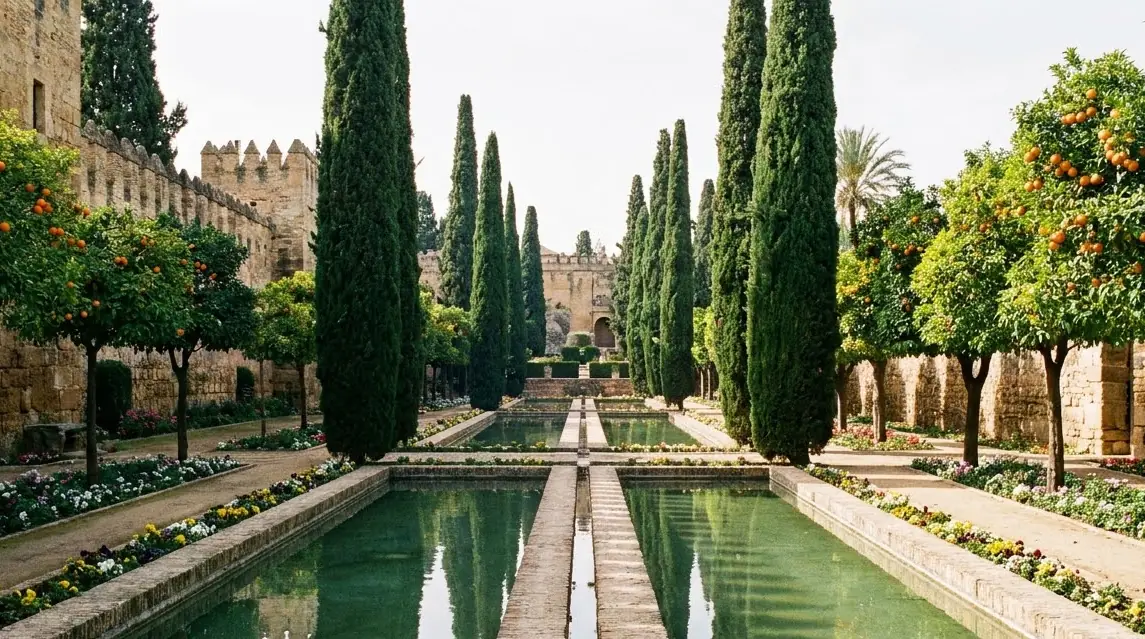
- The Alcázar de los Reyes Cristianos was a residence of the Catholic Monarchs; its terraced gardens of pools, cypresses and orange trees are the highlight.
- The Roman bridge crosses the Guadalquivir to the Calahorra tower, now a small museum of Córdoba’s past.
- The riverside walk below the bridge is the classic sunset view back to the Mezquita.
The Calahorra tower
The Calahorra tower, a fortified gate at the far end of the Roman bridge, houses a small museum about the three cultures, Muslim, Jewish and Christian, that shared medieval Córdoba. Its roof gives a view straight back across the river to the Mezquita.
The patios and the Palacio de Viana
Private courtyards of whitewashed walls hung with flower pots are Córdoba’s other great sight, and at the Patios festival in May their owners open them to visitors.
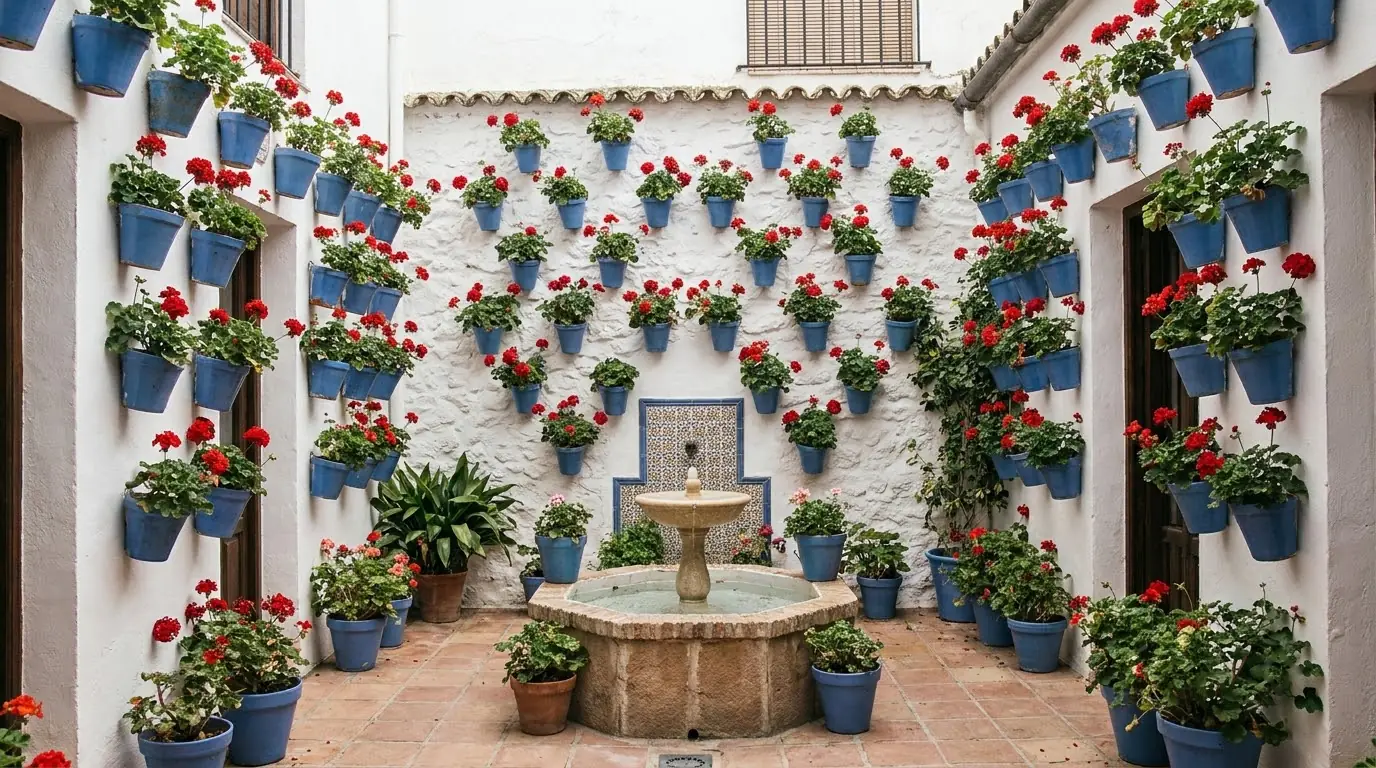
- The Patios festival, held in May, is on UNESCO’s list of intangible heritage; dozens of private patios open for free.
- The Palacio de Viana, a palace with a dozen patios, can be visited all year.
- The San Basilio and Santa Marina neighbourhoods have the most famous patios.
- Outside May, some patios open in small groups on guided visits.
May crosses and the fair
May is Córdoba’s festival month. The Cruces de Mayo, flower-covered crosses set up in squares with music and bars, come first; the Patios festival follows; and the city’s fair closes the month with tents, dancing and horses on the fairground by the river.
In May, the city is at its busiest, with the patios, the May crosses and the fair in quick succession; book rooms early and expect queues at the best-known patios.
Museums
Córdoba’s smaller museums fill a second day or a hot afternoon: the Archaeological Museum, built over the remains of a Roman theatre; the museum of the painter Julio Romero de Torres, a local favourite; and the Bullfighting Museum in the Judería, housed in a fine old mansion.
Córdoba at night
At night the Mezquita’s walls are lit, the Judería empties and the riverside fills with walkers. A sound-and-light show is held inside the Mezquita on many evenings; check the official programme and book ahead, as places are limited.
Medina Azahara and day trips
The ruined palace city of the caliphs, and a few towns nearby, fill the second day of a Córdoba trip.
- Medina Azahara, about 8 km west of the city, was built in the tenth century and destroyed within a century; it is a UNESCO World Heritage site since 2018, reached by tourist bus or taxi.
- Seville, under an hour away by high-speed train, for the Alcázar and the cathedral.
- Granada, about 1 hour 30 minutes by train, for the Alhambra.
- The white hill towns of the Sierra Subbética, such as Priego de Córdoba, by car.
Visiting Medina Azahara
At Medina Azahara, start at the visitor centre, which explains the site with models and finds, then take the shuttle up to the ruins. The reconstructed Hall of Abd al-Rahman III, with its carved arches, is the highlight. Allow half a day, and go early in summer: there is little shade on the terraces.
Book trains on Renfe. For Seville’s side of the trip, see day trips from Seville.
Eating in Córdoba: salmorejo and flamenquín
The city has its own dishes and a strong tapas culture, which makes it worth staying for dinner.
- Salmorejo, a thick cold soup of tomato, bread and oil topped with egg and ham, comes from Córdoba.
- Flamenquín is ham and pork rolled, breaded and fried.
- Rabo de toro, slow-cooked oxtail, is a classic in the old taverns.
- Montilla-Moriles, the local wine, is often served as a fino-style aperitif.
Tapas taverns
Córdoba’s old taverns, many with tiled walls and wine barrels, serve tapas and raciones with glasses of Montilla. Order salmorejo, flamenquín and berenjenas con miel, fried aubergine with molasses, and share them across the table.
The taverns around the Plaza de la Corredera and in the San Basilio quarter are more local than the restaurants beside the Mezquita.
One day or two in Córdoba
The city works as a day trip but rewards a night, which makes this the main planning choice.
One day in Córdoba
- Morning: the Mezquita at opening time, then the bell tower.
- Late morning: the Judería, the Synagogue and the Calleja de las Flores.
- Lunch: salmorejo and flamenquín in a tavern away from the Mezquita.
- Afternoon: the Alcázar gardens, or a rest in summer.
- Evening: the Roman bridge at sunset, then the train back to Seville or Madrid.
Two days in Córdoba
Two days adds Medina Azahara in the morning and the patios, the Palacio de Viana and the Plaza de la Corredera in the afternoon, with a second evening in the old town.
Staying the night
Staying the night means walking the Judería after dark, when it is quiet and lit, and reaching the Mezquita at opening time before the day visitors. Small hotels around the Mezquita and in the San Basilio quarter put everything within a few minutes’ walk; the area by the station is more practical for early trains.
Córdoba with children
With children, the Alcázar gardens, the Roman bridge and the patios work well, and the Mezquita’s forest of arches impresses all ages. Keep the visits short in summer and plan a pool or a long rest in the afternoon.
Getting around
The old town is compact and best on foot; the station is about 20 to 25 minutes’ walk from the Mezquita, or a short bus or taxi ride. A tourist bus serves Medina Azahara from the centre, and a car is only useful for the hill towns of the Sierra Subbética.
When to go, and what to skip
Córdoba’s summers are among the hottest in Spain, so timing matters more here than almost anywhere else. These are the 1981-2010 normals for Córdoba airport from AEMET.
- July and August average highs of 36.9°C and 36.5°C; sightsee early and rest from 2pm to 6pm.
- May averages 27.4°C and brings the Patios festival: the best month, and the busiest.
- December is the wettest month, at 111 mm; January averages a 14.9°C high with cold nights.
- Skip a midday visit to the Mezquita in summer: the queue and the heat both peak.
- Skip seeing Córdoba only as a two-hour stop between trains: give it at least a full day.
- Skip driving into the old town: the lanes are narrow and access is restricted.
On a route through Andalusia, Córdoba sits neatly between Seville and Granada: under an hour from the first and about 1 hour 30 minutes from the second by train, which makes a night here an easy way to break the journey.
For the wider route, see the southern Spain itinerary.
Where to stay in Córdoba
Choose the area before the hotel: it sets how much of Córdoba you can reach on foot. The map shows the same property across Booking.com and Agoda, with prices live from them.
Common questions
What is Córdoba best known for?
Córdoba is best known for the Mezquita, the great mosque with a cathedral built inside it, its whitewashed Jewish quarter, the flower-filled patios of its May festival, and its Roman bridge over the Guadalquivir. Its historic centre is a UNESCO World Heritage site.
Is one day enough for Córdoba?
One day is enough for Córdoba’s essentials: the Mezquita at opening time, the Judería, the Alcázar gardens and the Roman bridge at sunset. A second day adds Medina Azahara and the patios at a slower pace, and lets you see the old quarter quiet in the evening.
When is the best time to visit Córdoba?
The best time to visit Córdoba is spring, especially May for the Patios festival, with a 27.4°C average high according to AEMET. Avoid July and August if you can, when highs average 36.9°C and 36.5°C, among the hottest in Spain.
How do you get from Seville to Córdoba?
You get from Seville to Córdoba by high-speed train in under an hour, from Santa Justa station. Trains run often through the day; book ahead at weekends. The station is about 20 to 25 minutes’ walk from the Mezquita, or a short bus or taxi ride.
Is Medina Azahara worth visiting?
Medina Azahara is worth visiting for anyone interested in Moorish Spain: the ruins of a tenth-century palace city, with horseshoe arches and terraces below the hills, about 8 km west of Córdoba. It is a UNESCO World Heritage site and needs about half a day, reached by tourist bus or taxi.
Where should you stay in Córdoba?
Stay in the Judería or the San Basilio quarter, close to the Mezquita, so the old town is a few minutes’ walk and quiet in the evening. Many small hotels there are old houses built around patios. The area by the station suits early trains but is a 20-minute walk from the sights.
Keep planning Córdoba
Written and checked by
Travel Guide Kit Editorial
An editorial desk, not an invented persona. Every opening time, ticket price and transport connection here is checked against the operator’s own website and carries the date it was read. Where a page cannot draw on direct experience, it says so.