Quick answer
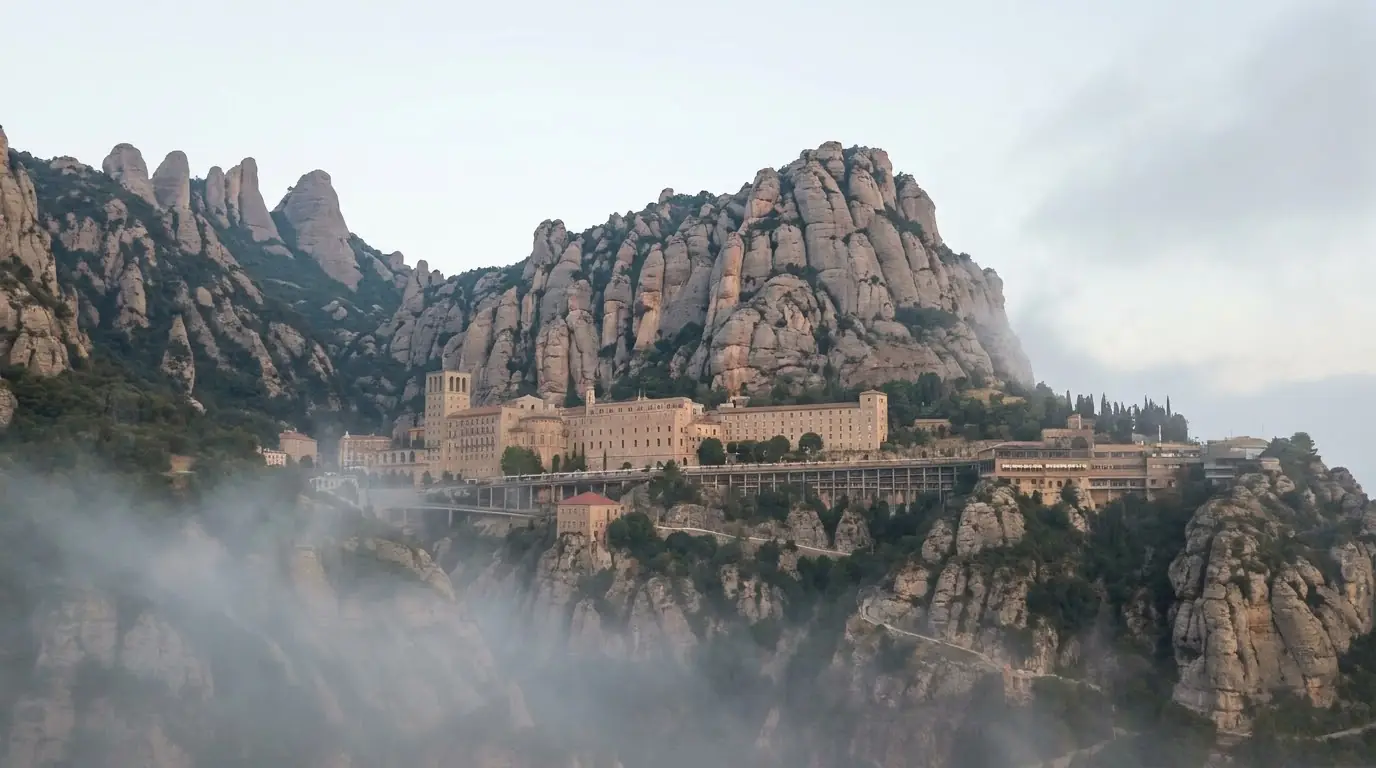
Montserrat is the best day trip from Barcelona, about an hour by train plus a rack railway; Girona, about 40 minutes by high-speed train, is the best city trip, and Sitges the easiest beach day.
The best day trips from Barcelona are Montserrat, about 1 hour by train, and Girona, about 40 minutes by high-speed train; Sitges, 35 minutes away, is the easy beach alternative. All three work without a car. Give each trip its own day, and save the Costa Brava villages for a hire car or a longer stay. Most trains leave from Sants or Plaça d’Espanya, and none of them needs a booking weeks ahead.
Barcelona day trips at a glance
Most trains leave from Sants or Plaça d’Espanya, and only the Costa Brava villages really need a car.
| Day trip | How to get there | Time one way | Best for |
|---|---|---|---|
| Montserrat | FGC R5 from Plaça d’Espanya, then rack railway or cable car | About 1 h to 1 h 20 min | Monastery, mountain walks |
| Girona | High-speed train from Sants | About 40 min | Walled old town, river houses |
| Sitges | Local train from Sants or Passeig de Gràcia | About 35 min | Beaches, old town |
| Tarragona | Train from Sants | About 30 min to 1 hour | Roman amphitheatre and walls |
| Figueres | High-speed train from Sants | About 55 min | Dalí Theatre-Museum |
| Penedès cava cellars | R4 local train to Sant Sadurní d’Anoia | About 45 min | Sparkling wine tastings |
| Costa Brava villages | Hire car or bus | About 1 h 30 min by road | Coves, fishing villages |
High-speed trains need a seat ticket on Renfe; the local Rodalies lines and the FGC trains to Montserrat do not. Times vary by service, so check the departure the day before.
Tour or train?
The train is the better choice for Montserrat, Girona, Sitges, Tarragona and the Penedès: the lines start in the city centre, run through the day and avoid the traffic on the ring roads. Tours earn their place for the Costa Brava villages and Besalú, which are poorly served by public transport.
Combined tours that fit Montserrat and a cava cellar, or Girona and Figueres, into one day exist, but they leave little time at each stop. If you have the days, two separate trips by train see more.
Which day trips suit which season
- Summer: Sitges and the Costa Brava for swimming; start early, as the coastal trains and roads fill at weekends.
- Spring and autumn: Montserrat and Girona, when the walks are cooler and the light is softer.
- September and October: the Penedès, during and after the grape harvest.
- Winter: Tarragona and Figueres, which are mostly indoor or compact sights on dry days.
Montserrat: the mountain monastery
The abbey is a Benedictine monastery set among jagged rock pinnacles, about an hour from Barcelona.
- Take the FGC R5 train from Plaça d’Espanya; change at Monistrol de Montserrat for the rack railway, or get off at Aeri de Montserrat for the cable car.
- In the basilica, the Black Madonna, La Moreneta, is reached by a separate queue; arrive early to keep it short.
- Two funiculars from the monastery lead higher up the mountain: Sant Joan for the ridge walks and Santa Cova down to a chapel in the rock.
- Combined tickets for the train and the rack railway are sold on the official Montserrat site; check what is included before you buy.
Making the most of Montserrat
The monastery terrace fills from late morning with tour groups, so the first train out of Plaça d’Espanya buys the quietest hour of the day. Go up to the ridges first and come back to the basilica later, when the queue for the Black Madonna has usually shortened.
The boys’ choir of the Escolania, one of the oldest in Europe, sings in the basilica on most weekdays around midday; check the schedule on the official site, because it does not sing every day or in the school holidays.
Montserrat is cooler and windier than the city, and the paths are rocky. Bring a layer and shoes with grip, and plan to be back in Barcelona for dinner.
Girona, Figueres and Besalú: north towards France
All three lie north of Barcelona towards France, and Girona is the best city day trip.
Girona
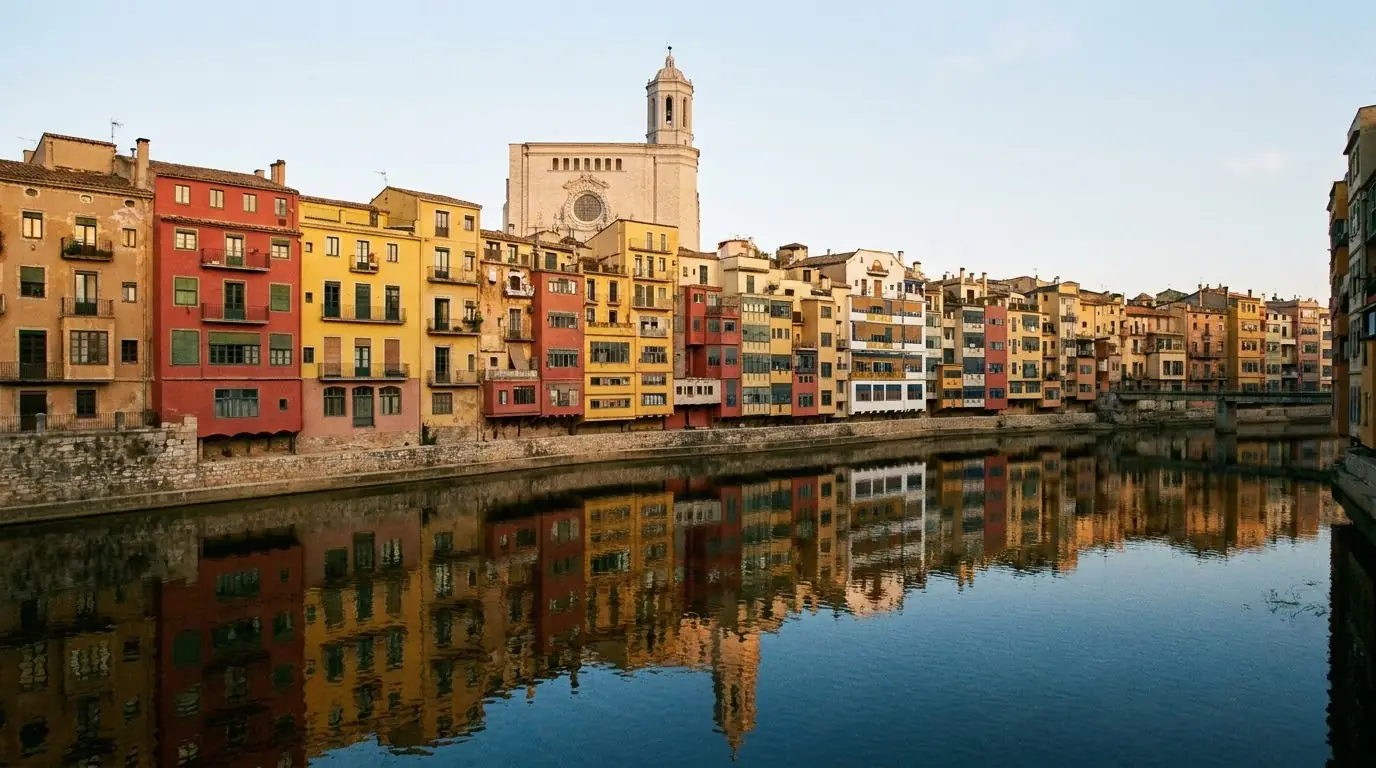
Girona has a compact walled old town on a hill above the Onyar river, lined with houses painted red, yellow and ochre. Climb to the cathedral by its long stairway, walk the medieval walls, and look for the old Jewish quarter, the Call, in the narrow lanes below.
In May, the Temps de Flors festival fills the courtyards, churches and stairways of the old town with flower installations, and the city is at its busiest. The rest of the year, Girona is calm enough that an afternoon on the walls can feel almost private.
Figueres
Figueres, about 55 minutes by high-speed train, is Dalí’s home town and the site of his Theatre-Museum, the artist’s own design, with a red facade topped by giant eggs. It is a half day; pair it with Girona on the way back if you start early. Dalí himself is buried in a crypt beneath the museum stage.
Besalú
Besalú is a small medieval town with a fortified Romanesque bridge over the river, about 30 minutes by car from Girona. Without a car it is hard to reach in a day; with one, it fits easily between Girona and Figueres.
Vic
Vic, inland on the R3 local line, is a market town with one of the largest main squares in Catalonia. Its market fills the square on Tuesday and Saturday mornings, and the town is known for its cured sausages. It suits a quiet half day away from the coast.
Sitges and the coast south of Barcelona
This is the easy beach day, and Sitges is the only trip that works as a half day.
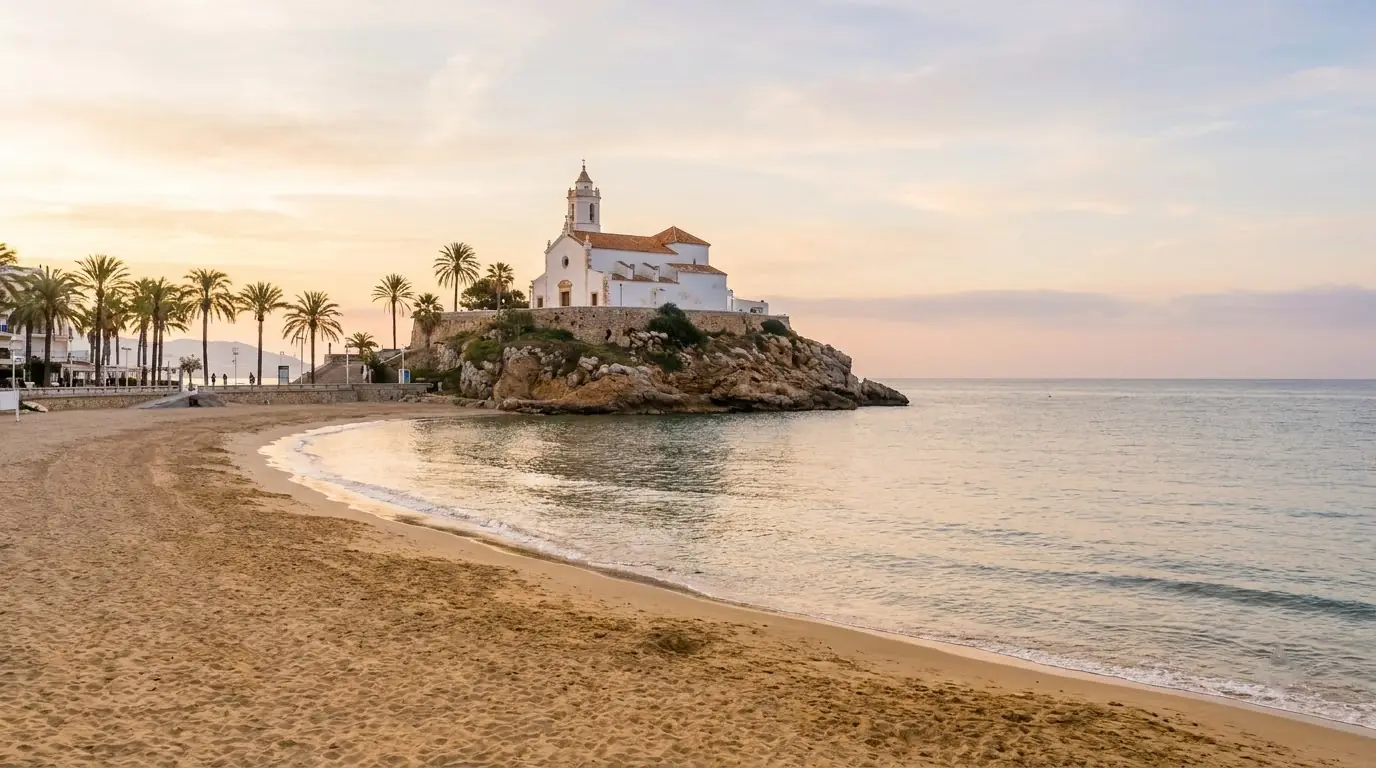
- Sitges has a string of sandy beaches, a white church on a small headland and an old town of whitewashed lanes.
- Local trains from Sants and Passeig de Gràcia take about 35 minutes and run often.
- The town is busiest during its February carnival and on summer weekends.
- Further south, Tarragona combines Roman ruins with a city beach below the amphitheatre.
Sitges also has an October film festival devoted to fantasy and horror cinema, and a lively nightlife that keeps the town busy after the day visitors have gone back to Barcelona.
In summer, leave early: the coastal trains fill up on weekend mornings and the beaches near the station are busiest from late morning.
Tarragona and the Penedès: Roman ruins and cava
Tarragona has Roman ruins by the sea, from the days when it was Tarraco, capital of a Roman province. Its archaeological ensemble is a UNESCO World Heritage site since 2000.
- The amphitheatre sits on a slope above the beach, with the sea behind the arena.
- Parts of the Roman circus survive under and between the buildings of the old town.
- The cathedral at the top of the old town mixes Romanesque and Gothic, with a quiet cloister.
- The Roman walls and the archaeological promenade along them close the loop.
- The Balcó del Mediterrani, at the end of the Rambla Nova, looks straight down over the sea and the beach.
Tarragona is also one of the heartlands of the castells, the human towers of Catalonia, which are built in its main squares during the Santa Tecla festival in late September. Outside the festival, the town museum explains the tradition.
Fast trains take about 30 minutes and regional trains about an hour. The old town is compact, so Tarragona fits comfortably into a day with a long seafood lunch.
Cava country: the Penedès
Cava country, the Penedès, is the wine region west of Barcelona where most of Spain’s sparkling wine is made, and its capital, Sant Sadurní d’Anoia, is about 45 minutes away on the R4 local train.
- Several of the large cava houses are a short walk from the station, with cellar tours and tastings.
- Smaller family producers are spread across the vineyards and need a taxi, a bike or a tour.
- Book tours ahead, especially at weekends and during the harvest in September and October.
If you would rather not drink and drive, the train makes the Penedès one of the easiest wine regions in Spain to visit independently.
The Costa Brava: coves and fishing villages
The coves and fishing villages start about an hour and a half north of Barcelona by road. It is better with a hire car or a night than as a rushed day by bus.
- Tossa de Mar has a walled old town on a headland above a sandy bay.
- Calella de Palafrugell and Llafranc are small whitewashed villages with fishing boats on the sand.
- Cadaqués, near Dalí’s house at Portlligat, is the furthest and the most remote, at the end of a winding road.
- The coastal path, the Camí de Ronda, links several coves on foot.
The Costa Brava is a summer coast: between November and March many hotels and restaurants in the smaller villages close, and the buses run less often. In July and August, the opposite problem applies, with full car parks above the best coves by mid-morning. June and September are the sweet spot.
A week of day trips without a car
The main trips sit on separate train lines that all start in the city, so a week of them needs no car.
- Day 4 of a week: Montserrat, leaving early from Plaça d’Espanya.
- Day 5: Girona, with Figueres in the afternoon if the Dalí museum appeals.
- Day 6: Sitges in the morning and back to Barcelona for a late lunch, or Tarragona for the whole day.
- Day 7: the Penedès for a cava tasting, back in time for a last dinner in the city.
Keep the first three days for Barcelona itself. Between trips, a slow day in the city helps more than a fifth day on trains.
Which day trips to skip, or do differently
The right skips depend on your days, but these plans rarely work:
- Montserrat as an afternoon: the train, the rack railway and the queues take most of a day.
- Girona, Figueres and the Costa Brava in one day: three places seen in a hurry, mostly from buses.
- Andorra as a day trip: it is several hours each way by road through the mountains.
- A day trip on a three-day visit to Barcelona: the city needs three days of its own first.
For the city days around the trips, use the Barcelona itinerary or Barcelona in 3 days, check where to stay in Barcelona near Sants or Plaça d’Espanya, and see things to do in Barcelona for the city itself.
Where to stay in Barcelona
A day trip starts and ends at your base, so sleep near the station or bus stop you will leave from. The map shows the same property across Booking.com and Agoda, with prices live from them.
Common questions
What is the best day trip from Barcelona?
Montserrat is the best day trip from Barcelona: a Benedictine monastery among jagged rock pinnacles, about an hour by FGC train from Plaça d’Espanya plus a rack railway or cable car. Girona, about 40 minutes by high-speed train, is the best city day trip, and Sitges the easiest beach day.
How do you get from Barcelona to Montserrat?
You get from Barcelona to Montserrat on the FGC R5 train from Plaça d’Espanya. Change at Monistrol de Montserrat for the rack railway, or get off at Aeri de Montserrat for the cable car. The trip takes about an hour to an hour and 20 minutes each way.
Is Girona worth a day trip from Barcelona?
Girona is worth a day trip from Barcelona: a walled old town on a hill above the Onyar river, with colourful riverside houses, a cathedral at the top of a long stairway and the old Jewish quarter. The high-speed train takes about 40 minutes, so it also suits a relaxed day.
Can you visit the Costa Brava as a day trip from Barcelona?
You can visit the Costa Brava as a day trip from Barcelona, but it works best with a hire car: the villages are about an hour and a half away by road and poorly linked by bus. Pick one or two, such as Tossa de Mar and Calella de Palafrugell, rather than several.
How many day trips should you take from Barcelona?
Take one day trip from Barcelona on a four-day stay, usually Montserrat or Girona, and two or three on a week, adding Sitges, Tarragona or the Penedès. Barcelona itself needs three days first, and each trip is best on its own day rather than combined.
Keep planning Barcelona
Written and checked by
Travel Guide Kit Editorial
An editorial desk, not an invented persona. Every opening time, ticket price and transport connection here is checked against the operator’s own website and carries the date it was read. Where a page cannot draw on direct experience, it says so.