Quick answer: where to stay in Mallorca
Mallorca has 14,505 licensed holiday-let houses: the north around Pollença and Alcúdia suits families, the Tramuntana couples, the south-east cove days, and Calvià large groups.
There are 14,505 licensed holiday-let houses and villas in Mallorca, and the typical one sleeps 6, according to the Consell de Mallorca register updated in September 2026. Almost 3 in 10 are in the north around Pollença and Alcúdia, the easiest area for a family villa. The Tramuntana suits couples and walkers, the south-east suits cove days, and Calvià has the most large houses. Every area needs a hire car.
Villas in Mallorca by area
The areas differ in size, beaches and how much you will drive. The figures below count houses on the official register of holiday lets, not flats, grouped by the municipalities around each base.
| Area | Licensed houses | Sleep 10 or more | Best for | Watch for |
|---|---|---|---|---|
| North: Pollença, Alcúdia | 4,261 | 10% | families, shallow sandy bays | summer limits on the Formentor road |
| Tramuntana: Sóller, Deià, Valldemossa | 1,530 | 12% | views, walking, couples | steep lanes, rocky coves only |
| South-east: Santanyí, Felanitx, Campos | 2,539 | 15% | coves and Es Trenc | car essential, coves full by late morning |
| East: Manacor, Artà, Capdepera | 2,423 | 11% | coves, caves, Cala Ratjada | longest drive from Palma airport |
| South-west: Calvià, Andratx | 801 | 20% | large groups, sea views, near Palma | the fewest houses |
| Palma and Llucmajor | 1,354 | 17% | city and beach together | more suburban than rural |
| Central plain: Inca, Algaida, Sineu | 1,597 | 13% | quiet fincas, central for touring | a drive to any beach |
- Families with young children: the north, near the long beaches of Alcúdia and Port de Pollença.
- Couples and walkers: the Tramuntana, where nearly 3 in 10 licensed houses sleep 4 or fewer.
- Beach days in small coves: the south-east around Santanyí.
- Groups of 10 to 12: Calvià, Palma or Felanitx, which have the highest shares of large houses.
- Touring the whole island: the central plain, within reach of both coasts.
The north: Pollença and Alcúdia
No other part of Mallorca has more licensed villas: 1,944 houses in Pollença and 961 in Alcúdia. Most sit in the countryside of the two valleys, a short drive from the bays.
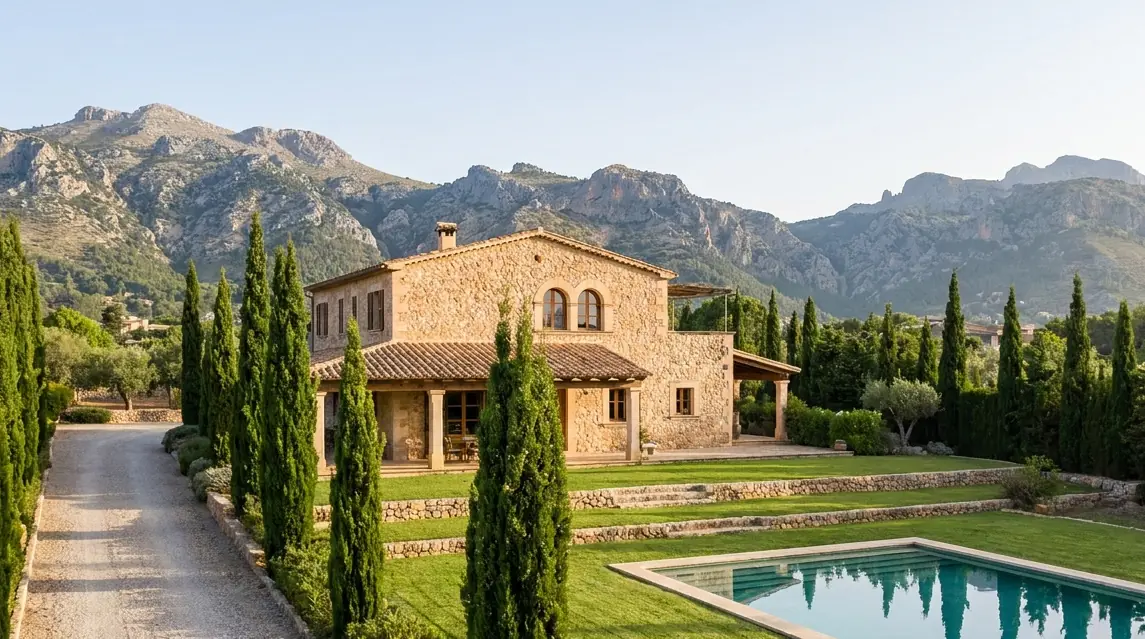
This is the easiest area for a family villa. Port d’Alcúdia has one of the longest shallow sandy beaches on the island, and Port de Pollença has a calm bay with a pine-shaded seafront walk. Pollença town, inland, has its Calvari steps and a Sunday market.
From a villa here, day trips are short: the Formentor peninsula, the walled old town of Alcúdia and the Tramuntana mountains are all close. In summer the road beyond Formentor beach is closed to private cars for most of the day, with a shuttle bus from Port de Pollença instead.
- Ask whether the pool is fenced or has a gate if you travel with small children.
- Check how far the house is from the bay by car, not in a straight line.
- TIB bus 301 links Port de Pollença with Palma, useful for a day without the car.
The Tramuntana: Sóller, Deià and Valldemossa
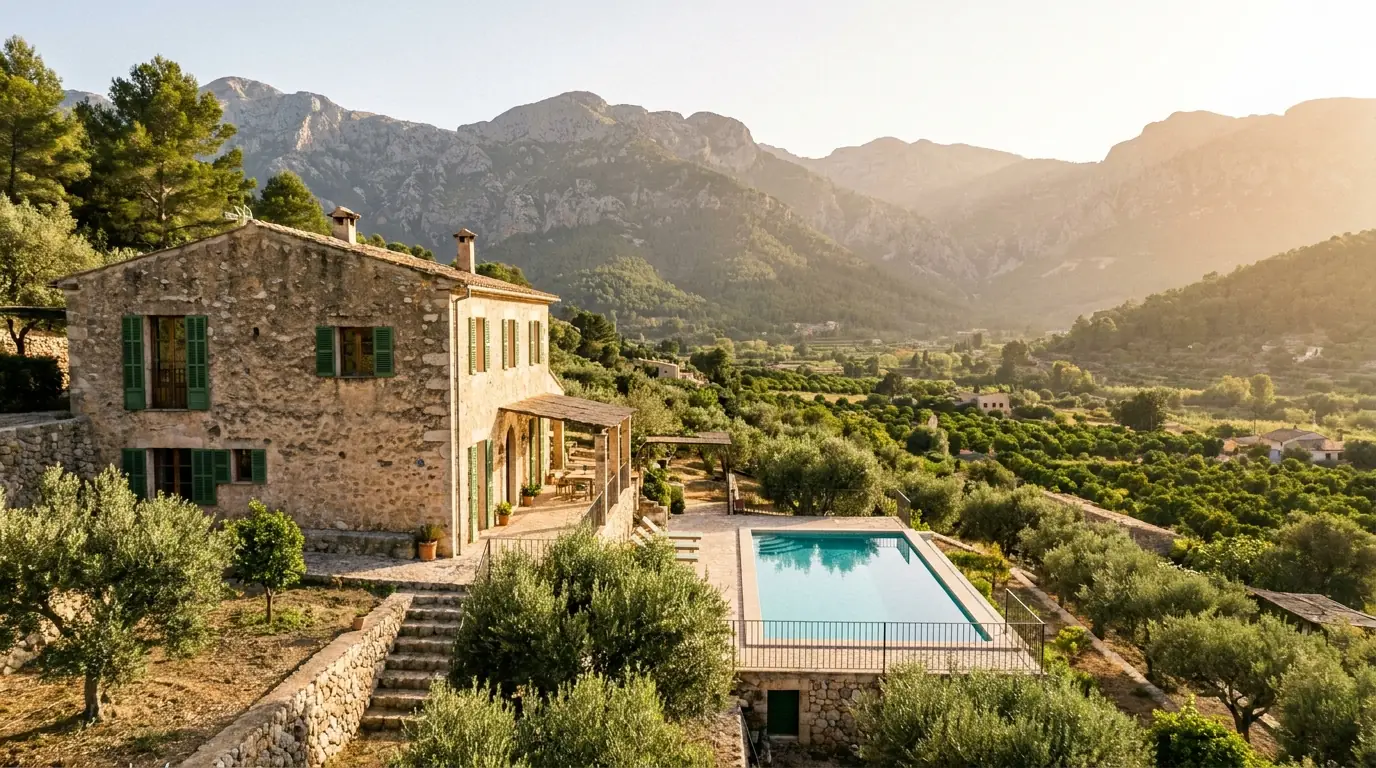
Mallorca’s most photographed stone fincas are in this mountain range along the north-west coast, listed by UNESCO: green shutters, olive terraces and views down to the sea.
It has fewer licensed houses than the coasts: 440 in Sóller, 128 in Valldemossa, 104 in Deià and 100 in Fornalutx. They are also smaller, with 28% sleeping 4 or fewer, the highest share on the island. That makes the Tramuntana the best area for a couple or a small family.
Sóller is the practical base, linked to Palma by the historic train in about 65 minutes and to its port by tram. Deià and Valldemossa are quieter still. The coast below is cliffs and rocky coves, so a villa pool matters more here than anywhere else.
Access roads in the mountains
Access roads in the mountains are the thing to check. Many fincas sit up narrow tracks or steep lanes off the main road. Ask for the route before you book, and whether a large hire car will fit, especially after dark.
The south-east and the east coast
A third of Mallorca’s licensed houses, 4,962, are on these two coasts, spread behind the small coves of turquoise water between pine and rock.
Santanyí, Felanitx and Campos
Santanyí, Felanitx and Campos are the south-east villa towns, with 1,105, 701 and 524 licensed houses. Santanyí is a stone town with a market and restaurants; Cala Mondragó and other coves are close, and Es Trenc, a long natural beach, is reached from Ses Salines and Colònia de Sant Jordi.
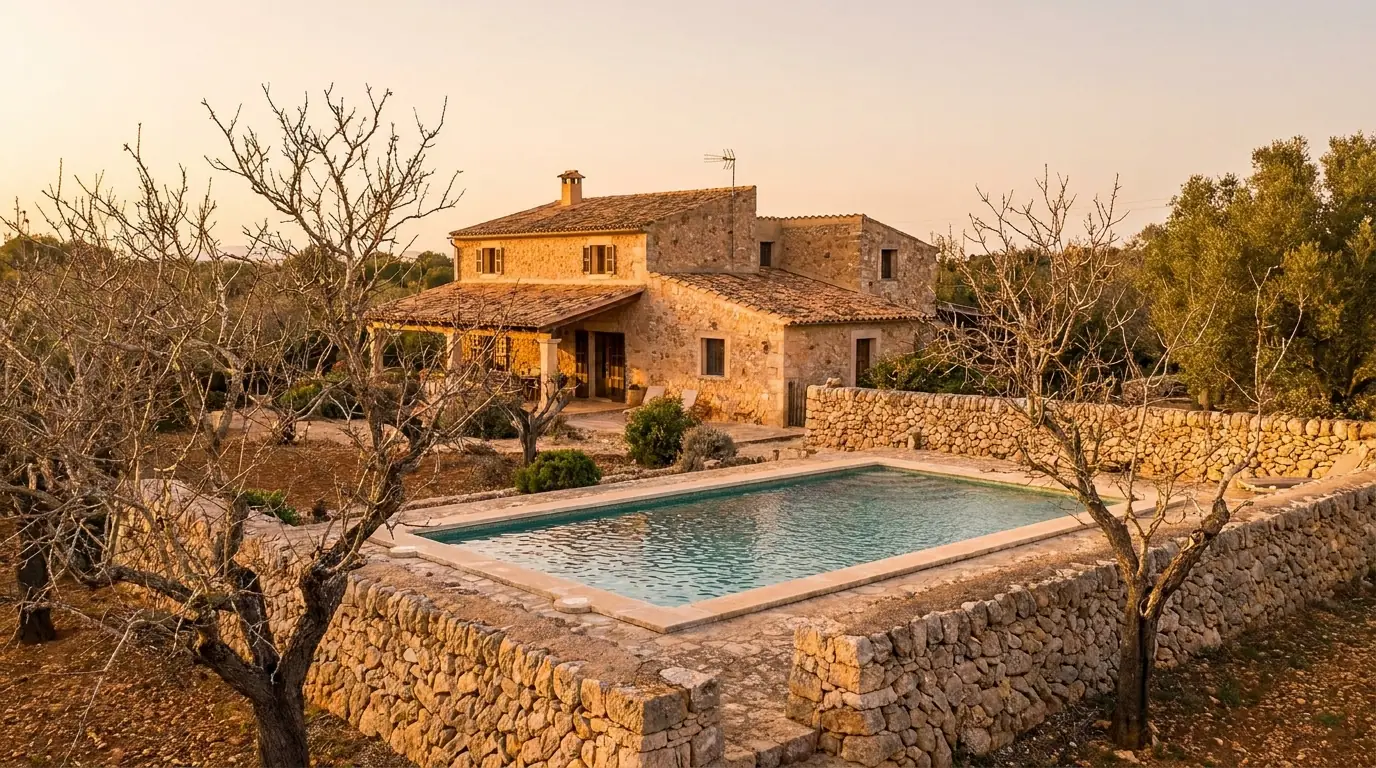
Felanitx has one of the highest shares of large houses, with 17% sleeping 10 or more. This coast depends on a car: buses are thin, and the cove car parks fill by mid-morning in July and August, so go early and spend the afternoon at the villa.
Manacor, Artà and Capdepera
Manacor, Artà and Capdepera cover the east, with 834, 534 and 473 licensed houses. Cala Ratjada, at the north-east tip, is the liveliest base, and Porto Cristo has the Caves of Drach. This is the far side of the island from Palma airport, so allow for the longest transfer.
Calvià, Andratx and the central plain
These are the two less obvious choices: one for big groups and sea views, the other for quiet countryside in the middle of the island.
Calvià and Andratx
Calvià and Andratx, in the south-west, have only 801 licensed houses, but they are the largest: 24% of those in Calvià sleep 10 or more, the highest share in Mallorca. Hillside villas look over the sea, and Palma and the airport are close.
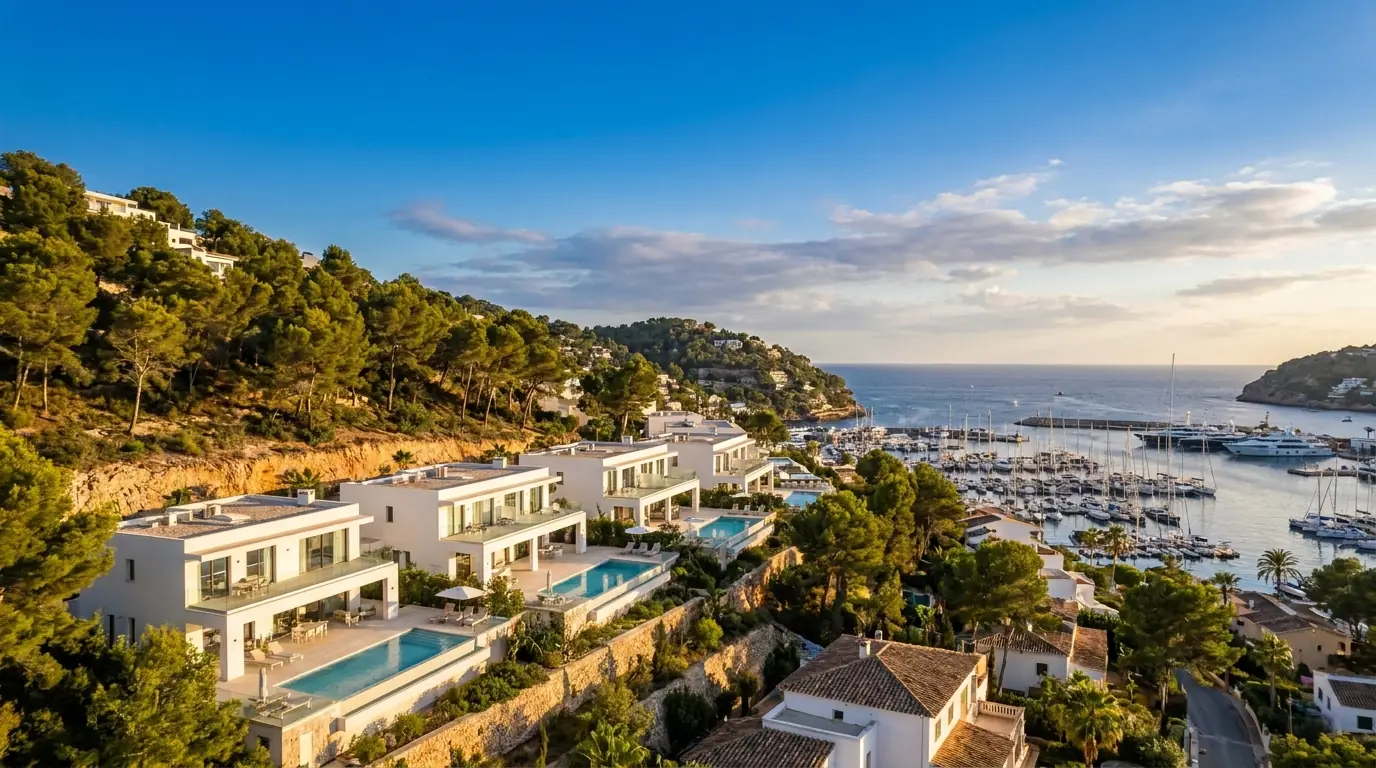
Port d’Andratx is a smart marina with restaurants, linked to Palma by TIB bus 101. Calvià also includes the nightlife strip of Magaluf, so check exactly where a house is if you want a quiet week.
The central plain
The central plain, Es Pla, has 1,597 licensed houses across small farming towns such as Inca, Algaida and Sineu. Many are restored stone farmhouses among almond trees and fields, with no sea view but central for touring.
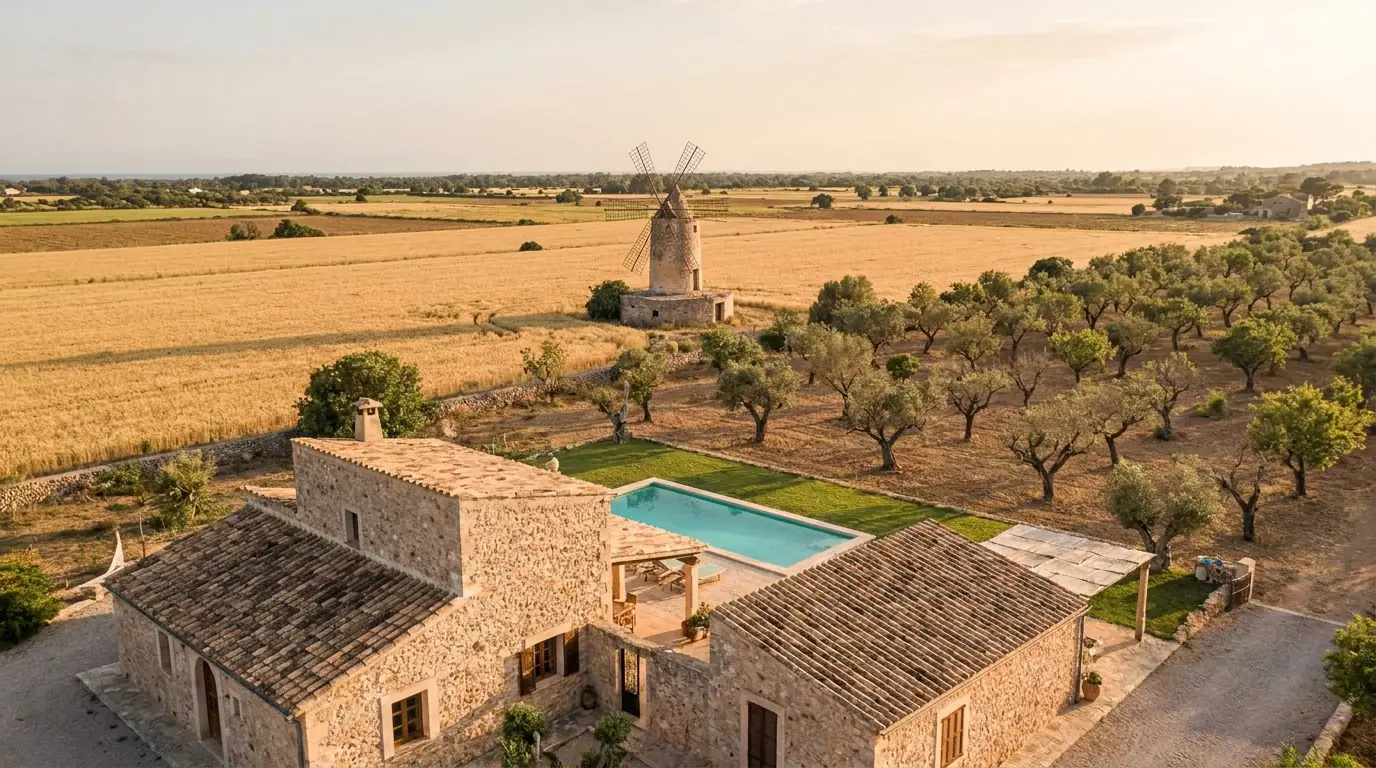
From the plain, both coasts and Palma are within reach for day trips, so it suits a week of exploring rather than a week on one beach. Every beach is a drive away, so the pool is the place to cool off in the afternoon.
What to check before you book a villa in Mallorca
Five things matter: the licence, the group size, the tax, the pool and the car.
- The licence number. Legal holiday lets are on the Consell de Mallorca register, with a number starting ETV, ETVPL or VT. The register is published as open data, with the municipality, rooms and places of each house. If a listing shows no number, ask for it.
- Group size. The register records how many guests each house is licensed for, and 99.7% of houses are licensed for 12 or fewer. A group of 14 needs two houses, not one with extra beds.
- The tourist tax. Holiday homes pay €2 per guest per night from May to October and a quarter of that from November to April; the rate halves from the ninth night, and under-16s are exempt (Balearic law 2/2016).
- The pool. Ask whether it is heated: at Palma airport, nights average 11°C in May and 13°C in October (AEMET), so an unheated pool is cold outside summer.
- Air conditioning. July and August highs average 31°C, so check that the bedrooms, not only the living room, are cooled.
- The car, parking and the drive from the airport, which decide the first and last day of the holiday.
- The terms: minimum stay, changeover day, deposit and what is included, such as cleaning and pool care.
When a villa in Mallorca is the wrong choice
In these cases a hotel or an apartment serves better:
- Without a car. Every villa area needs one; without it, stay in Palma, Sóller or Port de Pollença instead.
- For two or three nights. Shopping, cooking and the drive eat into a short stay; a town hotel works better.
- For a group of more than 12, unless you book two houses close together.
- For a first visit centred on Palma, its old town, restaurants and the train to Sóller.
- In winter, when highs are about 15°C and pools are cold; a town base suits better then.
For the hotel areas, see where to stay in Mallorca; for the season, see the best time to visit Mallorca; and to plan the days out from a villa, the Mallorca itinerary. The island overview is in the Mallorca guide, and other islands and regions are in the Spain guide.
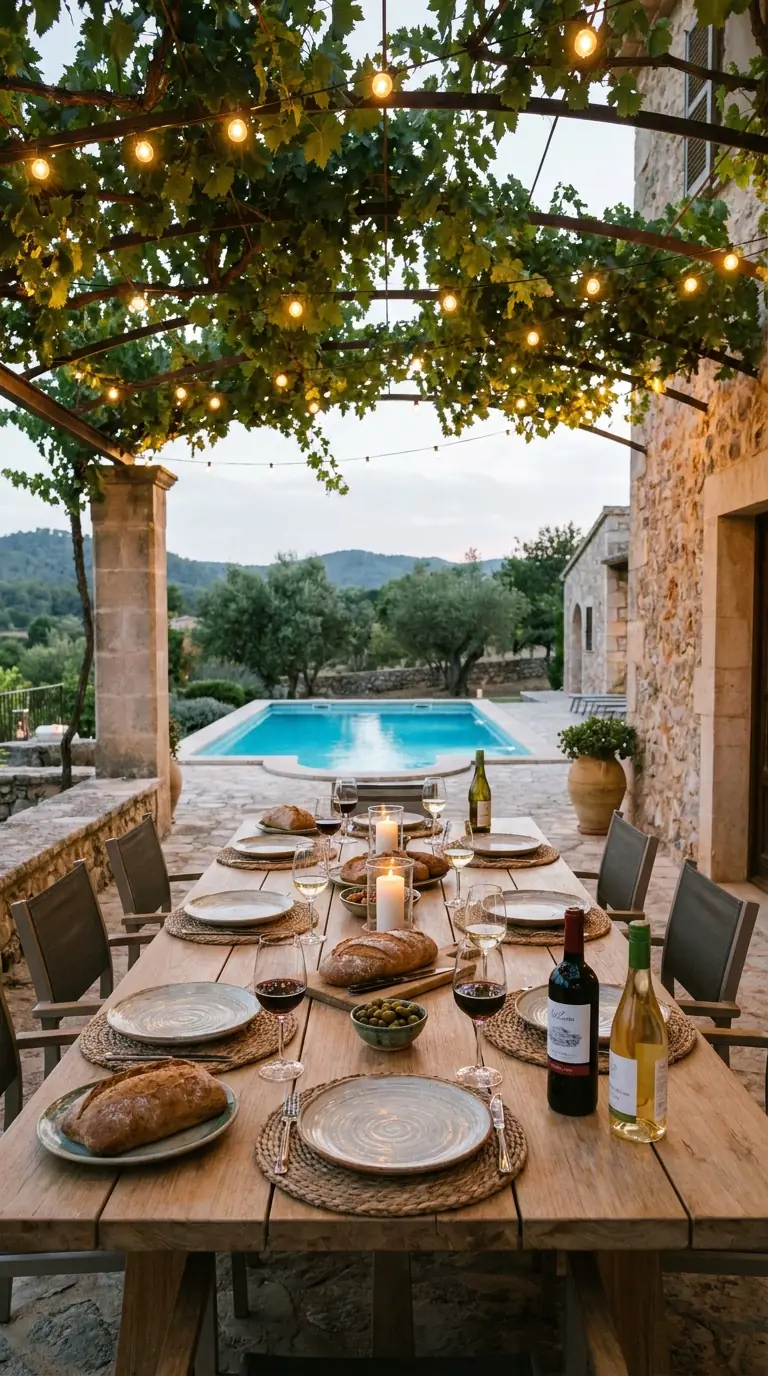
This page compares areas, not individual houses: we do not name villas we have not assessed, and the illustrations show the style of each area, not a specific property. Read the editorial policy for how facts are checked.
Every hotel in Mallorca on one map
Prices and availability come live from the booking sites
Common questions
How many holiday villas are there in Mallorca?
Mallorca has 14,505 houses licensed as holiday lets on the Consell de Mallorca register, updated in September 2026, not counting flats. Pollença has the most, with 1,944, followed by Santanyí and Alcúdia. The typical licensed house sleeps 6, and only 12.6% sleep 10 or more.
What is the best area for a villa in Mallorca?
The best area for a villa in Mallorca depends on the trip. The north, around Pollença and Alcúdia, suits families with its shallow sandy bays; the Tramuntana suits couples and walkers; the south-east suits cove days; and Calvià suits large groups, with the most houses sleeping 10 or more.
How do you check that a Mallorca villa is licensed?
Ask for the registration number, which starts ETV, ETVPL or VT, and look it up in the Consell de Mallorca register, published as open data. It lists the municipality, rooms and number of guests for each licensed house. A listing with no number, or more guests than the register allows, is a warning sign.
How much is the tourist tax for a villa in Mallorca?
The tourist tax for a villa in Mallorca is €2 per guest per night from May to October and €0.50 from November to April. The rate halves from the ninth night of a stay, and guests under 16 pay nothing. Some owners add it to the booking, others collect it on arrival.
Do you need a car for a villa holiday in Mallorca?
Yes, a car is needed for a villa holiday in Mallorca, because most licensed houses are in the countryside and buses are thin outside Palma, Sóller and Port de Pollença. Book it with the villa for July and August, and check that the access road suits the size of car.
When is the best time for a villa holiday in Mallorca?
The best time for a villa holiday in Mallorca is June or September, when highs are about 28°C at Palma airport and the sea is warm. July and August are hotter, at 31°C, and busier. In May and October, ask for a heated pool, because nights fall to 11–13°C.
Keep planning Mallorca
Written and checked by
Travel Guide Kit Editorial
An editorial desk, not an invented persona. Every opening time, ticket price and transport connection here is checked against the operator’s own website and carries the date it was read. Where a page cannot draw on direct experience, it says so.