
Quick answer
A 7-day southern Spain itinerary gives three days to Seville, one to Córdoba and three to Granada by train; ten days adds Ronda and Málaga, and two weeks adds Cádiz and the white towns.
A 7-day southern Spain itinerary gives 3 days to Seville, 1 to Córdoba and 3 to Granada, all linked by train in under 2 hours a leg. With 10 days, add Málaga and Ronda; with 2 weeks, add Cádiz, Jerez and the white towns by car. Book the Alhambra first, because its timed tickets decide the Granada days, and the rest of the route can move around them.
The southern Spain itinerary at a glance
Andalusia’s great cities lie in a rough line from Seville in the west to Granada in the east, with Málaga on the coast below them.
| Length | Route | Best for |
|---|---|---|
| 7 days | Seville 3, Córdoba 1, Granada 3 | The great monuments by train |
| 10 days | Seville 3, Córdoba 1, Granada 2, Ronda 1, Málaga 3 | Cities plus the coast |
| 14 days | Cádiz and Jerez 2, Seville 3, Córdoba 1, Granada 3, white towns 2, Málaga 3 | A slow loop with a car |
Arriving and leaving
Andalusia has three useful airports: Málaga, the busiest, with the most international flights; Seville; and the smaller Granada airport. From Madrid, the high-speed train reaches Seville in about two and a half hours and Málaga in under three, so a southern route also fits after a few days in the capital.
Each version runs one way, so fly into Seville and out of Málaga, or the reverse. Book the faster trains on Renfe a few days ahead; the direct services between Córdoba, Granada and Málaga run only a few times a day.
Where to sleep on this route
A plan built one area at a time only works if you sleep near those areas. The map shows the same property across Booking.com and Agoda, with prices live from them.
Seven days in southern Spain: Seville, Córdoba and Granada
A week covers the three great cities of Andalusia, Seville, Córdoba and Granada, without a car.
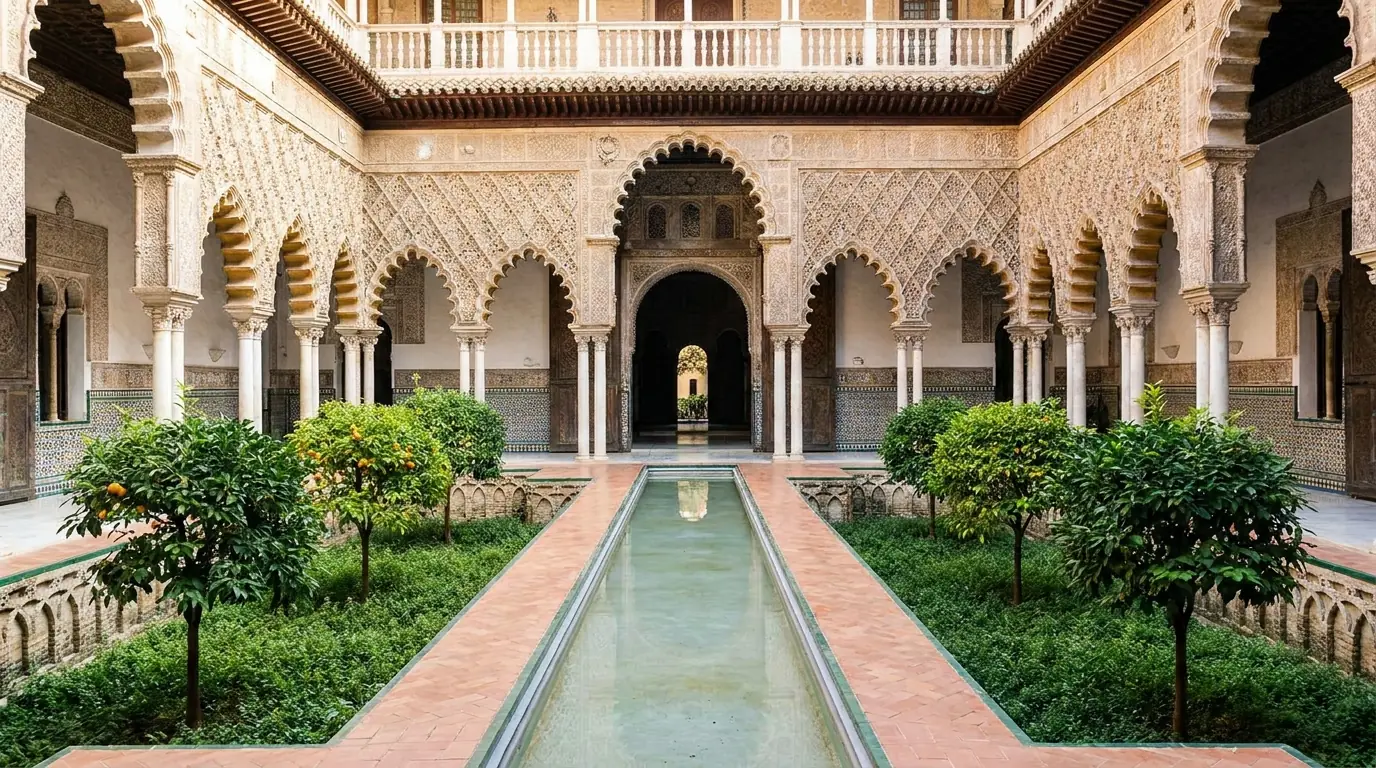
- Day 1, Seville: the Real Alcázar at opening time, the cathedral and the Giralda, Santa Cruz in the evening.
- Day 2, Seville: the Plaza de España, María Luisa park and the river, then Triana for sunset and dinner.
- Day 3, Seville: Las Setas, the palaces of the north and a flamenco show at night.
- Day 4, Córdoba: under an hour by train; the Mezquita at opening time, the Judería and the Roman bridge; stay the night.
- Day 5: the train to Granada, about 1 hour 30 minutes, then the Albaicín at sunset from the Mirador de San Nicolás.
- Day 6, Granada: the Alhambra, with a timed slot for the Nasrid Palaces.
- Day 7, Granada: the cathedral and the Royal Chapel, then the flight home or the bus to Málaga airport.
Staying a night in Córdoba rather than visiting from Seville means seeing the Mezquita early, before the tour groups arrive from the coast, and walking the lit-up Judería after dark. For Seville in more depth, see the Seville itinerary.
The Alhambra day
The Alhambra day needs more planning than any other on the route. Book the Nasrid Palaces slot on the official Alhambra site as soon as your dates are fixed, then build the day around it: the Alcazaba fortress and the Generalife gardens before or after, and a long lunch in between.
Allow most of a day for the whole complex, wear shoes for gravel paths and hills, and plan the Albaicín for the evening, when the view back to the Alhambra turns red at sunset.
Seven days from Málaga instead
If your flights use Málaga, run the week the other way: two days in Málaga, two in Granada, then Córdoba and three days in Seville, flying home from Seville. The trains east of Córdoba are fewer, so check the Granada connections first.
Ten days: add Málaga and Ronda
Málaga and Ronda join the route, which becomes a line ending at Málaga airport, the busiest in the region.
- Days 1 to 4: Seville and Córdoba, as in the seven-day route.
- Days 5 and 6, Granada: the Albaicín, the Alhambra and the cathedral.
- Day 7: Ronda, by bus or by train via Antequera, for the gorge, the Puente Nuevo and a night in the old town.
- Day 8: the train from Ronda to Málaga, about 1 hour 45 minutes to 2 hours, then the old town in the evening.
- Days 9 and 10, Málaga: the Alcazaba, Gibralfaro and the Picasso Museum, and a last afternoon on the beach.
Why stay the night in Ronda
Ronda fills with day visitors from the coast between late morning and late afternoon. Staying the night means the bridge and the gorge at sunset, the old town quiet in the evening, and an early walk down to the viewpoints below the bridge before the coaches arrive.

Ronda is the stop that makes this version: a night there lets you see the gorge and the bridge after the day visitors have gone. For Málaga’s sights and trips, see day trips from Málaga and things to do in Málaga.
Food along the route
Each stop has its own table. In Seville, tapas at the bar: espinacas con garbanzos and salmorejo. In Córdoba, salmorejo again, thicker, and flamenquín, rolled ham and pork fried in breadcrumbs. In Granada, many bars still serve a free tapa with each drink. In Málaga, espetos, sardines grilled on skewers on the beach, and sweet Málaga wine.
Two weeks: Cádiz, Jerez and the white towns
The second week adds the Atlantic coast and the white towns of the hills, and is best with a car.
- Days 1 and 2: Cádiz and Jerez, about 1 hour 30 minutes and 1 hour from Seville by train; old Cádiz on its spit of land, and a sherry bodega in Jerez.
- Days 3 to 5: Seville.
- Day 6: Córdoba, with a night there.
- Days 7 to 9: Granada, with time for the Alhambra, the Albaicín and a slower day.
- Days 10 and 11: the white towns by car, such as Setenil, Zahara de la Sierra and Grazalema, with a night in Ronda.
- Days 12 to 14: Málaga and the coast, with Nerja or Frigiliana for a day.
Cádiz is the surprise of the longer route: one of the oldest cities in western Europe, built on a narrow spit almost surrounded by the Atlantic, with a golden-domed cathedral on the sea wall and a beach at the edge of the old town. Its February carnival is one of the liveliest in Spain.
For the coast and the white towns, pick up a car at the end of the Granada days and drop it in Málaga; the cities are easier on foot and by train, and parking in their old centres is slow and scarce.
The Alpujarra
With an extra day and the car, the Alpujarra villages on the southern slopes of the Sierra Nevada, south of Granada, are among the most beautiful in Spain: flat-roofed white houses stacked on steep hillsides, with walking paths between them. The mountain roads are slow, so stay a night rather than driving back the same day.
Car or train in Andalusia?
The cities are linked by train and bus, while the white towns and the hills need a car.
- Train: Seville, Córdoba, Granada, Málaga, Cádiz and Jerez, with Córdoba under an hour from Seville.
- Bus: Granada and Málaga when the few direct trains do not fit, and Ronda from Seville or Málaga.
- Car: the white towns, the Sierra de Grazalema, the Alpujarra villages south of Granada and the smaller beaches.
- Neither: inside Seville, Córdoba, Granada and Málaga, which are best on foot.
A hybrid usually works best: trains for the first week of cities, then a car for three or four days of villages and coast, collected and returned in different cities.
Where to base yourself
Following the route, rather than staying in one place, keeps the choice of base simple.
- Seville: Santa Cruz or Arenal for a first visit, near the Alcázar and the cathedral.
- Córdoba: the Judería, beside the Mezquita, for one night.
- Granada: near the cathedral for the buses and trains, or the Albaicín for the views, accepting the hills.
- Málaga: the old town or La Malagueta, near the beach.
- Ronda: the old town, south of the bridge, for one night.
Travelling with children
With children, keep the moves to three or four and the sightseeing to the mornings. The Plaza de España’s boats in Seville, the gardens of the Alcázar and the Generalife, and the beaches of Málaga at the end of the route give each day a break. Book rooms with a pool from June to September.
For the area-by-area detail, see where to stay in Seville and where to stay in Málaga.
When to go: the heat decides
Heat sets the timing. These figures are the 1981-2010 normals from AEMET, the Spanish state meteorological agency.
- Seville averages a 36.0°C high in July and 27.2°C in May; inland cities are much hotter than the coast in summer.
- Málaga, on the coast, averages 30.5°C in July and 16.8°C in January.
- March to May and late September to early November are the best windows for the full route.
- Holy Week and Seville’s April Fair fill the cities; book months ahead or choose other weeks.
- November and December bring the most rain, but also the shortest queues at the Alhambra and the Mezquita.
For every month, see the best time to visit Seville and the best time to visit Málaga.
Festivals along the route
Spring is festival season in Andalusia. Holy Week brings processions to every city on the route, Seville’s April Fair fills a whole district with tents and dancing, Córdoba opens its flower-filled patios to visitors in May, and Jerez holds its horse fair in spring. They are the most memorable weeks of the year and the hardest to book.
What not to build a southern Spain trip around
Heat, tickets and too many moves cause the common mistakes:
- Granada without an Alhambra ticket: the Nasrid Palaces are entered by timed slot, sold on the official site weeks ahead in spring and autumn.
- Granada as a day trip from Seville: it is far, and the Alhambra deserves a night.
- Sightseeing in July and August afternoons inland: keep the hours from 2pm to 6pm for rest.
- A new town every night: each move costs half a day; two or three nights per city works better.
- Driving into the old centres: narrow lanes, restricted zones and scarce parking.
Common questions
How many days do you need for southern Spain?
You need seven days for southern Spain’s three great cities, Seville, Córdoba and Granada, by train. Ten days adds Málaga and Ronda, and two weeks adds Cádiz, Jerez and the white towns by car. Fewer than seven days means choosing between Seville and Granada.
What is the best route through Andalusia?
The best route through Andalusia runs one way: fly into Seville, take the train to Córdoba and Granada, continue to Ronda and finish in Málaga for the coast and the airport. Running the other way from Málaga works just as well if your flights suit it.
Do you need a car for southern Spain?
You do not need a car for southern Spain’s cities: trains and buses link Seville, Córdoba, Granada, Málaga, Cádiz and Jerez. A car is worth it for the white towns, the Sierra de Grazalema and the Alpujarra, picked up after the city days rather than at the start.
When is the best time to visit southern Spain?
The best time to visit southern Spain is March to May and late September to early November, when the cities are warm but not hot. Seville averages a 36.0°C high in July, according to AEMET’s 1981-2010 normals, so summer trips need early starts and afternoon rest.
Should you stay in Seville or Granada?
Stay in both: Seville needs three days for the Alcázar, the cathedral and Triana, and Granada two or three for the Alhambra and the Albaicín. If you must choose one base, choose Seville for more to see and Granada for the Alhambra, but the route works best with nights in each.
Can you do southern Spain without driving?
You can do southern Spain without driving: Seville, Córdoba, Granada, Málaga, Cádiz, Jerez and Ronda are all on train or bus routes. What you lose is the white towns of the hills and the Alpujarra, which are hard to reach by public transport. Tours can fill that gap for a day.
Keep planning Andalusia
Written and checked by
Travel Guide Kit Editorial
An editorial desk, not an invented persona. Every opening time, ticket price and transport connection here is checked against the operator’s own website and carries the date it was read. Where a page cannot draw on direct experience, it says so.