Quick answer: where to stay in Lisbon
Baixa and Chiado is the default first-time base: flat, central, and the metro runs under it.
In short
- Baixa and Chiado are the default first-visit base: flat, central, and served by the Baixa-Chiado metro station.
- Príncipe Real and Santos are the quieter choices for a longer stay, each about 15 minutes from the centre.
- Do not book in Alfama with heavy luggage: many doors are up flights of steps that no taxi can reach.
- Lisbon adds a tourist tax of €4 per person per night, up to 7 nights, from age 13.
Stay in Baixa or Chiado on a first visit to Lisbon: both are within about 15 minutes’ walk of the castle hill, Bairro Alto and the river, and the Baixa-Chiado station between them serves 2 metro lines. Alfama is the most atmospheric base and the hardest with a suitcase. Príncipe Real and Santos are quieter for longer stays, and Saldanha is the practical choice for an early flight.
The areas compared
| Area | Best for | Walk to Baixa | At night | Nearest metro or train | Book |
|---|---|---|---|---|---|
| Baixa and Chiado | a first visit | You are in it | Medium | Baixa-Chiado, Rossio | Hotels |
| Alfama and Graça | the old city and the views | 10–20 min, steep | Quiet; loud in June | Santa Apolónia, Tram 28 | Hotels |
| Príncipe Real | a quieter, longer stay | 15 min downhill | Quiet | Rato | Hotels |
| Bairro Alto | going out | 10 min downhill | Loud late at weekends | Baixa-Chiado | Hotels |
| Cais do Sodré and Santos | the river and day trips | 10–20 min, flat | Loud near the bars; Santos quieter | Cais do Sodré (metro and trains) | Hotels |
| Avenida da Liberdade | a calm central hotel | 15–20 min downhill | Quiet | Restauradores, Avenida, Marquês de Pombal | Hotels |
| Saldanha and Avenidas Novas | an early flight | Metro ride | Quiet | Saldanha (red line to the airport) | Hotels |
| Belém | monuments and space | Train or tram | Very quiet | Belém station, Tram 15 | Hotels |
| Parque das Nações | families and late arrivals | Metro ride | Very quiet | Oriente (red line, trains) | Hotels |
Baixa and Chiado: the first-visit base
Baixa and Chiado are where most first visits to Lisbon should start. Baixa is the flat grid of streets between Rossio and the river, rebuilt after the 1755 earthquake; Chiado is the elegant slope just west of it, with the old cafés, bookshops and theatres. Every main sight is a walk or one metro stop away.
The transport is the reason. Baixa-Chiado station is on both the blue and green metro lines, Rossio station has the trains to Sintra, and Cais do Sodré, at the bottom, has the trains to Belém and Cascais. Prices reflect all of this, and the pedestrian streets around Rua Augusta are crowded by day.
- Best for: a first visit of two to four days, and day trips by train.
- Watch for: rooms on Rua Augusta and around Rossio, busy from morning to late evening.
Alfama and Graça: the old city on the castle hill
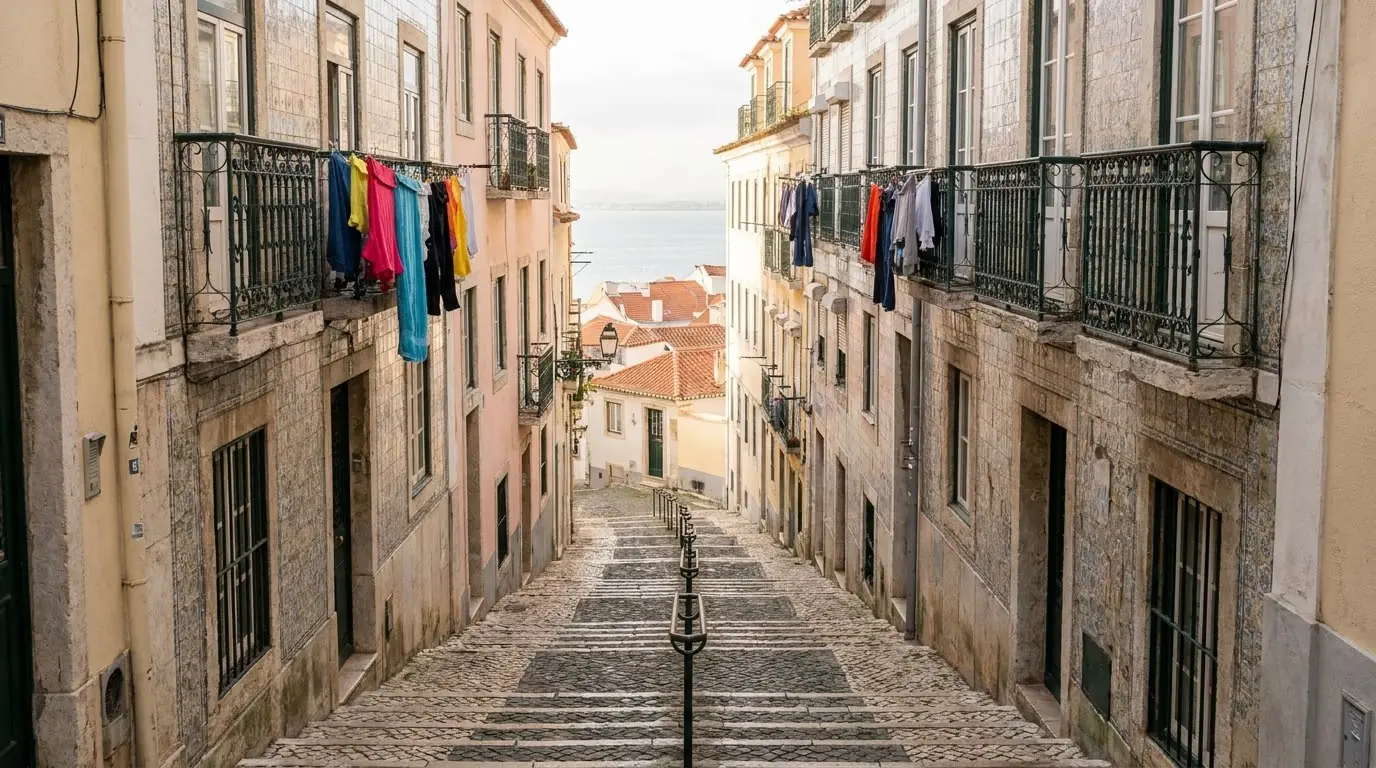
Alfama is the oldest district of Lisbon, the tangle of lanes below the castle that largely survived the 1755 earthquake. Graça, higher up, has the best viewpoints in the city. Staying here means mornings in quiet lanes before the day visitors arrive, and fado drifting out of small restaurants at night.
The cost is access. Many lanes are stairways, taxis stop at the bottom, and Tram 28, the route through the district, is often full by mid-morning. In June, during the Santos Populares, Alfama is the centre of the street festivals, with grills and music until very late, especially on the night of 12 to 13 June.
Mouraria, Intendente and Anjos, on the north side of the castle hill, are the budget version of the old city. They are the most mixed part of Lisbon, with Asian and African groceries, hostels and guesthouses, and Tram 28 starts at Martim Moniz. Rooms cost less; some streets feel rough late at night, so pick a lit, busy one.
Príncipe Real and Bairro Alto: the hill west of Chiado
Príncipe Real is the calm, leafy neighbourhood at the top of the hill west of Chiado, built around a garden square, with independent shops and some of the best small restaurants in Lisbon. It suits a longer stay. The trade is the hill: the walk down to Baixa is easy, and the walk home is uphill.
Bairro Alto, just below it, is the opposite. By day it is a quiet grid of narrow streets; at night it is the city’s bar district, with crowds drinking outside until the early hours, loudest on Friday and Saturday. Stay here only if going out is the point of the trip.
Cais do Sodré and Santos: the river and the trains
Cais do Sodré is the riverside district at the western end of Baixa, and it is the best base for day trips along the coast. The station there has the green metro line, the trains to Belém and Cascais, and the ferries across the Tagus. The Mercado da Ribeira food hall is next door.
Its bar street, Rua Nova do Carvalho, is loud late into the night, so look at Santos, the next district west, instead. Santos is flatter than most of Lisbon, residential, close to the river and about 15 minutes’ walk from Chiado, with design shops and fewer visitors.
Estrela and Lapa, up the hill behind Santos, are the embassy district: large houses, the Estrela Basilica and its garden, and Tram 28 at the door. They are the quietest central base, at the price of a climb and few restaurants after dark.
Avenida da Liberdade, Saldanha, Belém and Parque das Nações: further out, and calmer
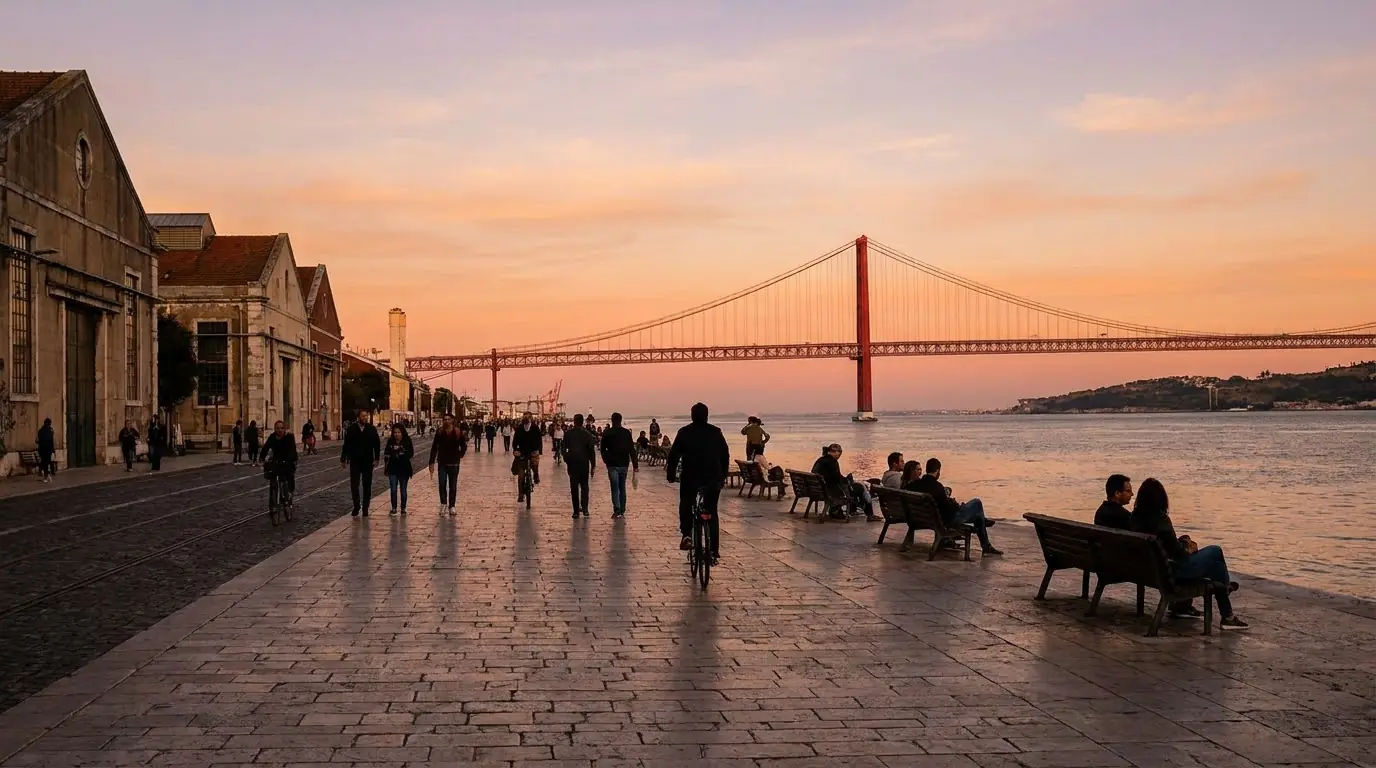
Avenida da Liberdade is Lisbon’s grand boulevard, running north from Restauradores to Marquês de Pombal, lined with large hotels and international shops. It is calm, central enough and about 15 to 20 minutes’ walk from Baixa. The blue metro line runs beneath it; for the airport you change once, at São Sebastião.
Saldanha and the Avenidas Novas, further north, are the modern business district: less charm, lower prices and the red metro line, which runs straight to the airport. Belém, 6 km west on the river, has the Jerónimos Monastery and the Belém Tower and very quiet nights, 8 minutes by train from Cais do Sodré.
Parque das Nações, the former Expo 98 site on the river to the east, is modern Lisbon: wide flat promenades, the Oceanário, newer hotels and Oriente station, with long-distance trains and the red metro line three stops from the airport. It suits families and late arrivals; the old city is a metro ride away, with one change.
Getting around: the airport, the hills and the day trips
Getting from Lisbon airport to the centre is quickest by metro. Aeroporto station is the end of the red line, open from about 06:30 to 01:00. The red line reaches Saldanha directly; for Baixa, Chiado or Avenida da Liberdade, change to the green line at Alameda or the blue line at São Sebastião.
- Lisbon is built on seven hills. Count the climb, not just the distance, when a listing says ten minutes’ walk.
- Trams 28 and 15 and the funiculars help with the hills, but they are slow and crowded at peak times.
- For Sintra by train, Rossio station is the start, about 40 minutes away; for Cascais and Belém, Cais do Sodré.
Check the building as well as the area. Much of central Lisbon is four- and five-storey houses from the late 1700s and 1800s, and many guesthouses and holiday flats have no lift. Cobbled streets and trams carry sound, so a room at the back is quieter than one over the street. Both are worth asking about before you pay.
When to book early, and what the stay costs on top
Book early for June, when the Santos Populares fill Alfama, Graça and Mouraria, and for August. Summer nights are warm: in August the mean high is 28.8°C and about 7 nights stay above 20°C (IPMA, Lisboa Geofísico, 1991-2020), so air conditioning matters more than a top-floor view. November, the wettest month at 134 mm, is the cheapest.
Lisbon’s municipal tourist tax is €4 per person per night for guests aged 13 and over, capped at 7 consecutive nights, or €28 per guest. It is collected by the hotel or holiday flat, and is often shown apart from the room price when you book.
To plan the days around the room, see how many days to spend in Lisbon and the best time to visit Lisbon, month by month.
Every hotel in Lisbon on one map
Prices and availability come live from the booking sites
Where not to stay in Lisbon
Where not to stay in Lisbon comes down to noise, stairs and distance. These bases look fine on a map and disappoint in practice:
- Bairro Alto and Rua Nova do Carvalho on Friday and Saturday if you plan to sleep: the drinking happens in the street.
- Alfama with a large suitcase or limited mobility: many addresses are up stone stairways a car cannot reach.
- Hotels sold as near the airport in Olivais or Moscavide: a metro ride from every sight you came for.
- Rooms on Rua Augusta or facing Rossio for light sleepers: the pedestrian crowds and buskers run until late.
- Anywhere in Alfama or Graça on 12 to 13 June unless you want the festival, which runs all night under the windows.
If Lisbon is one stop of a longer trip, compare the bases in where to stay in Porto, and plan the days with Lisbon in 3 days or the Lisbon itinerary. Still deciding? Read whether Lisbon is worth visiting and the Lisbon guide.
Common questions
Which area of Lisbon is best for first-time visitors?
Baixa and Chiado are the best areas for a first visit to Lisbon. Baixa is the flat grid rebuilt after the 1755 earthquake, Chiado sits just above it, and the Baixa-Chiado metro station serves both. The castle hill, Bairro Alto and the riverfront are all within about 15 minutes on foot.
Is it worth staying in Alfama?
Alfama is worth it if you travel light and stay several nights. It is the oldest and most atmospheric district, on the castle hill, but many lanes are stairways that no taxi can reach. With a large suitcase, a late arrival or limited mobility, choose Baixa or Chiado and visit Alfama by day.
Where should you not stay in Lisbon?
Avoid Bairro Alto and the bar streets of Cais do Sodré on weekend nights if you want to sleep, because the drinking spills into the street until the early hours. Skip Alfama with heavy luggage. Hotels sold as near the airport, in Olivais or Moscavide, leave you a metro ride from everything you came to see.
Which part of Lisbon is best for getting to the airport?
Saldanha and the Avenidas Novas are the easiest base for the airport, because the red metro line runs from Saldanha to Aeroporto with no change. From Baixa, Chiado or Avenida da Liberdade you change once, at São Sebastião or Alameda. The metro runs from about 06:30 to 01:00, so very early flights need a taxi.
Is central Lisbon walkable?
Central Lisbon is walkable but hilly. Baixa, the riverfront and Avenida da Liberdade are flat; Alfama, Graça, Bairro Alto and Príncipe Real sit on steep hills linked by stairs, trams and funiculars. Most visitors walk downhill and ride up. Comfortable shoes with grip matter, because the limestone pavements turn slippery when wet.
How much is the tourist tax in Lisbon?
Lisbon charges a municipal tourist tax of €4 per person per night for guests aged 13 and over. It is capped at 7 consecutive nights, so the most one guest pays per stay is €28. Hotels and holiday flats collect it during the stay, and booking sites often show it separately from the room price.
Opens a price map of Lisbon. We may earn a commission if you book, at no extra cost to you.
Where to next
Things to Do in Lisbon
The main guide — how long to stay and what is worth the time.
Is Lisbon Worth Visiting?
An honest answer, and who Lisbon suits least.
Lisbon in 3 Days
A three-day plan for Lisbon that does not sprint.
Lisbon Itinerary
Day-by-day plans for Lisbon, from one day to a full week.
Keep planning Lisbon
Written and checked by
Travel Guide Kit Editorial
An editorial desk, not an invented persona. Every opening time, ticket price and transport connection here is checked against the operator’s own website and carries the date it was read. Where a page cannot draw on direct experience, it says so.