Quick answer
Lisbon suits trips of 3 to 4 days and winter visits, being drier; Porto suits a long weekend and summer, being milder in August. With a week, visit both, about three hours apart by train.
In short
- Lisbon is the bigger trip: 3 or 4 days, more neighbourhoods and Sintra 40 minutes away by train.
- Porto is the compact trip: 2 or 3 days, one dramatic river centre, and the Douro valley as its day trip.
- Porto is milder in summer, with 3.5 days above 30°C in an average August against 10.2 in Lisbon.
- Porto is wetter, at 1,146.9 mm of rain a year against Lisbon’s 793.5 mm, so winter favours Lisbon.
Lisbon or Porto comes down to time and season: Lisbon needs 3 to 4 days and is drier, with 793.5 mm of rain a year, while Porto fits into 2 to 3 days and stays milder in August. Neither is simply better; each suits a different trip. On a first trip with a week, most people do both, about three hours apart by fast train.
Lisbon vs Porto at a glance
Lisbon vs Porto at a glance: the numbers below are the ones that change a trip, from the days you need to the rain you should pack for.
| Lisbon | Porto | |
|---|---|---|
| Days needed | 3, or 4 with Sintra | 2 to 3, or 4 with the Douro |
| Best day trip | Sintra, about 40 min by train | Douro valley, about 2 h by train |
| Terrain | Several steep hills | One steep slope to the river |
| August mean high | 28.8°C | 24.8°C |
| August days above 30°C | 10.2 | 3.5 |
| Rain per year | 793.5 mm | 1,146.9 mm |
| Best months | June and September | June to September |
| Beach | Cascais or Caparica, by train or bus | Foz and Matosinhos, by tram or metro |
The climate figures are the 1991-2020 normals from IPMA, the Portuguese meteorological institute, for Lisboa / Instituto Geofísico and Porto / Pedras Rubras.
Sights and atmosphere: a capital and a river city
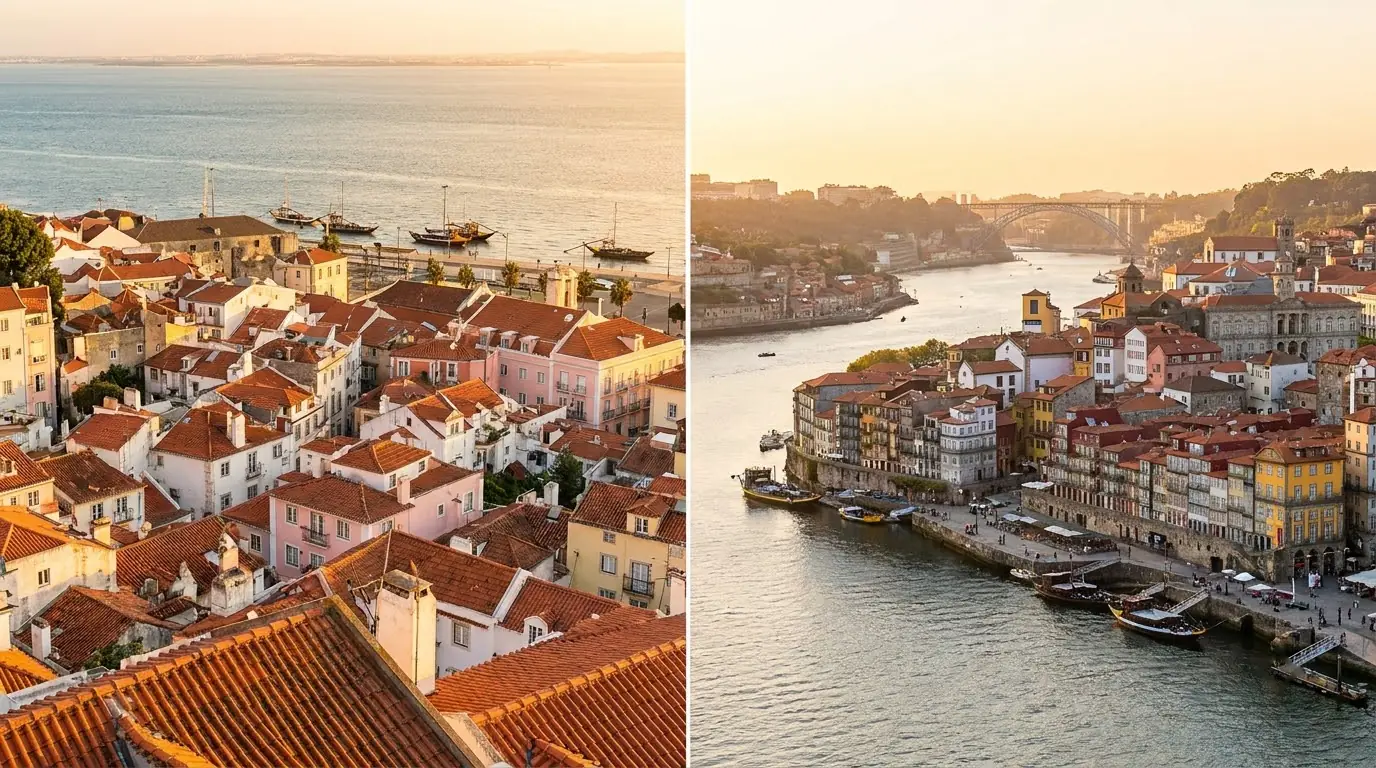
The sights and atmosphere differ more than the guidebooks suggest: Lisbon is a capital spread across hills and districts, Porto a river city built around one view.
Lisbon
- Alfama and the castle, the medieval quarter that survived the 1755 earthquake, with viewpoints over the river.
- Belém, 6 km west, with the Jerónimos Monastery and the Torre de Belém, both UNESCO-listed.
- Baixa, Chiado and the Bairro Alto: a grand rebuilt grid, an elegant slope and a nightlife district.
- Museums worth the ticket: the Gulbenkian, the National Tile Museum, MAAT on the river.
Porto
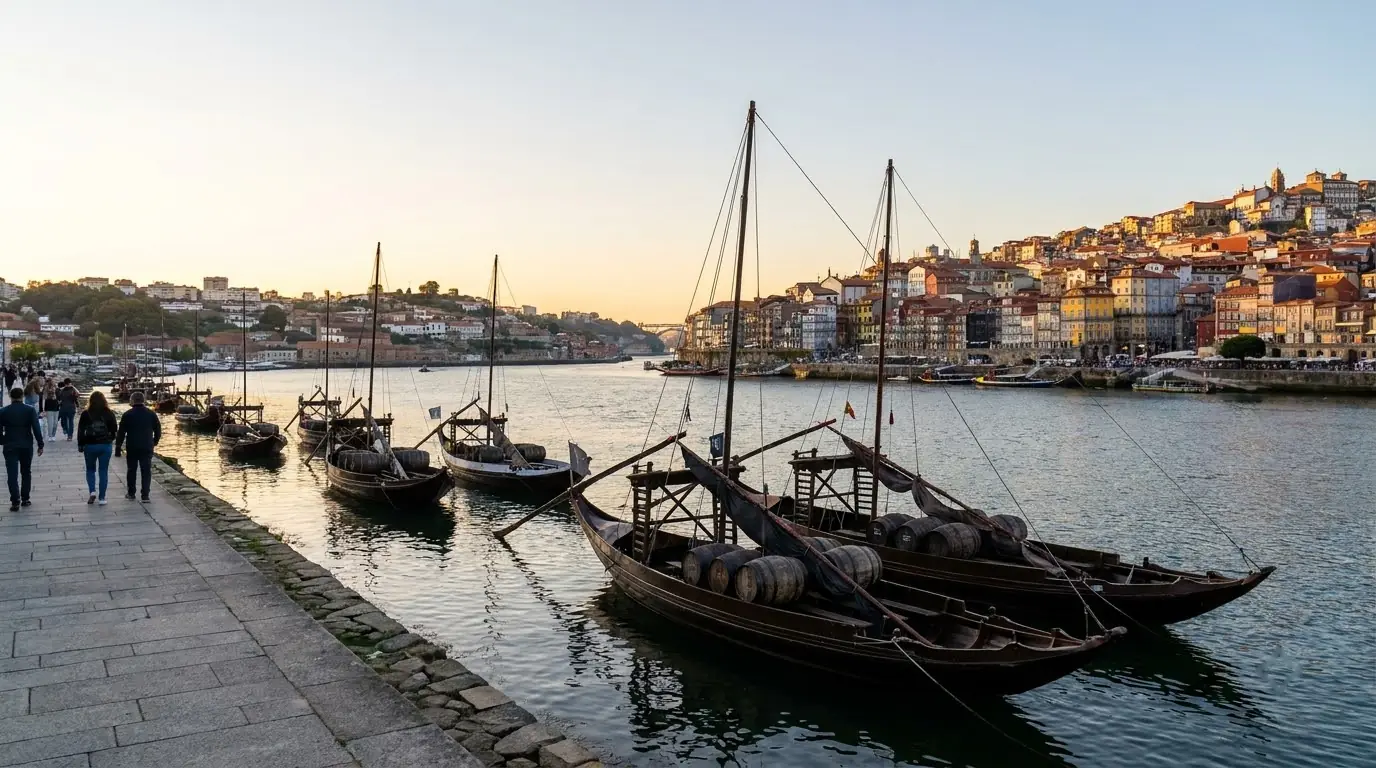
- The Ribeira waterfront and the Dom Luís I bridge, with the old city stacked on one bank and Gaia on the other.
- The port lodges of Vila Nova de Gaia, where the wine is aged and tasted.
- São Bento station’s tiled hall, the cathedral terrace and the Clérigos Tower.
- Foz, where the Douro meets the Atlantic, and the Serralves contemporary art museum and park.
Lisbon has more to fill a week; Porto delivers its best in fewer days. Lisbon feels larger and busier, Porto more intimate and, outside the Ribeira, more local. See things to do in Lisbon and things to do in Porto for the full lists.
Size and pace
Lisbon is more than twice the size of Porto: about 545,000 residents in the city itself against about 232,000 in Porto, according to the 2021 census by INE, the national statistics institute.
The difference shows on the streets: Lisbon has more traffic, more visitors and more districts to choose from; Porto feels like a town by comparison once you leave the waterfront.
Nightlife
Lisbon has the bigger night out: the bars of the Bairro Alto fill the lanes until late, and Rua Nova do Carvalho, the pink-painted street at Cais do Sodré, carries on after them. Porto’s nightlife gathers in the streets around Rua da Galeria de Paris, smaller and closer together.
For music, Lisbon has fado in the small houses of Alfama and the Bairro Alto; in Porto, fado is less central, and an evening is more likely to be a glass of port on a terrace in Gaia.
Weather and the best time to go
The weather is the clearest difference between Lisbon and Porto, and it decides which city suits which month.
- Summer favours Porto for walking: August averages a 24.8°C high and 3.5 days above 30°C, against 28.8°C and 10.2 days in Lisbon.
- Winter favours Lisbon: it receives 793.5 mm of rain a year, Porto 1,146.9 mm, about one and a half times as much.
- November is the wettest month in both, at 133.9 mm in Lisbon and 165.9 mm in Porto.
- July is almost dry in Lisbon, at 2.6 mm, and in Porto, at 16.6 mm.
- June and September suit both cities, with warm days and little rain.
For a trip between October and March, give Lisbon the larger share of the days and keep an indoor plan for Porto.
Spring and autumn are closer than the averages suggest: May and October are pleasant in both, but October already brings heavy showers, more often in Porto. Pack a rain jacket for either city from October to April. For month-by-month figures, see the best time to visit Lisbon and the best time to visit Porto.
Food and drink: tascas and francesinhas
Food and drink in both cities are generous and good value by western European standards, but each has its own dishes and its own drink.
- Lisbon: grilled sardines in June, bacalhau in many forms, the bifana pork sandwich, and pastéis de nata, best known from the bakery in Belém.
- Porto: the francesinha, a heavy sandwich of meats and cheese under a beer-and-tomato sauce, tripe stew, and grilled fish in Matosinhos.
- Drink: ginjinha, the cherry liqueur, in Lisbon; port wine tasted at the lodges in Gaia, in Porto.
- Markets: the Time Out Market at Cais do Sodré in Lisbon; the restored Mercado do Bolhão, reopened in 2022, in Porto.
Coffee culture is shared: a bica in Lisbon and a cimbalino in Porto are both a short espresso drunk at the counter. Each city has a grand old café that visitors queue for, A Brasileira in Chiado and the Majestic on Porto’s Rua de Santa Catarina; the coffee is the same a street away, without the queue.
Getting around: hills, trams and the metro
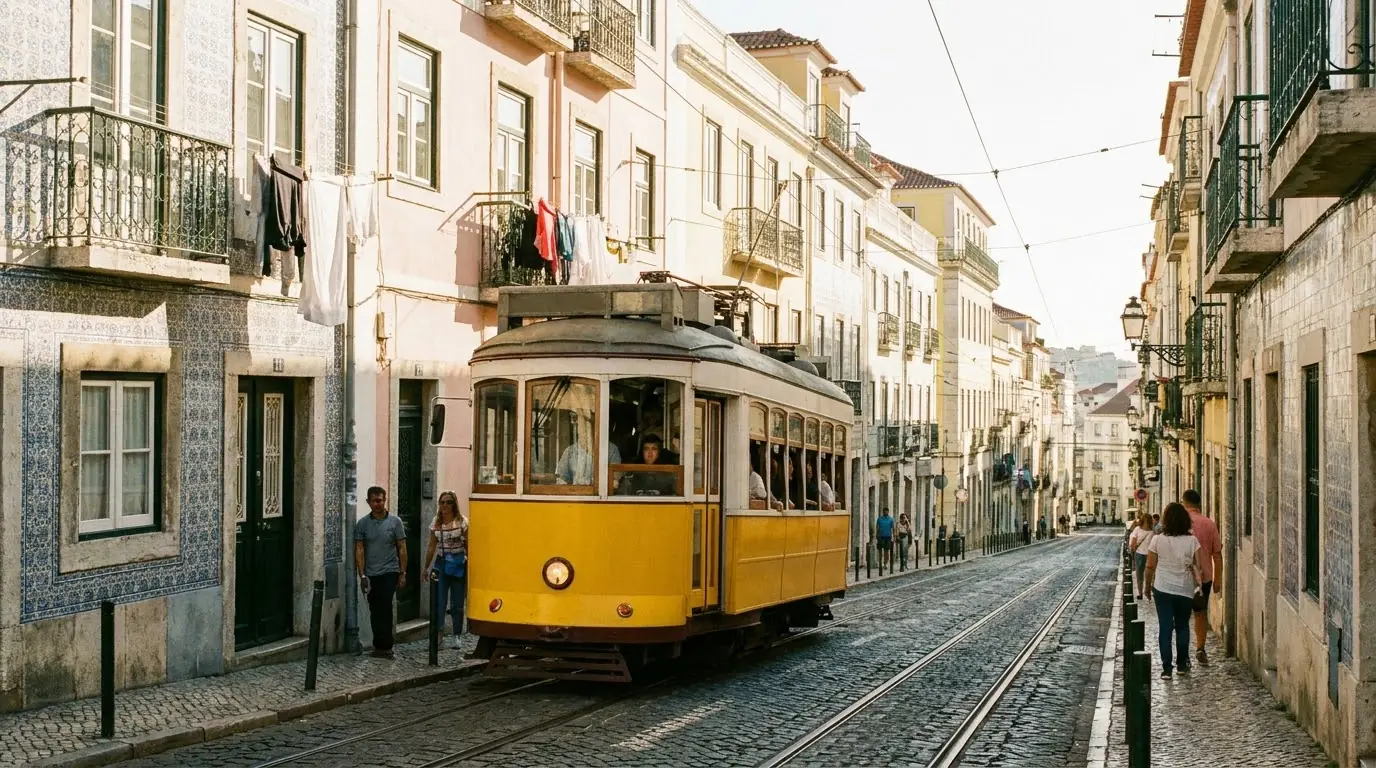
Getting around both cities means hills: Lisbon is spread across several of them, Porto falls steeply on one slope to the river.
- Both airports are linked to the centre by metro, which makes arrival easy without a taxi.
- Lisbon uses trams, funiculars and the Santa Justa lift for the climbs; Tram 28 is a scheduled service, not a tour.
- Porto’s centre is compact enough to walk, with the Guindais funicular, the metro over the bridge and the Gaia cable car for the steep parts.
- Belém in Lisbon and Foz in Porto are the two areas to reach by tram or train rather than on foot.
Walk downhill and ride up in both cities, and wear shoes with grip: the stone pavements are slippery when wet. Neither city needs a car; hire one only for day trips.
Where to stay in each city
Where you stay matters in both cities because of the slopes. In Lisbon, Baixa and Chiado are central and close to the metro, with Alfama for character and Príncipe Real for quiet. In Porto, a base near São Bento, Aliados or the Clérigos puts you at the top of the old city, so evenings end downhill.
Riverside rooms in the Ribeira look the part but mean a climb every time you go out. Both cities have area-by-area guides on this site, linked at the end of this page.
Beaches
Neither city has a swimming beach in the centre. Lisbon’s are a train ride away along the coast to Cascais, or across the river at Costa da Caparica, with warmer water in late summer. Porto’s are at Foz and Matosinhos, reached by tram or metro, on the open Atlantic, where the water stays cold even in August.
Day trips: Sintra against the Douro valley
Day trips from Lisbon and Porto are part of the choice, and both cities have one that people travel for.
- From Lisbon: Sintra’s palaces, about 40 minutes by train, plus Cascais, Évora and Óbidos.
- From Porto: the Douro valley’s vineyards, about 2 hours by train, plus Braga, Guimarães, Aveiro and Coimbra.
- Sintra is closer and needs timed tickets; the Douro is further and needs a booked tasting.
- Coimbra sits between the two cities on the main line, so it can be a stop on the way rather than a return trip.
Both cities give a good second week of trips. See day trips from Lisbon and day trips from Porto for the full lists.
Lisbon or Porto: which city for which traveller
Lisbon or Porto depends on the traveller more than on the cities, so here is the verdict by kind of trip.
- First trip to Portugal with a week: both, three days in Porto and four in Lisbon, about three hours apart by train.
- A long weekend: Porto, because its centre fits into two or three days without rushing.
- Summer in July or August: Porto, for milder afternoons; Lisbon if you want beaches close by train.
- Winter or late autumn: Lisbon, the drier of the two.
- Wine lovers: Porto, for the lodges in Gaia and the Douro valley.
- Museums, nightlife and variety: Lisbon, the larger city with more of each.
- Families with young children: Porto for the shorter distances, Lisbon for the Oceanário and the beaches.
A sample week: four days in Lisbon, three in Porto
- Day 1, Porto: São Bento, the cathedral terrace, the Clérigos Tower and down through the lanes to the Ribeira.
- Day 2, Porto: across the Dom Luís I bridge to Gaia for the port lodges, sunset at the Jardim do Morro.
- Day 3, Porto: Tram 1 to Foz, or the Douro valley by train; evening train south to Lisbon.
- Day 4, Lisbon: the castle and Alfama from the top down, sunset at Senhora do Monte.
- Day 5, Lisbon: Belém in the morning, Chiado and the Bairro Alto in the afternoon and evening.
- Day 6, Lisbon: Sintra by train from Rossio, with timed palace tickets booked ahead.
- Day 7, Lisbon: Baixa, a museum and the river, before the flight home from Lisbon.
Reverse the order if your flights land in Lisbon and leave from Porto. The late train on day three keeps the transfer out of daylight sightseeing time.
Can you visit both in one trip?
You can visit both in one trip easily: the Alfa Pendular train links Lisbon and Porto in about 2 hours 50 minutes to 3 hours, with departures through the day on CP, the Portuguese railway. Fly into one and out of the other to avoid backtracking, and stop in Coimbra on the way if you have an extra day.
Who should skip Lisbon, and who should skip Porto
Who should skip one of the two cities is a shorter list than it looks, but these trips are better with only one.
- Skip Lisbon if you have only two or three days and want to see a city properly rather than sample it.
- Skip Porto if your trip is between November and January and walking outdoors is the plan.
- Skip both on one long weekend: the train takes a day out of three.
- Skip the hilly old quarters of either city if stairs and steep lanes are a problem; base yourself on the flat.
To plan the days, use the Lisbon itinerary and the Porto itinerary, and check where to stay in Lisbon and where to stay in Porto.
Common questions
Is Lisbon or Porto better for a first trip to Portugal?
For a first trip to Portugal, Lisbon is better if you have four days or more, because it has more sights and Sintra nearby; Porto is better for a long weekend, because its centre fits into two or three days. With a week, visit both, about three hours apart by train.
Is Porto or Lisbon better in summer?
Porto is better for walking in summer: August averages a 24.8°C high and 3.5 days above 30°C, against 28.8°C and 10.2 days in Lisbon, according to IPMA’s 1991-2020 normals. Lisbon is better for beach days, with Cascais and Costa da Caparica close by train and bus.
Is Porto or Lisbon better in winter?
Lisbon is better in winter because it is drier: 793.5 mm of rain a year against 1,146.9 mm in Porto, according to IPMA’s 1991-2020 normals. November is the wettest month in both. Porto still works in winter if the trip is built around the port lodges and indoor sights.
How do you get from Lisbon to Porto?
You get from Lisbon to Porto most easily by the Alfa Pendular train, which takes about 2 hours 50 minutes to 3 hours between Santa Apolónia and Porto Campanhã. Intercity trains are slower and cheaper. Buses take a similar time, and flights rarely save time once airports are included.
How many days should you split between Lisbon and Porto?
On a week, split the days four in Lisbon and three in Porto. Lisbon’s fourth day goes to Sintra; if wine matters, move one day to Porto for the Douro valley. With five days in total, three in Lisbon and two in Porto is the realistic minimum for both.
Keep planning Lisbon
Written and checked by
Travel Guide Kit Editorial
An editorial desk, not an invented persona. Every opening time, ticket price and transport connection here is checked against the operator’s own website and carries the date it was read. Where a page cannot draw on direct experience, it says so.