Quick answer
Sintra is the best day trip from Lisbon, about 40 minutes by train from Rossio; Cascais with Cabo da Roca is the easiest coast day, and Évora, about 1 hour 30 minutes away, suits a slower day.
In short
- Sintra is the best day trip from Lisbon: about 40 minutes by train from Rossio, with palaces that use timed tickets.
- Cascais and Cabo da Roca make the easiest coast day, about 40 minutes by train from Cais do Sodré to Cascais.
- Évora, about 1 hour 30 minutes by train, is the best trip for Roman ruins and the Alentejo countryside.
- Óbidos, Nazaré and the monasteries of Batalha and Alcobaça are easiest on a tour or with a hire car.
The best day trips from Lisbon are Sintra, 40 minutes by train, and Cascais with Cabo da Roca, also 40 minutes away; with more days, add Évora, about 1 hour 30 minutes by train, and Óbidos, about an hour by bus. Sintra is the one not to miss, and it needs a full day. Pick one trip per day: most of them do not combine well.
Lisbon day trips at a glance
Lisbon day trips at a glance: the first three run on suburban trains every day, and the rest need a long-distance train, a bus, a tour or a car.
| Day trip | How to get there | Time one way | Best for |
|---|---|---|---|
| Sintra | Train from Rossio | About 40 min | Palaces and gardens |
| Cascais and Cabo da Roca | Train from Cais do Sodré, then bus | About 40 min to Cascais | Coast and cliffs |
| Setúbal and Arrábida | Fertagus train from Roma-Areeiro | About 1 hour | Beaches, seafood, dolphins |
| Évora | Intercity train | About 1 h 30 min | Roman temple, Alentejo |
| Óbidos | Rápida Verde bus from Campo Grande | About 1 hour | Walled medieval town |
| Batalha, Alcobaça, Nazaré | Tour or hire car | 1 h 15 min to 2 hours by road | Monasteries and the coast |
| Tomar | Regional train | About 2 hours | Templar Convent of Christ |
Train times change with each timetable, so check the exact departure on CP, the Portuguese railway, the day before. Suburban tickets for Sintra and Cascais are cheap and need no booking; the palaces are the part to book.
Train, bus, tour or hire car?
Use the train for Sintra, Cascais, Setúbal, Évora and Tomar: the lines start in central Lisbon and avoid traffic and parking. Take a tour for the Óbidos, Batalha, Alcobaça and Nazaré circuit, where buses connect badly.
Hire a car only for Arrábida, Mafra and Ericeira, or the Alentejo villages beyond Évora, and pick it up on the morning you leave the city: driving and parking in central Lisbon cost more time than they save.
Which day trips suit which season
- Summer: the coast. Cascais, Costa da Caparica, Arrábida and the Berlengas boats, which sail in the warmer months.
- Spring and autumn: Sintra, Évora and Tomar, when walking between sights is comfortable and the queues are shorter.
- Winter: Nazaré for the giant Atlantic waves, and Évora or Óbidos on dry days; Sintra’s hill is often in cloud.
- Any season: book Sintra’s palaces ahead at weekends and in school holidays.
Sintra: the day trip to do first
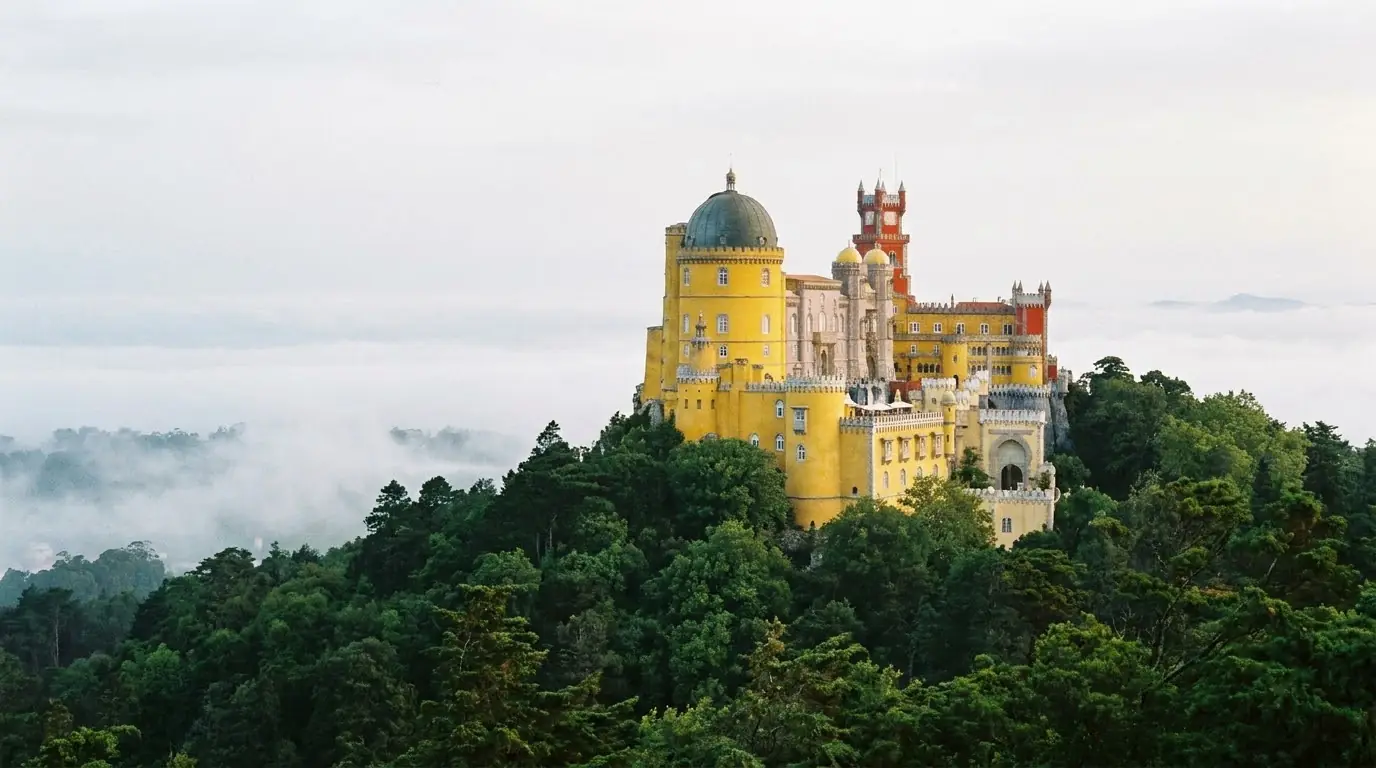
Sintra is the day trip to do first, and it is the one almost every visitor underestimates. Its palaces and gardens are spread across a steep wooded hill above the town, the shuttle bus between them is slow, and the main sites sell entry by time slot.
- Take an early train from Rossio station; the trip takes about 40 minutes, and the queues grow from late morning.
- Pena Palace tickets are sold for a set date and time on the Parques de Sintra site; the park opens from 9:00 to 19:00.
- Quinta da Regaleira, with its initiation well, is in the town and needs no shuttle; the Moorish Castle sits on the ridge next to Pena.
- Aim for two palaces and the walk between them. Three in a day turns Sintra into a queue.
Wear shoes with grip: the paths between the palaces are steep, and the hill is often cooler and damper than Lisbon. Plan to be back in the city for dinner rather than for lunch. For how Sintra fits a longer stay, see how many days to spend in Lisbon.
If you have a second day in Sintra
A second day in Sintra suits the quieter sights: the gardens and Moorish-style palace of Monserrate, west of the town, and the Sintra National Palace in the centre, with its two conical kitchen chimneys. Staying a night lets you reach Pena before the day trippers arrive.
Cascais and Cabo da Roca: the coast in a day
Cascais and Cabo da Roca make the easiest coast day from Lisbon: the train runs along the river and the sea from Cais do Sodré to Cascais in about 40 minutes, with beaches close to the line.
- Cascais is a former fishing town with a marina, small beaches and a seafront promenade to the Boca do Inferno cliffs.
- Cabo da Roca, a short bus or taxi ride inland and west, is the westernmost point of mainland Europe, a headland of cliffs with a lighthouse.
- Estoril, one stop before Cascais, has a long beach and a promenade between the two towns.
- On a clear day, Cabo da Roca can be combined with Sintra by bus, but it makes a long day; most visitors pick one.
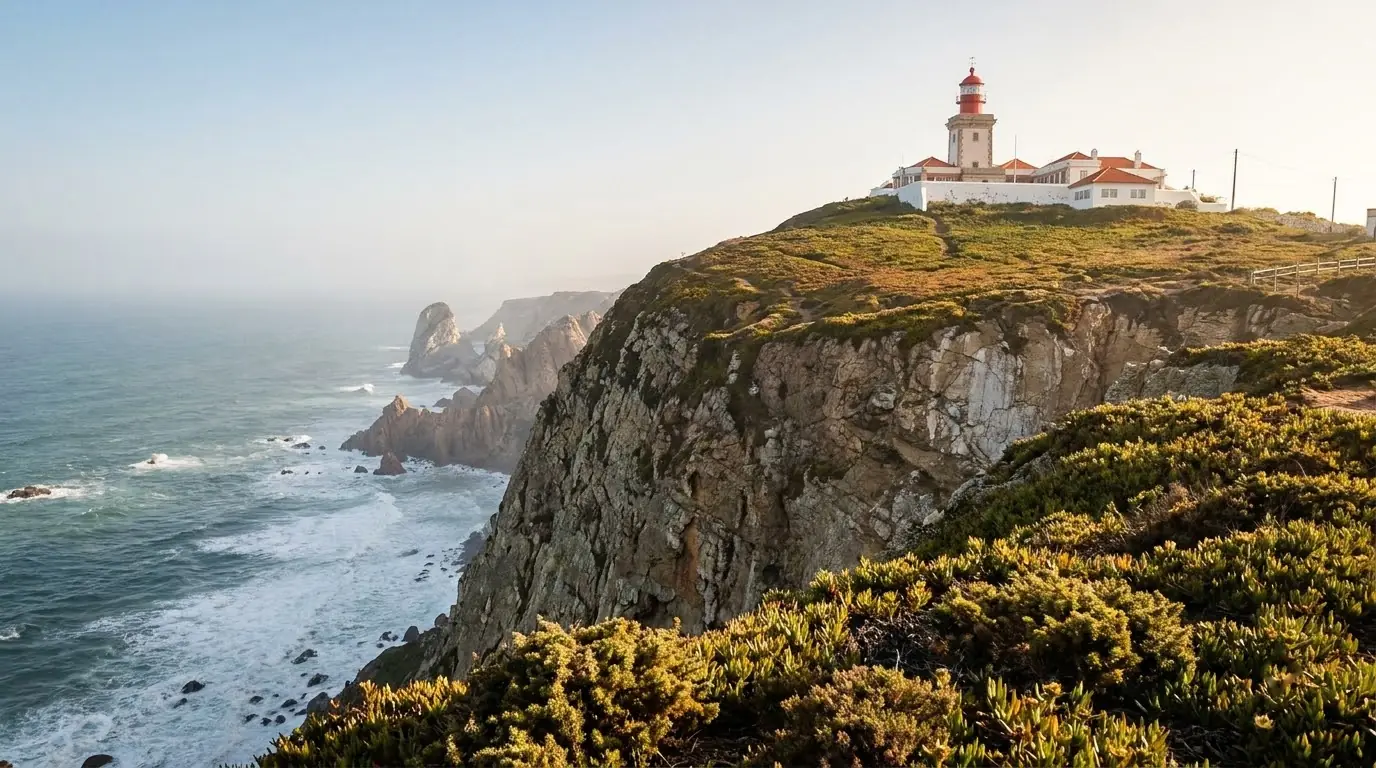
Go in the afternoon for the light on the cliffs, and bring a layer: the wind at Cabo da Roca is strong even in summer. In July and August, the beaches near the train line fill up at weekends.
Évora: Roman ruins and the Alentejo
Évora is the day trip for Roman ruins and the Alentejo, the rolling, cork-oak country east of Lisbon. Its walled historic centre is a UNESCO World Heritage site since 1986, and the train takes about 1 hour 30 minutes.
- The Roman Temple, its granite columns standing in the middle of the old town, is the image of Évora.
- The Chapel of Bones inside the Church of São Francisco is lined with human bones, with a blunt inscription about mortality above the door.
- The cathedral roof gives a view over the whitewashed town and the plain beyond.
- Lunch is the Alentejo’s strength: slow-cooked pork, bread soups and local red wine.
Évora suits a slower day than Sintra: the old town is compact, flat by Portuguese standards and quiet in the afternoon. Check the return train before you set out, because departures are far fewer than on the suburban lines.
Going further into the Alentejo
With a hire car, Évora becomes a base for the Alentejo: Monsaraz, a walled hilltop village above the Alqueva reservoir, and the megalithic stones of the Almendres Cromlech, a short drive west of the city. Both are hard to reach by bus, and both are best in the late afternoon light.
Óbidos, Nazaré and the monasteries of the centre
Óbidos, Nazaré and the monasteries of Batalha and Alcobaça lie north of Lisbon and are usually combined on one organised tour, sometimes with Fátima, the pilgrimage town.
- Óbidos is a whitewashed town inside medieval walls you can walk along; the Rápida Verde bus from Campo Grande takes about an hour.
- Alcobaça and Batalha are two great Gothic monasteries, both UNESCO World Heritage sites, about 20 minutes apart by road.
- Nazaré is a fishing town on the Atlantic, known for the giant winter waves off its northern point and for the view from the cliff-top Sítio.
- Fátima is one of the largest Catholic sanctuaries in the world, busiest around 13 May and 13 October.
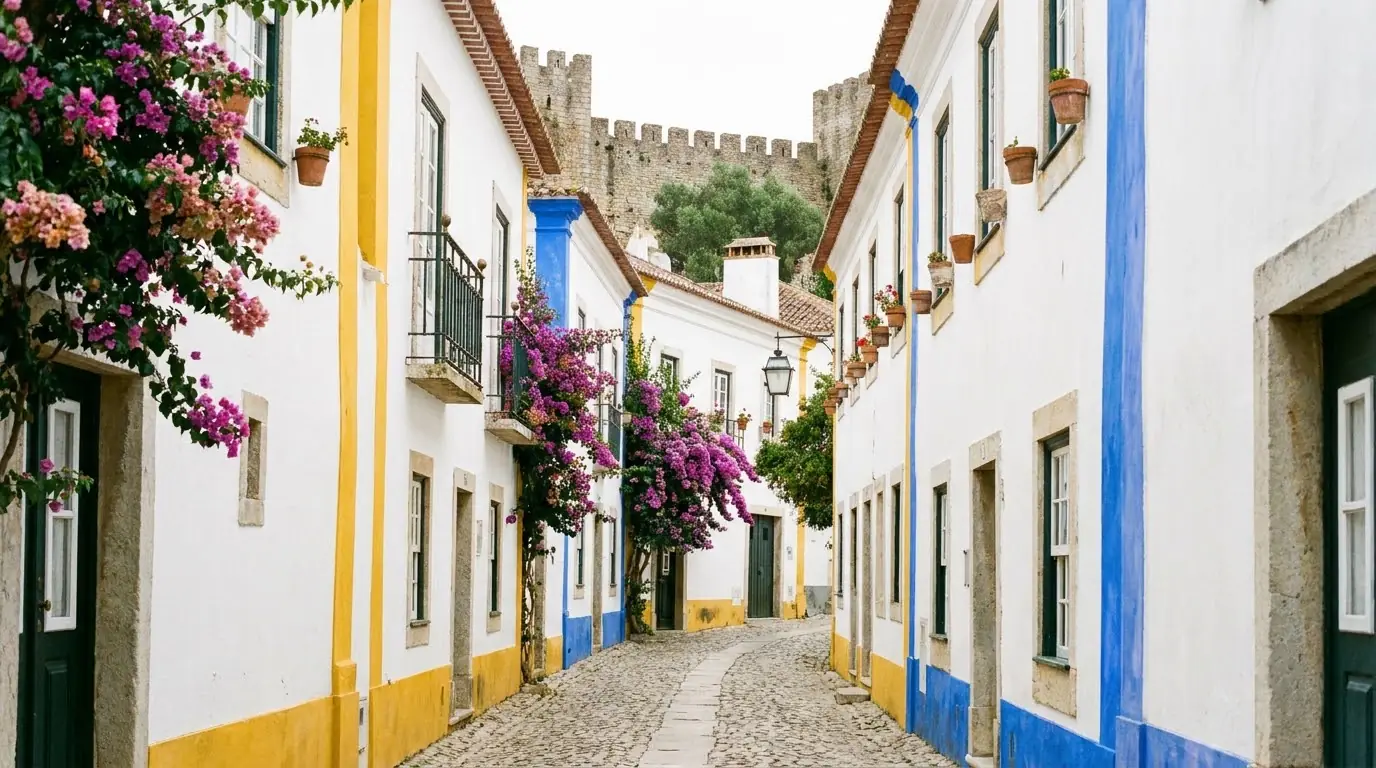
By public transport, Óbidos alone is the realistic day. To see the monasteries and Nazaré as well, a tour or a hire car saves several changes of bus.
South of the river: Setúbal, Arrábida and Costa da Caparica
South of the river, Setúbal, the Arrábida hills and the long beaches of Costa da Caparica are the day trips Lisbon residents take themselves.
- The Fertagus train crosses the 25 de Abril bridge and reaches Setúbal from Roma-Areeiro in about 57 minutes.
- Setúbal is known for grilled fish and fried cuttlefish, and boat trips on the Sado estuary look for its resident bottlenose dolphins.
- The Arrábida Natural Park has sheltered coves with clear water below limestone hills; access roads to the beaches are restricted in summer, so check the shuttle before you go.
- Costa da Caparica, just across the river, has kilometres of sand and surf schools; buses leave from Praça de Espanha.
Further out: Tomar, Mafra and the Berlengas
Further out, Tomar, Mafra and the Berlengas islands make good day trips for a second visit or a longer stay.
Tomar
Tomar is about two hours by regional train from Santa Apolónia. Its Convent of Christ, built by the Templars and later the Order of Christ, is a UNESCO World Heritage site, with a round church at its heart.
Mafra and Ericeira
The Mafra National Palace, a vast royal palace, basilica and convent with a celebrated library, is a UNESCO site since 2019. Ericeira, ten minutes away on the coast, is a surf town with a small old centre; the pair is easiest by car.
The Berlengas
The Berlengas are a protected archipelago off Peniche, reached by boat in the warmer months. Landing on Berlenga Grande needs the BerlengasPass from the ICNF, the nature conservation institute, and visitor numbers are capped at 550, so book both the pass and the boat ahead.
Which day trips to skip, or do differently
Which day trips to skip depends on how many days you have, but some plans fail on almost every trip.
- Sintra in an afternoon: the queues and the shuttle bus eat half a day before you reach a palace.
- Sintra, Cabo da Roca and Cascais in one day: three places seen in a hurry, mostly from bus windows.
- Fátima, Batalha, Alcobaça, Nazaré and Óbidos on one tour without checking the time on the ground at each stop.
- A day trip on a three-day visit to Lisbon: the city needs three days of its own; take the trip on a fourth.
- The Berlengas without a pass and a boat booking in summer: you may not be allowed to land.
For the days in the city around the trips, use the Lisbon itinerary or Lisbon in 3 days, check the best time to visit Lisbon, and see things to do in Lisbon for the city itself. To base yourself near the stations for the trains, read where to stay in Lisbon.
Common questions
What is the best day trip from Lisbon?
Sintra is the best day trip from Lisbon: palaces and gardens on a wooded hill about 40 minutes by train from Rossio. Book the Pena Palace tickets for a set time, take an early train and plan two palaces, not three. Cascais and Cabo da Roca are the easier coast alternative.
Can you do Sintra and Cascais in one day?
You can do Sintra and Cascais in one day by bus over Cabo da Roca, but it makes a rushed day: Sintra’s palaces alone fill most of it. Choose Sintra for the palaces or Cascais for the coast, and keep the other for a second day trip if you have five days or more.
Is Évora worth a day trip from Lisbon?
Évora is worth a day trip from Lisbon for Roman ruins, the Chapel of Bones and the Alentejo countryside. The train takes about 1 hour 30 minutes and runs only a few times a day, so plan the return before you go. It suits a slower, quieter day than Sintra.
How do you get from Lisbon to Óbidos?
You get from Lisbon to Óbidos by the Rápida Verde express bus from Campo Grande, which takes about an hour and stops just outside the town walls. Weekend departures are fewer, so check the return time. Combining Óbidos with Nazaré or the monasteries is easier on a tour or by car.
How many day trips should you take from Lisbon?
Take one day trip from Lisbon on a four-day stay, usually Sintra, and two or three on a week, adding Cascais, Évora or Óbidos. Each trip needs its own day: combining two in one day means seeing both in a hurry. Lisbon itself needs three days before any trips.
Keep planning Lisbon
Written and checked by
Travel Guide Kit Editorial
An editorial desk, not an invented persona. Every opening time, ticket price and transport connection here is checked against the operator’s own website and carries the date it was read. Where a page cannot draw on direct experience, it says so.