
Quick answer
Toledo is the best day trip from Madrid, 33 minutes by high-speed train from Atocha; Segovia, about 30 minutes from Chamartín, is the easier second choice, and El Escorial suits a half day.
In short
- Segovia, about 30 minutes by high-speed train from Chamartín, has a Roman aqueduct and a hilltop alcázar.
- El Escorial, Aranjuez and Alcalá de Henares are easy on local Cercanías trains, from about 37 minutes to an hour.
- Ávila, Cuenca and Salamanca each take 1 to 2 hours by train and suit a longer stay.
The best day trips from Madrid are Toledo, 33 minutes by high-speed train, and Segovia, about 30 minutes away; both are walled hill towns that fill a full day. El Escorial and Aranjuez are closer royal sites on the local trains. Choose one trip per day, and book the fast trains ahead at weekends. All of them leave from Atocha or Chamartín, so no trip needs a car.
Madrid day trips at a glance
Every trip below runs by train from Atocha or Chamartín, so none needs a car.
| Day trip | Train from | Time one way | Best for |
|---|---|---|---|
| Toledo | Atocha (high-speed) | About 33 min | Medieval city, cathedral, El Greco |
| Segovia | Chamartín (high-speed) | About 30 min | Roman aqueduct, alcázar |
| El Escorial | Atocha or Chamartín (Cercanías) | About 1 hour | Royal monastery and palace |
| Aranjuez | Atocha (Cercanías) | About 45 min | Royal palace and gardens |
| Alcalá de Henares | Atocha (Cercanías C2) | About 37 min | University town, Cervantes |
| Cuenca | Chamartín or Atocha (high-speed) | About 1 hour | Hanging houses over a gorge |
| Ávila | Chamartín or Príncipe Pío | About 1 h 30 min to 2 h | Complete medieval walls |
| Salamanca | Chamartín (Avant/Alvia) | About 1 h 40 min | Plaza Mayor, golden sandstone |
High-speed and Avant trains need a seat ticket; book on Renfe a few days ahead for weekends. The Cercanías local trains need no booking, and the station machines sell tickets on the spot.
Toledo: the day trip to do first
A hill city wrapped by the Tagus river gorge, Toledo has a cathedral, synagogues and mosques side by side. Its historic centre is a UNESCO World Heritage site since 1986.
- The cathedral alone takes about two hours, with El Greco paintings in its sacristy.
- Santo Tomé church holds El Greco’s Burial of the Count of Orgaz.
- The old Jewish quarter has the Synagogue of El Tránsito and the Santa María la Blanca synagogue.
- For the classic view, take a taxi or the tourist bus to the road on the far side of the gorge late in the day.
The station sits below the old city; walk up over the Alcántara bridge or take a bus or taxi to the top, then walk downhill through the day. The lanes are steep and on stone, so wear shoes with grip.
Segovia: the aqueduct and the alcázar
Segovia is the easier of the two classic day trips. The old town and its Roman aqueduct are a UNESCO World Heritage site since 1985.
- The Roman aqueduct crosses the main square on two tiers of granite arches built without mortar.
- The cathedral, one of the last Gothic cathedrals built in Spain, sits at the top of the old town.
- The alcázar stands at the far end of the ridge, with towers that look like a castle from a fairy tale.
- Roast suckling pig, cochinillo, is the local dish for a long lunch.
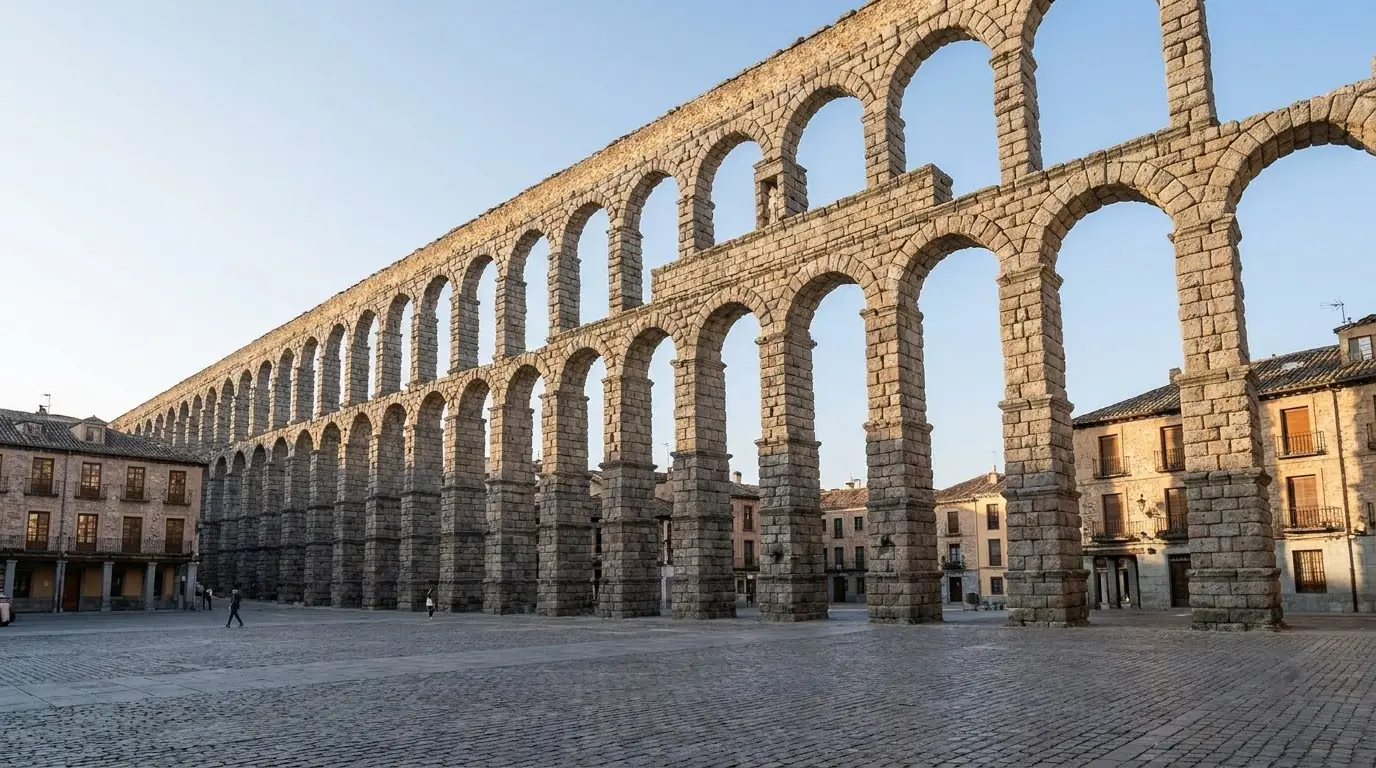
The high-speed station is outside the town; a local bus links it with the aqueduct. The walk from the aqueduct through the old town to the alcázar is about 30 minutes, downhill on the way back.
Royal sites on the local trains: El Escorial and Aranjuez
These two are the easiest trips from Madrid, and both suit a half day.
San Lorenzo de El Escorial
The monastery and palace built for Philip II is a vast granite complex with a basilica, a royal pantheon and a library, set below the Guadarrama mountains. The Cercanías train takes about an hour; the town is a short walk up from the station.

Aranjuez
Aranjuez, about 45 minutes away, was the spring residence of the Spanish court: a royal palace beside the Tagus, with long avenues of trees and formal gardens. It is best in spring, when the gardens are at their fullest.
Alcalá, Cuenca, Ávila and Salamanca: further out
Each of these four suits a second trip on a longer stay.
- Alcalá de Henares, about 37 minutes on the C2 Cercanías from Atocha, is the birthplace of Cervantes, with a historic university and a long arcaded main street.
- Cuenca, about an hour by high-speed train, is known for its hanging houses built over the edge of a deep gorge; a bus links the station with the old town.
- Ávila, 1 hour 30 minutes to 2 hours by train, has the most complete medieval walls in Spain, which you can walk along in part.
- Salamanca, about 1 hour 40 minutes on the Avant or Alvia, has one of the finest main squares in Spain and an old university built of golden sandstone.
These four make long days by public transport. Salamanca in particular is better with a night, so its main square can be seen lit up after dark.
Tour, train or hire car?
The choice depends on how many places you want in one day. For a single town, the train is fastest and avoids parking in narrow old streets.
- Train: Toledo, Segovia, El Escorial, Aranjuez, Alcalá and Cuenca are all straightforward on your own.
- Tour: combined Toledo and Segovia tours exist, but they leave little time inside either city.
- Hire car: only for Chinchón, a village with an arcaded main square about an hour south-east, or the Guadarrama mountains; pick the car up on the way out of the city.
Which day trips to skip, or do differently
These plans cost more time than they give back:
- Toledo and Segovia on the same day: two half-seen cities, and most of the day on buses or trains.
- Toledo as a half day: the train is quick, but the old city and the cathedral need the whole day.
- A day trip on a three-day visit to Madrid if the museums are the point: it leaves two city days, so take the trip on a fourth (the trade-off is set out in Madrid in 3 days).
- July and August afternoons in Toledo: the stone lanes hold the heat; arrive early and rest at lunch.
For the days in Madrid around the trips, use the Madrid itinerary or Madrid in 3 days, check where to stay in Madrid near the stations, and see things to do in Madrid for the city itself.
Where to stay in Madrid
A day trip starts and ends at your base, so sleep near the station or bus stop you will leave from. The map shows the same property across Booking.com and Agoda, with prices live from them.
Common questions
What is the best day trip from Madrid?
Toledo is the best day trip from Madrid: a medieval hill city above the Tagus gorge, 33 minutes by high-speed train from Atocha. Give it a full day for the cathedral, the synagogues and El Greco’s paintings. Segovia, about 30 minutes from Chamartín, is the easier second choice.
Toledo or Segovia: which day trip is better?
Toledo is better if you have one day: denser, older and more varied, with a cathedral, synagogues and El Greco. Segovia is easier and more immediately striking, with its Roman aqueduct in the main square and the alcázar on the ridge. With two days, do both on separate days.
Can you do Toledo and Segovia in one day?
You can do Toledo and Segovia in one day only on an organised tour, and it leaves little time inside either city. By train the two are on different lines from different stations. Each is worth a full day of its own, so spread them over two days if you can.
Do you need to book trains for day trips from Madrid?
Book the high-speed and Avant trains to Toledo, Segovia, Cuenca and Salamanca a few days ahead, especially at weekends, because they need seat tickets and can sell out. The Cercanías local trains to El Escorial, Aranjuez and Alcalá need no booking.
How many day trips should you take from Madrid?
Take one day trip from Madrid on a four-day stay, usually Toledo, and two or three on a week, adding Segovia and El Escorial or Cuenca. Madrid itself needs three days first, and each trip is best on its own day rather than combined with another.
Keep planning Madrid
Written and checked by
Travel Guide Kit Editorial
An editorial desk, not an invented persona. Every opening time, ticket price and transport connection here is checked against the operator’s own website and carries the date it was read. Where a page cannot draw on direct experience, it says so.